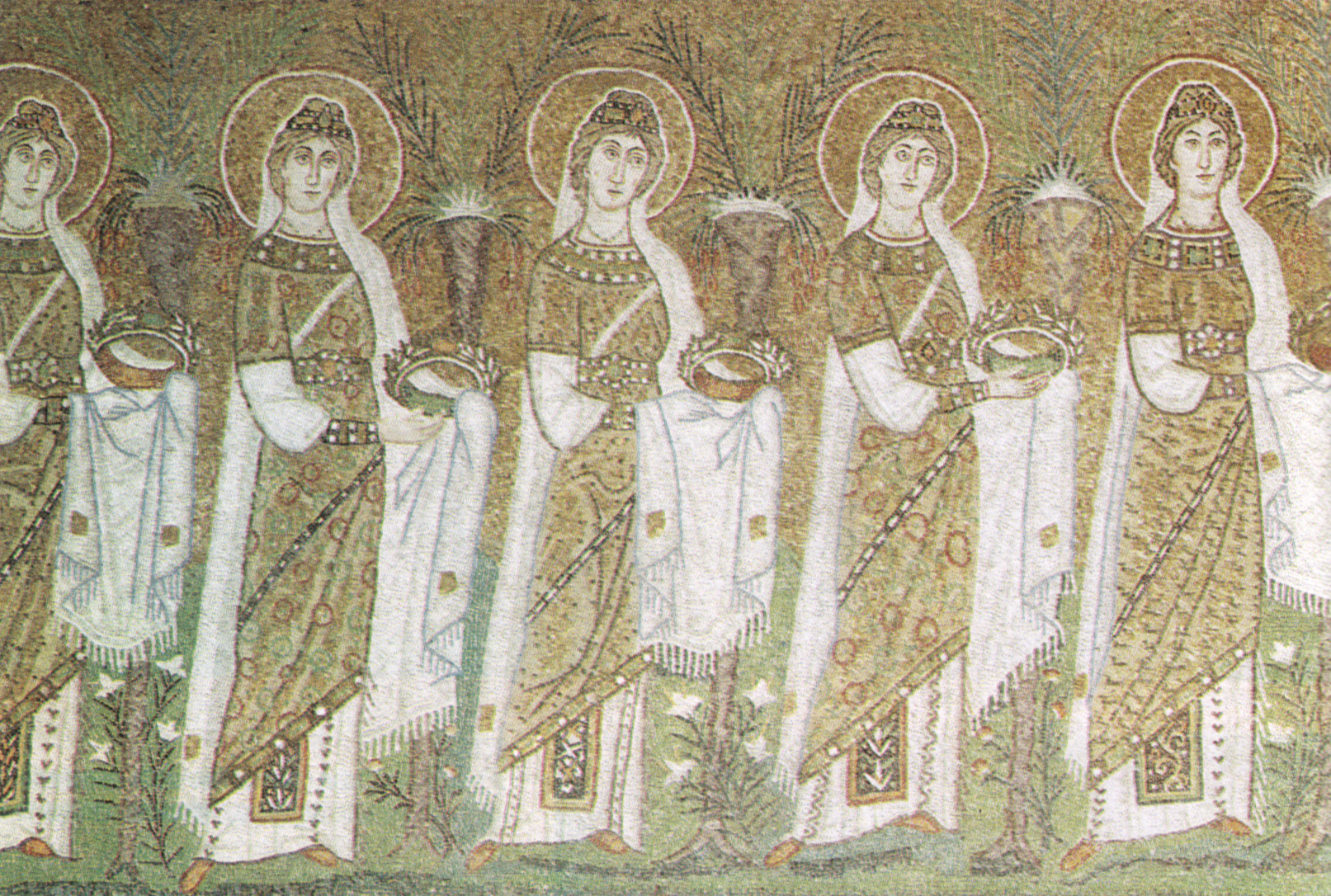
Procession of Virgin Martyrs, Sant'Apollinare Nuovo
Doctrinal reflection
The Procession of Virgin Martyrs at Sant'Apollinare Nuovo, Ravenna, constitutes one of the most extensive surviving mosaic programs from the sixth century AD. Executed in the nave of the basilica, the procession occupies the lower register of the north wall and dates to the episcopate of Agnellus of Ravenna (c. 556–569 AD), following the Ostrogothic basilica's transition from Arian to Nicene orthodox use under Byzantine administration after Justinian I's reconquest of Italy. The original Theodorician decorative scheme, visible in the upper registers, was modified by the removal of Arian palatial imagery and the addition of these processional friezes. Twenty-two crowned female martyrs, identifiable by tituli and hagiographic attributes, advance in stately single file from the Palace of Theodoric toward the enthroned Theotokos and Child flanked by angels. The figures wear identical white robes beneath golden-edged mantles, their faces frontally presented, their hands bearing gemmed crowns or palm fronds as tokens of martyrial witness. The gold tessera ground dematerializes spatial recession, projecting the scene into a timeless liturgical present consistent with Byzantine theological aesthetics. Stylistically, the figures reflect the transition from Hellenistic volumetric modeling toward the flattened, hieratic conventions characteristic of middle Byzantine art in embryonic form. The program's theological significance lies in its articulation of the communio sanctorum converging upon the Theotokos as intercessor, enacting in visual terms the heavenly liturgy described in Revelation. Scholarly interest centers on the redactional layers separating Theodorician from Agnellan work and on Ravenna's role as a transmission point between Eastern and Western iconographic traditions. Sources: Dumbarton Oaks Papers; Papers of the British School at Rome; Cahiers Archéologiques.