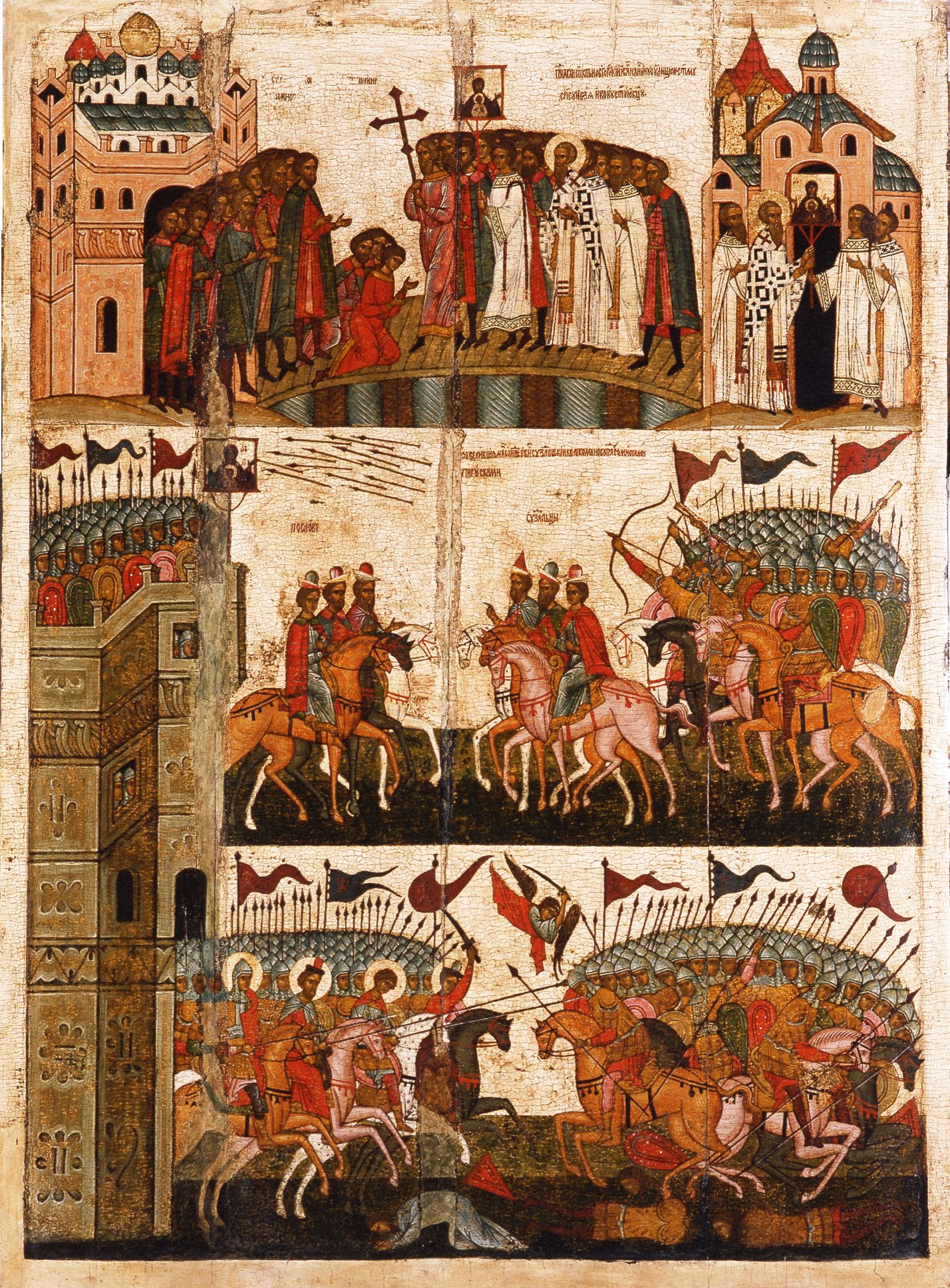
The Battle of the Novgorodians with the Suzdalians
Doctrinal reflection
The Battle of the Novgorodians with the Suzdalians, commonly designated 'The Miracle of the Icon of the Sign,' is a mid-15th century AD panel painting produced within the Novgorod school and preserved in exemplars including the celebrated version now in the Novgorod Museum of History, Architecture and Art (with close variants associated with the Tretyakov Gallery, Moscow). Executed in egg tempera on a gessoed wood support, the icon employs a tripartite register composition—a formal innovation of considerable art-historical consequence—to narrate the events of the 1170 AD siege of Novgorod by the forces of Andrei Bogolyubsky of Suzdal. The uppermost register depicts the translation of the wonderworking icon of the Theotokos of the Sign (Znamenie) from the Church of the Transfiguration on Elijah Street to the Novgorod kremlin walls. The middle register presents a parley between Novgorodian and Suzdalian envoys, while the lower and most dynamic register shows the rout of the Suzdalian host, whose soldiers are depicted struck blind and turning upon one another—a visual rendering of miraculous military intervention. Theologically, the icon functions as a votive commemoration articulating Novgorodian civic identity through Marian intercession: the Theotokos as protectress of the city (Hodegetria and Sign typologies conflated) reflects middle Byzantine theological currents adapted to a distinctly Russian communal memory. Iconographically, the triregister narrative format anticipates later Russian hagiographic icon traditions. The work has attracted substantial scholarly attention regarding its function in Novgorodian political theology and its relationship to chronicle sources. Sources: Lazarev, Viktor N., Novgorodian Icon Painting (1969); Onasch, Konrad, and Schnieper, Annemarie, Icons: The Fascination and the Reality (1995); Tradigo, Alfredo, Icons and Saints of the Eastern Orthodox Church (2006).