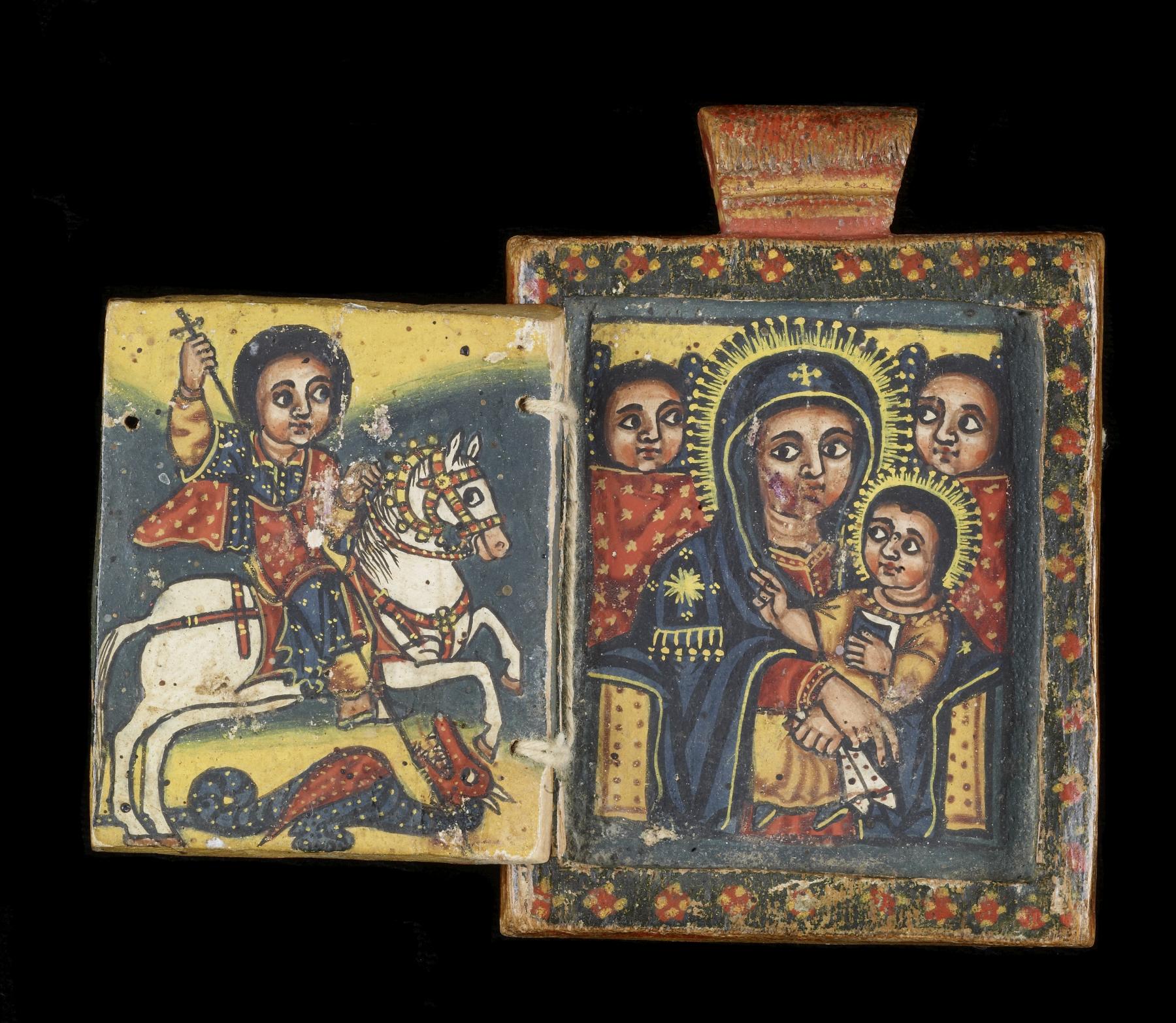
Ethiopian Diptych: The Virgin and Child with Saint George
Doctrinal reflection
This diptych, dated to the 17th–18th century AD and now housed at the Walters Art Museum in Baltimore, represents the Ethiopian Orthodox Tewahedo Church's mature panel-painting tradition, which constitutes the southernmost continuous branch of the broader eastern Christian icon tradition. Executed in tempera on gessoed wood, the work displays the characteristically Ethiopian synthesis of Byzantine iconographic prototypes with a distinctly indigenous formal language: frontally enthroned figures rendered in flat planes of saturated mineral pigment, schematized drapery articulated by rhythmic parallel lines, and large almond-shaped eyes that dominate stylized facial features. The left panel presents the Virgin Hodegetria-derived type, enthroned and flanked by two archangels—likely Michael and Gabriel—while the Christ Child, rendered frontally in the manner of a diminutive adult, offers a gesture of benediction. The right panel depicts Saint George as a mounted warrior-saint, slaying the dragon, a compositional type that entered Ethiopian painting no later than the Gondarine period (mid-17th century AD) and reflects Coptic and broader eastern Mediterranean transmission. Theologically, the pairing encodes the dual devotional pillars of Ethiopian Orthodox piety: Mariological veneration centered on the Theotokos, expressed through the Marian feast cycle (Kidane Mehret), and the martial intercessory power of Saint George (Girgis), patron of the Ethiopian imperial house. The diptych format itself echoes late antique and Byzantine portable devotional objects, here thoroughly recontextualized within an Aksumite-derived liturgical framework. Scholarly interest centers on questions of workshop transmission, pigment sourcing, and the Gondarine court's patronage networks. Sources: African Arts; Journal of Ethiopian Studies; Dumbarton Oaks Papers.