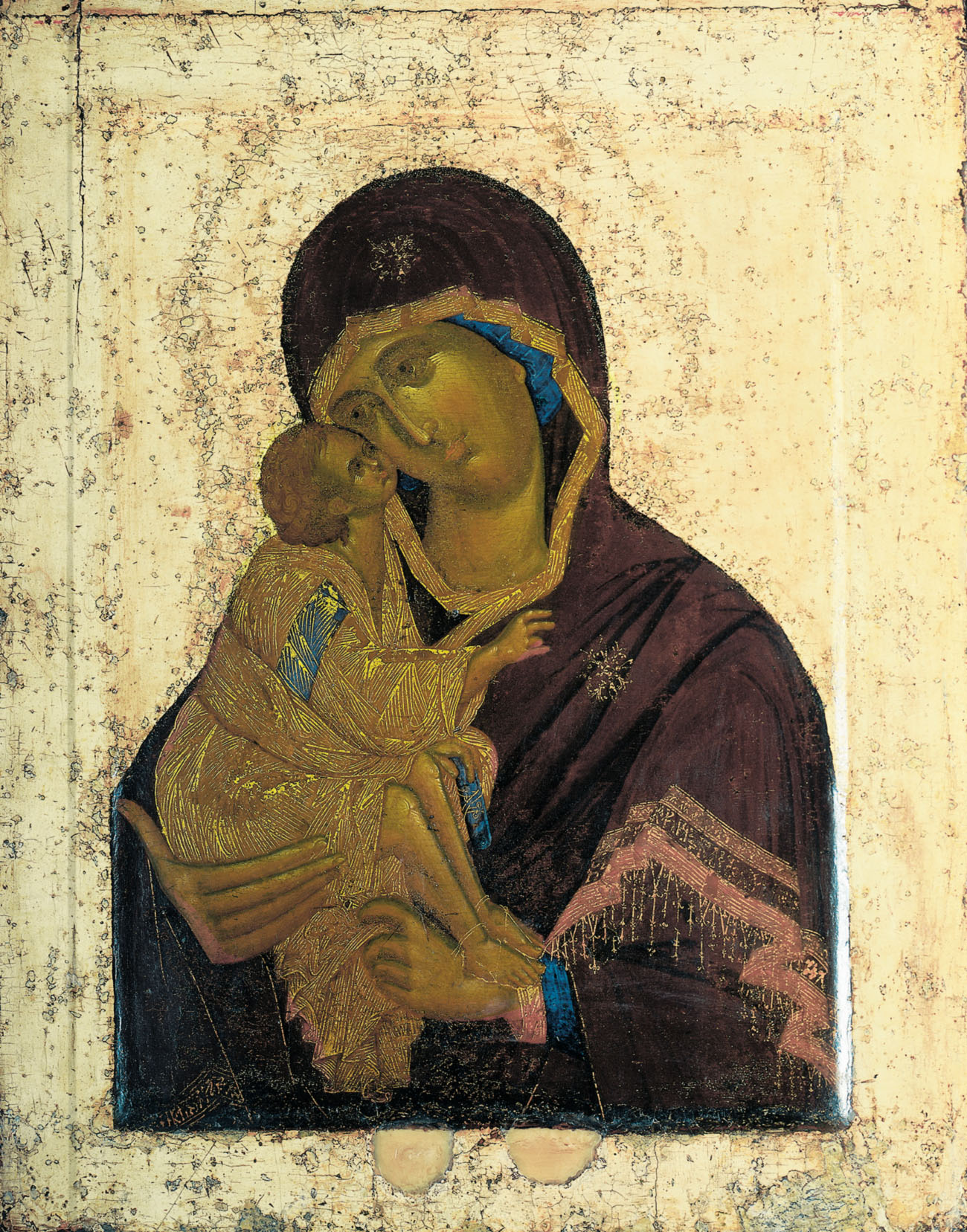
Don Mother of God (Donskaya Theotokos)
Doctrinal reflection
The Don Mother of God (Donskaya Theotokos) is a tempera-on-panel icon dated to the late 14th century AD, now housed in the Tretyakov Gallery, Moscow. It belongs to the Eleousa (Virgin of Tenderness) typological tradition, in which the Christ Child presses His cheek intimately against the Virgin's, their faces unified in an image of profound affective reciprocity. The work is attributed to the circle of Theophanes the Greek (c. 1340–c. 1410 AD), the Byzantine master active in Novgorod and Moscow, though precise authorship remains debated in scholarly literature. The panel exhibits characteristic Palaeologan refinement: subtle modelling of the flesh through layered ochre and warm undertones, expressive physiognomies departing from hieratic stiffness, and a restrained gold ground that concentrates devotional focus on the figures. The Annunciation on the reverse panel is of particular art-historical interest, suggesting a double-sided processional function and demonstrating the icon's liturgical, not merely commemorative, role. Theologically, the Eleousa type enacts the communicatio idiomatum: the Virgin's title Theotokos (God-Bearer), affirmed at Ephesus in 431 AD, is visually argued through physical intimacy, while the Christ Child's bare flesh insists upon genuine Incarnation against docetic abstraction. The icon's association with the Battle of Kulikovo (1380 AD) and its later role as a palladium for military campaigns reflect the Russian reception of Byzantine imperial icon theology. It entered the Kremlin's Dormition Cathedral before eventually passing to the Tretyakov. Sources: Vizantiysky Vremennik; Dumbarton Oaks Papers; Byzantine and Modern Greek Studies.