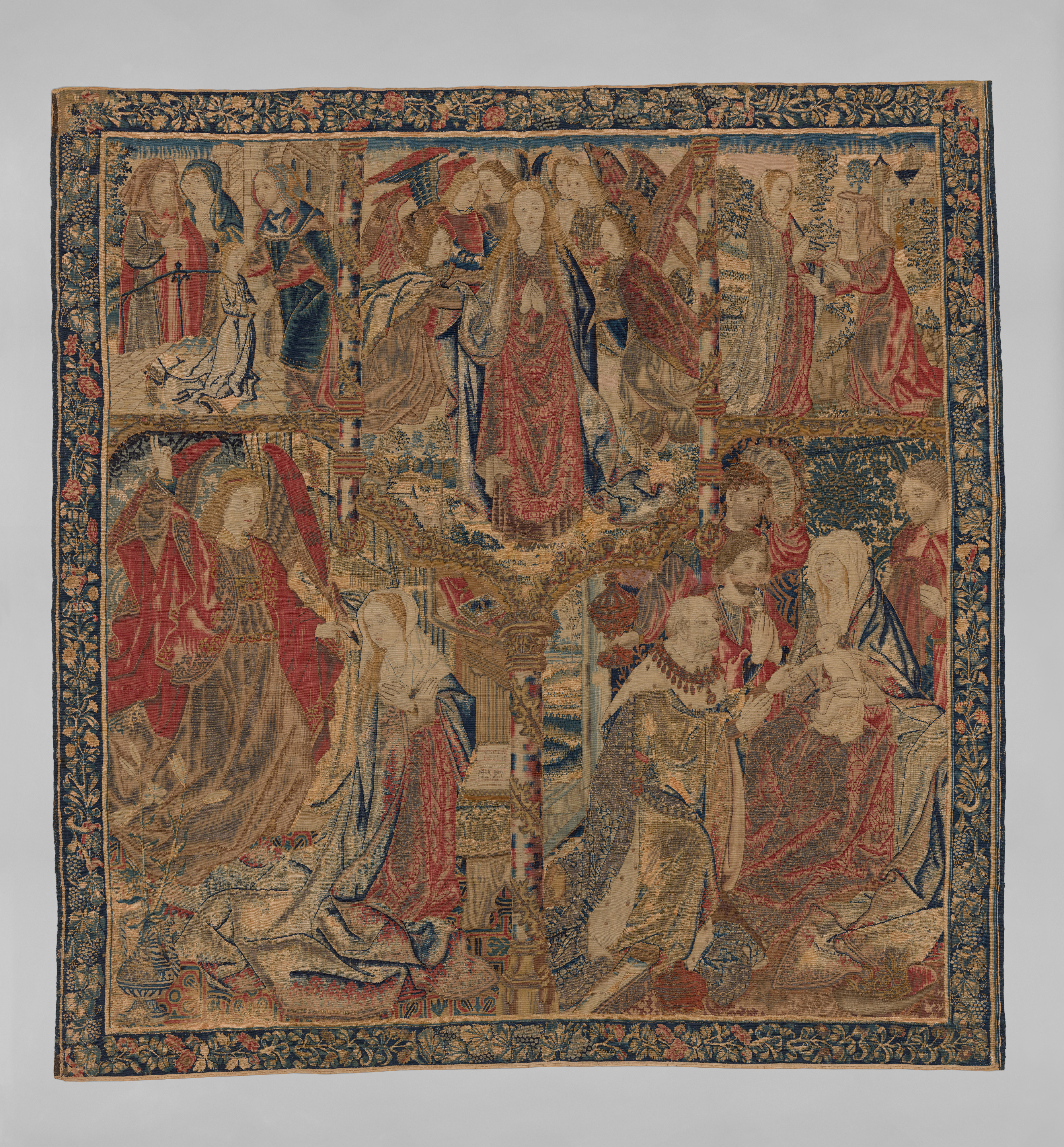
Scenes from the Life of the Virgin
Doctrinal reflection
This South Netherlandish tapestry depicting Scenes from the Life of the Virgin dates to approximately AD 1490–1510 and is held in the Medieval Art collection of the Metropolitan Museum of Art (Bequest of Benjamin Altman, 1913). The medium — wool warp with wool, silk, and metallic wefts — situates the work within the luxury textile production of the Burgundian Netherlands, whose workshops in Brussels, Tournai, and Bruges dominated European tapestry manufacture in this period; the metallic threads mark a high-status courtly or ecclesiastical commission. The narrative program requires sorting text from tradition. Episodes such as the Annunciation belong to Scripture (Luke 1:26-38). But the framing cycle — Mary's own nativity and her presentation in the Temple as a child — derives from the Protoevangelium of James, a second-century apocryphal text, not from the Gospels, and late medieval cycles of this type commonly close with her Dormition or Coronation as Queen of Heaven, scenes drawn entirely from later Catholic tradition. Where such cycles were read as teaching Mary's immaculate conception or her primacy as heavenly intercessor, that teaching is the tradition's, not the Bible's: Scripture honors Mary as blessed among women (Luke 1:42) and shows her pointing away from herself — 'whatsoever he saith unto you, do it' (John 2:5) — while naming one mediator between God and men, the man Christ Jesus (1 Timothy 2:5). As a material witness, the tapestry testifies to the wealth of Netherlandish workshops and to how thoroughly apocryphal narrative had saturated late medieval devotional imagery. Sources: Cavallo, A. S., Medieval Tapestries in the Metropolitan Museum of Art (1993); Campbell, T., Tapestry in the Renaissance (2002).