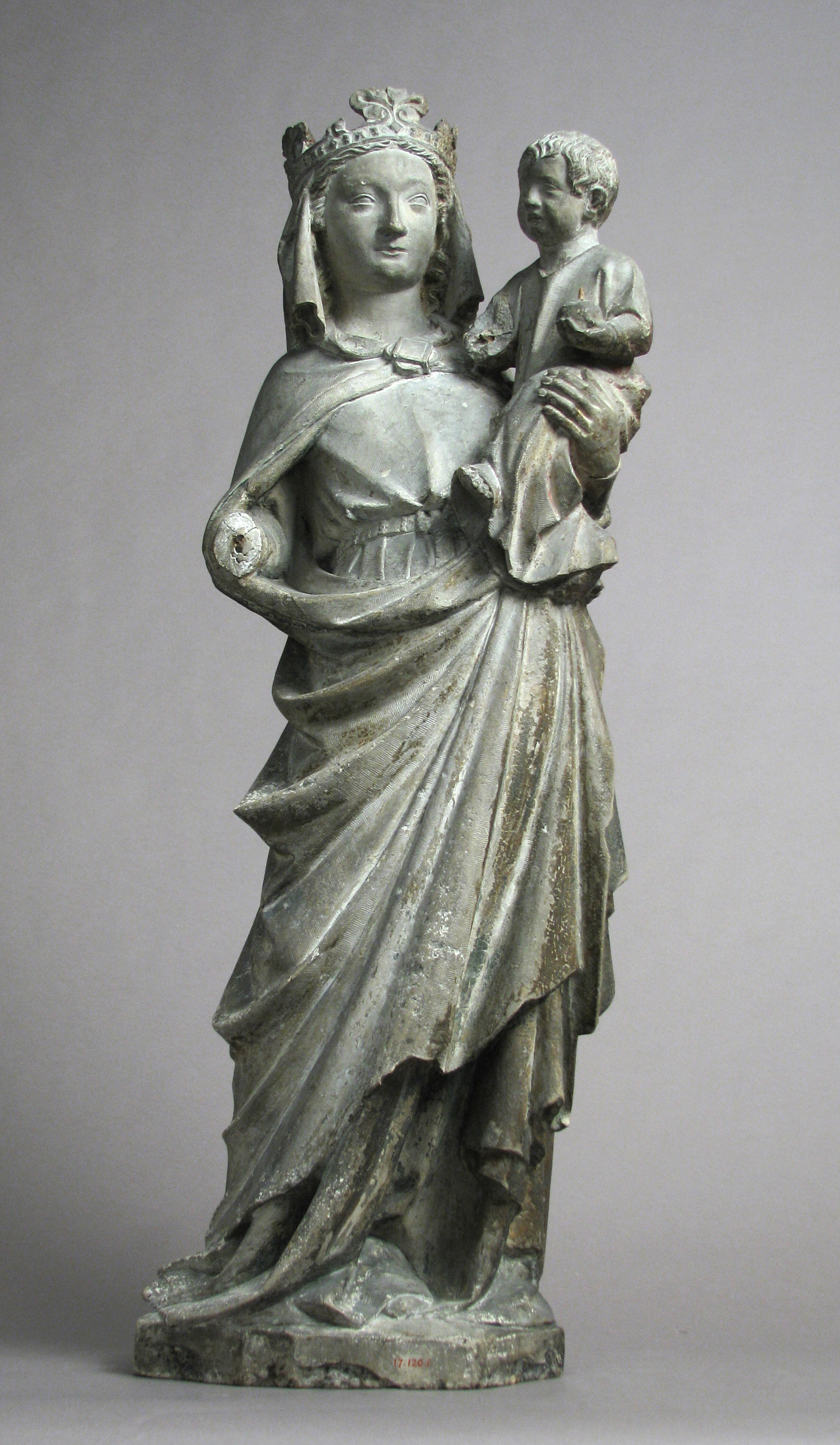
Virgin and Child
Doctrinal reflection
This limestone statuette of the Virgin and Child is a French Gothic work of the fourteenth century AD, preserved in the Medieval Art galleries of the Metropolitan Museum of Art as part of the Mr. and Mrs. Isaac D. Fletcher Collection (bequest 1917). Though catalogued in a Byzantine archive context, the object is a product of the French Gothic tradition, included here for comparative reference: its composition — the Virgin bearing the Christ Child on one arm — descends from the Byzantine Hodegetria type, transformed in the Gothic milieu toward naturalism, lyrical drapery, and maternal tenderness. Traces of original polychromy attest to the chromatic richness of Gothic devotional sculpture. What the image was made to teach deserves precise handling. Theotokos, 'God-bearer,' affirmed at the Council of Ephesus in AD 431, is a confession about Christ — the child Mary bore is God the Son (Luke 1:43) — and it stands. But by the fourteenth century, Western devotion had added a further title the text never gives: Mediatrix, Mary as channel of grace and heavenly advocate, a formulation developed in medieval piety from Bernard of Clairvaux onward and later embraced in Catholic teaching. Scripture draws the line the tradition crossed: 'there is one God, and one mediator between God and men, the man Christ Jesus' (1 Timothy 2:5). A statuette like this one instructed household devotion — a portable object of private piety — and scholarly interest centers on the westward transmission of Marian types, the survival of polychromy, and the Fletcher bequest's place in early American medieval collecting. The mother presents the child; the text keeps the mediation with the child alone. Sources: Gesta (International Center of Medieval Art); Speculum (Medieval Academy of America); Metropolitan Museum Journal.