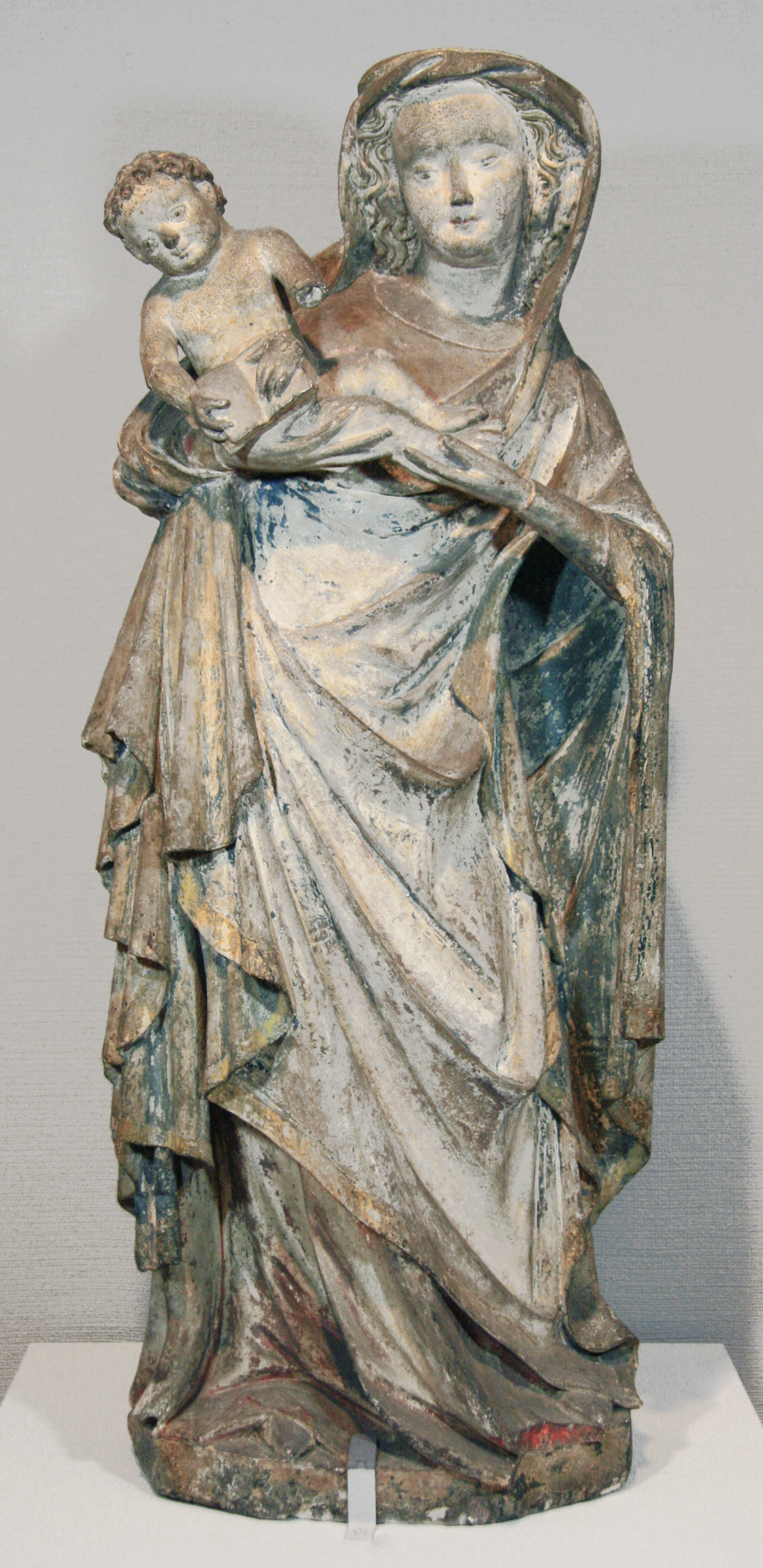
Virgin and Child
Doctrinal reflection
This limestone statue of the Virgin and Child, dated 1400–1440 and attributed to French production, represents a late Gothic sculptural type rather than a Byzantine work strictly defined. Its inclusion in a Scriptorium Byzantine archive entry requires careful qualification: the object belongs to the Western medieval tradition and falls outside the geographic and stylistic boundaries of Byzantine art proper. Nevertheless, the theological program it embodies—the Theotokos as throne of wisdom cradling the incarnate Logos—derives from iconographic conventions that Byzantine art transmitted to the Latin West across centuries of exchange. The compositional type, with the Christ Child held frontally against the Virgin's torso while she inclines her head with courtly elegance, reflects the Gothic transformation of the hieratic Hodegetria model into an affective, humanized devotional image. The French limestone medium situates the work within the Île-de-France or regional workshop tradition, where soft-stone carving flourished under court and ecclesiastical patronage in the early fifteenth century. The elongated proportions, swaying contrapposto stance, and richly draped mantle are characteristic of the International Gothic style that circulated between Paris, Burgundy, and the Rhineland circa 1380–1440. Scholarly assessment of this work focuses on workshop attribution, the typology of the Virgin's crown, and the gesture of the Christ Child, which may indicate a lost attribute such as an orb or book. The Morgan gift provenance places it among a cohort of high-quality medieval objects acquired for the Metropolitan in the early twentieth century. Sources: Gaborit-Chopin, Sculpture française (Paris, 1978); Williamson, Gothic Sculpture 1140–1300 (Yale UP, 1995); Metropolitan Museum Bulletin, Medieval Art acquisitions.