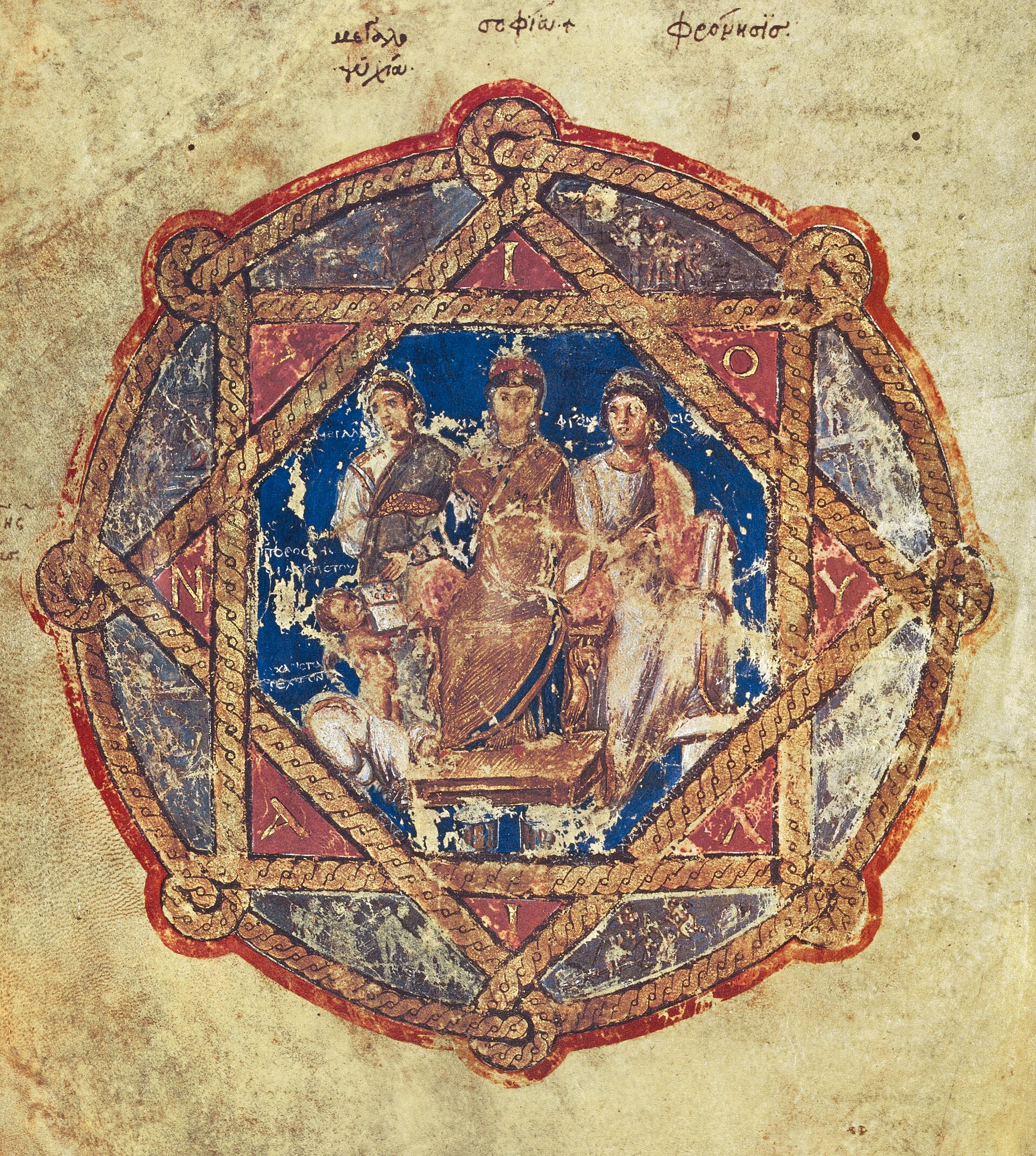
Vienna Dioscurides — Anicia Juliana
Doctrinal reflection
The Vienna Dioscurides (Österreichische Nationalbibliothek, Cod. Med. gr. 1) is a luxury Byzantine manuscript produced in Constantinople c. AD 515, representing one of the most significant survivals of late antique book art. The dedication miniature depicts Anicia Juliana, a prominent aristocrat of the Theodosian dynasty, enthroned in a posture of imperial authority and flanked by personifications — commonly identified as Megalopsychia (Magnanimity) and Phronesis (Prudence) — while a kneeling figure representing the Gratitude of the Arts gestures toward her. The composition constitutes the earliest securely dated and identified dedication portrait in a surviving Byzantine manuscript, establishing a formal typology that would persist throughout the middle and late Byzantine periods. Anicia Juliana was a major architectural patron, responsible for the church of St. Polyeuktos in Constantinople, and the miniature functions as a programmatic statement of aristocratic munificence and cultural authority in the post-Theodosian court milieu. The portrait draws heavily on Roman imperial iconographic conventions — the frontal throne composition, the flanking allegorical figures — while operating within a Christian cultural framework that equates patronal largesse with virtuous governance. The putto at lower center displaying an open codex reinforces the manuscript's self-referential identity as an object of elite patronage. Executed in tempera and gold on parchment, the miniature exhibits refined Hellenistic figure modeling combined with the flattening tendencies emergent in early sixth-century Constantinopolitan art. Scholarly debate centers on the precise workshop provenance and the relationship of its classicizing style to contemporaneous Justinianic production. Sources: Dumbarton Oaks Papers; Jahrbuch der Österreichischen Byzantinistik; Byzantine and Modern Greek Studies.