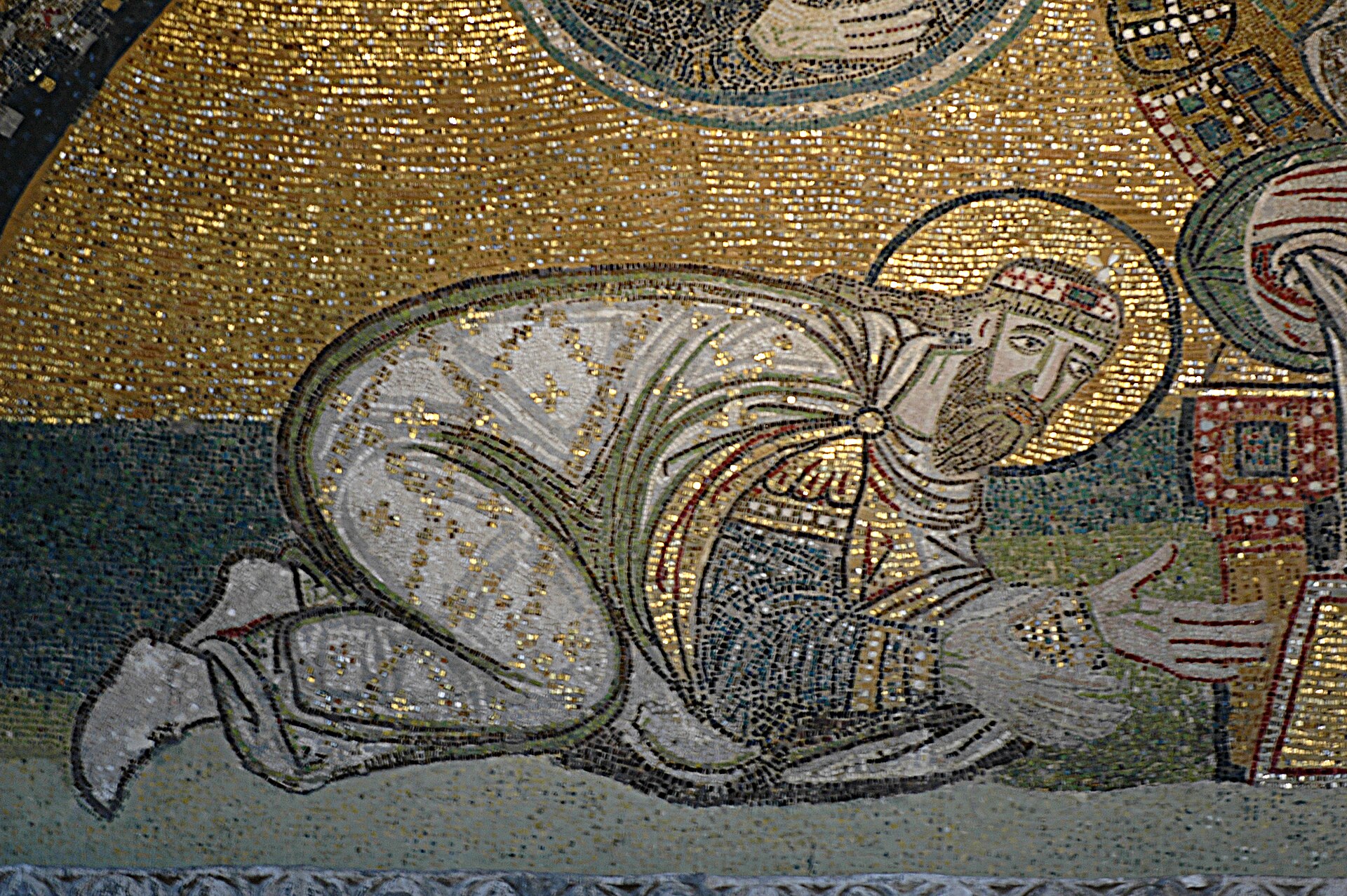
Emperor Leo VI Mosaic (Hagia Sophia)
Doctrinal reflection
The Emperor Leo VI Mosaic, dateable to c. AD 900, occupies the lunette above the Imperial Door in the inner narthex of Hagia Sophia, Constantinople. Executed in the refined mosaic technique characteristic of the middle Byzantine period, the composition presents Christ Pantokrator enthroned at center, flanked by two medallions bearing the Virgin Orans and the Archangel Gabriel, while Emperor Leo VI (r. AD 886–912) performs full proskynesis before him. The prostration is a calculated theological and political statement: the basileus, despite his sacral status as God's earthly vicegerent, submits unconditionally to divine sovereignty. This programmatic humility directly addresses Leo's documented ecclesiastical difficulties, most notably the controversy surrounding his fourth marriage (the tetragamy affair, c. AD 906), which provoked severe censure from Patriarch Nicholas I Mystikos. Scholars including Cormack and Maguire have interpreted the prostrate posture as penitential in register, functioning as a visual petition for divine forgiveness and legitimation precisely when Leo's authority faced canonical challenge. Christ's open Gospel codex, displaying a text of benediction and authority, reinforces the asymmetry of the exchange: imperial power derives from and remains accountable to celestial sanction. Stylistically, the mosaic demonstrates the post-Iconoclast Macedonian Renaissance aesthetic: crisp gold tesserae ground, volumetric drapery articulation, and classicizing facial modeling that distinguish ninth- and tenth-century Constantinopolitan court production. The medallion format for flanking figures reflects an established hierarchical convention codified in middle Byzantine monumental programs. The work remains indispensable for reconstructing the ideology of Byzantine imperial theology at its most rhetorically concentrated. Sources: Dumbarton Oaks Papers; Byzantine and Modern Greek Studies; Oxford Handbook of Byzantine Studies.