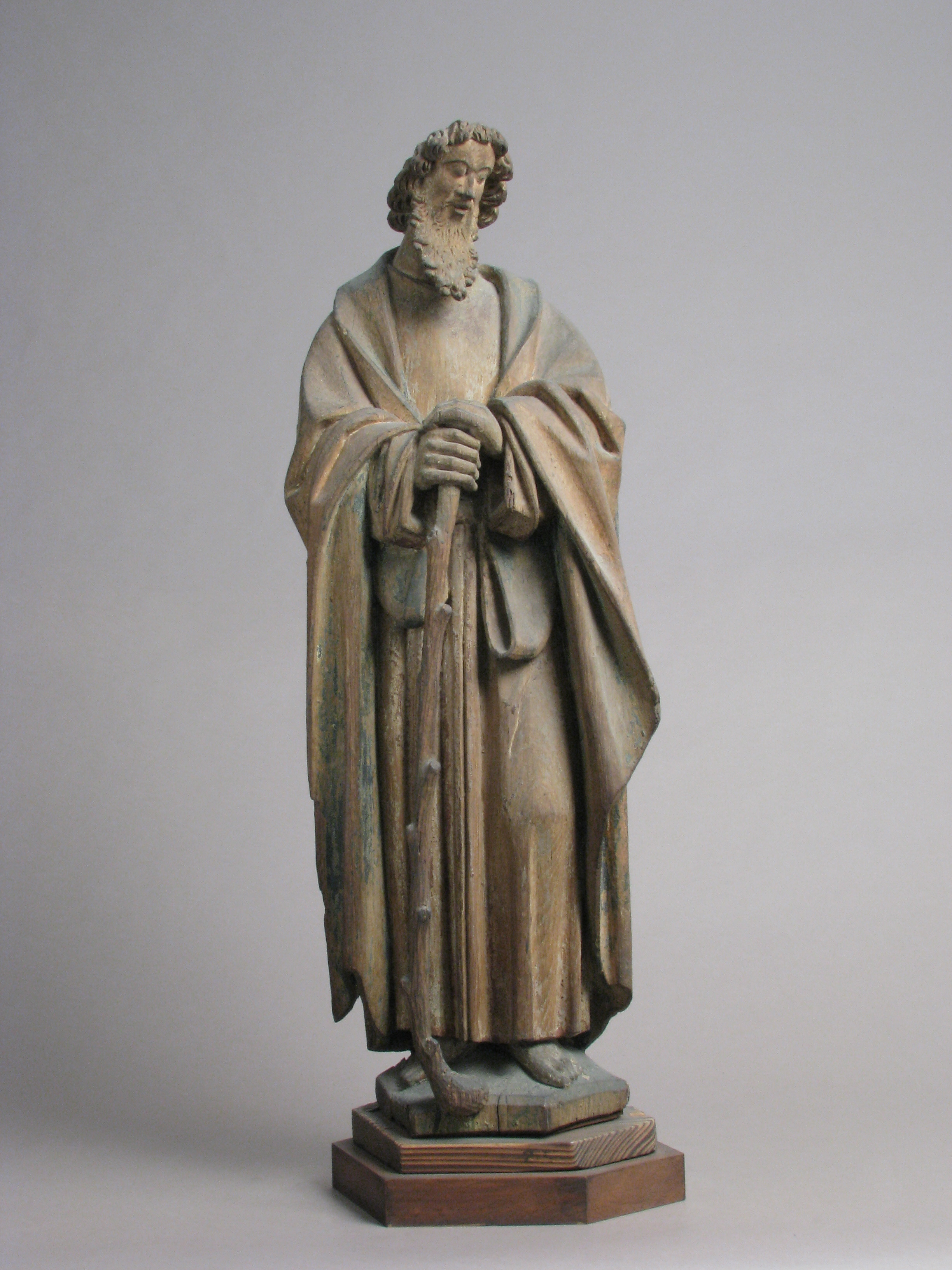
St. James the Less
Doctrinal reflection
This North Netherlandish carved oak statuette of Saint James the Less, dated approximately AD 1500 and bearing traces of polychromy and gilding, is housed in the Medieval Art collection of the Metropolitan Museum of Art (Gift of J. Pierpont Morgan, 1916). It is not a Byzantine artwork — it belongs to the late Gothic sculptural tradition of the Low Countries, carved in the final phase of Gothic sculpture before Italian Renaissance conventions penetrated north of the Alps, and it is archived here for comparative reference. The title it carries deserves the same care as the chisel-work. 'James the Less' reflects a long-standing Western tradition, given influential form by Jerome in the fourth century, that merged several New Testament men named James into one figure. Scripture is more careful: it names James son of Zebedee and James son of Alphaeus among the Twelve, and separately James the brother of the Lord (Matthew 13:55; Galatians 1:19), who led the Jerusalem church, wrote the epistle bearing his name, and was martyred around AD 62 according to Hegesippus as preserved by Eusebius. Whether the son of Alphaeus and the Lord's brother were the same man is a question the tradition answered but the text leaves open — and John 7:5 with Acts 1:14 places the Lord's brothers outside the Twelve during his ministry. The fuller's club conventionally shown with this saint is the martyrdom instrument of James the brother of the Lord in the early accounts. The statuette's polychromy reflects Netherlandish workshop practice, in which oak figures passed to specialist painters for finishing; comparable figures are treated in studies of Brabantine and Rhenish workshops. The Morgan provenance reflects the founding era of American medieval collecting. Sources: Steyaert, J., Late Gothic Sculpture (1994); Williamson, P., Gothic Sculpture 1140–1300 (1995); MMA Bulletin, Morgan Collection issues.