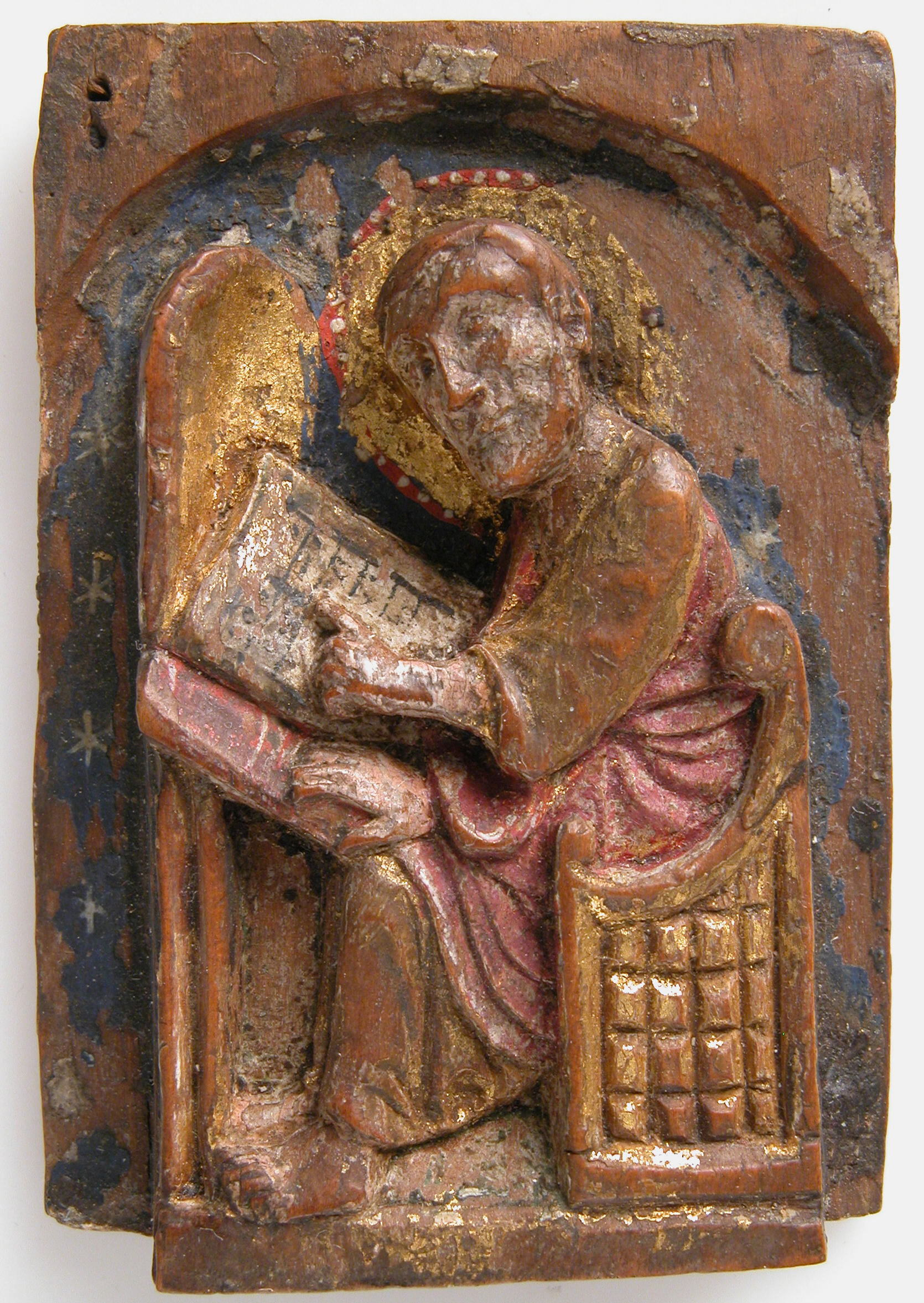
Miniature Relief of a Saint Luke at His Writing Table
Doctrinal reflection
This small polychrome and gilded wood relief, produced in Germany between approximately AD 1200 and AD 1225, depicts the Evangelist Luke seated at his writing table, engaged in the composition of his Gospel. The object belongs to the Romanesque tradition of small-format devotional carving, likely functioning as a book cover plaque, portable altar component, or altar retable element. The Evangelist portrait type descends from late antique author iconography and was standardized in Byzantine and Carolingian manuscript illumination before migrating into German relief carving during the Ottonian and Romanesque periods. Luke is conventionally shown with his symbol, the winged ox drawn from Ezekiel 1:10 and Revelation 4:7, a four-living-creatures typology applied to the four Evangelists by Irenaeus in the second century AD and codified further by Jerome in the fourth century; that symbolic assignment is patristic tradition, not explicit New Testament identification. The seated scribe pose—writing desk, quill, ink horn, open codex—signals the Evangelist's role as inspired recorder of the Gospel narrative (Luke 1:1–4). The gilding and polychrome finish are characteristic of Mosan and Rhenish workshop practice of this period, connecting the piece to high-quality ecclesiastical luxury production. The relief entered the Metropolitan Museum of Art collection through the 1941 bequest of George Blumenthal. Scholarly analysis situates this work within the broader corpus of German Romanesque ivory and wood relief carving studied in relation to contemporary manuscript illustration programs. Sources: Haussherr, R., in studies of German Romanesque sculpture; Kahsnitz, R., studies of Romanesque German wood carving; Metropolitan Museum of Art Bulletin.