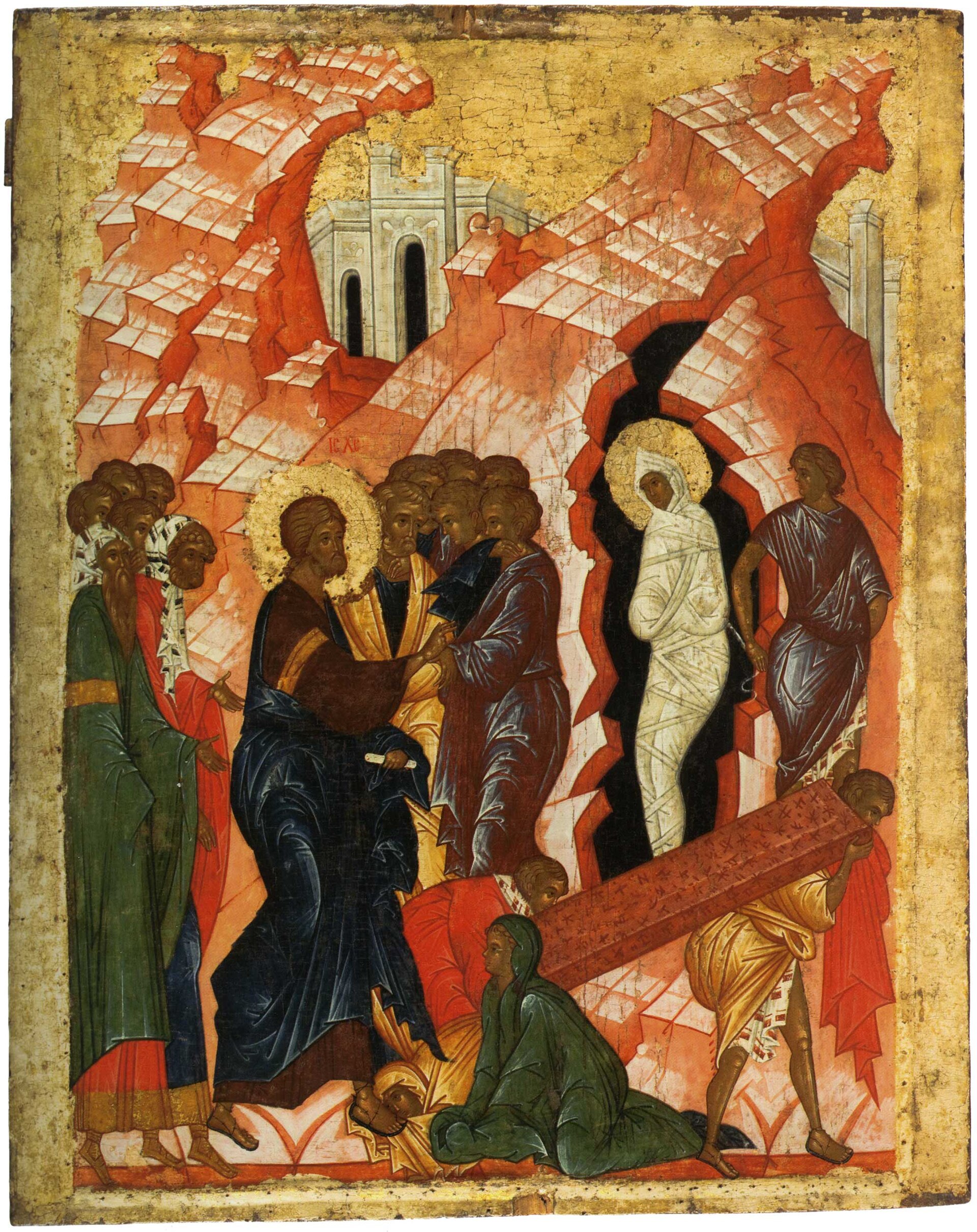
The Raising of Lazarus (Novgorod)
Doctrinal reflection
This fifteenth-century AD panel painting, executed in the Novgorod school and associated with the Kirillo-Belozersky Monastery—now held in the Russian Museum, St Petersburg—represents the Raising of Lazarus as a festival icon (prazdnichnyi chin). The work belongs to the well-established Byzantine iconographic tradition that stabilized the composition's essential elements by the middle Byzantine period and transmitted them with remarkable fidelity into Rus' workshops. Novgorodian craftsmanship is typically identifiable through saturated cinnabar reds, flat architectural schematism, and bold graphic linearity rather than Constantinopolitan three-dimensionality. The canonical Byzantine recension organizes the scene along a diagonal axis: Christ stands at left, right hand extended in the commanding gesture of vivification, flanked by apostles; the rock-cut tomb dominates center-right, before which servants unwrap Lazarus, depicted as a mummiform standing figure still swathed in grave cloths. Mary and Martha prostrate themselves at Christ's feet in postures of supplication, while bystanders register astonishment or hold garments before their faces against the odor of four days' death (John 11:39). The rocky landscape, rendered as stylized Byzantine hillocks, locates the scene at Bethany without naturalistic ambition. Theologically the image functions as a twofold prefiguration: of Christ's own resurrection and of the eschatological general resurrection, a reading institutionalized in the Orthodox lectionary through its assignation to Lazarus Saturday. The icon thus occupies a pivotal liturgical position in Holy Week preparation. Its scholarly significance lies in demonstrating the unbroken transmission of middle Byzantine compositional conventions into Palaiologan-period Novgorodian production. Sources: Byzantinische Zeitschrift; Dumbarton Oaks Papers; Искусство Древней Руси (studies on Old Russian art).