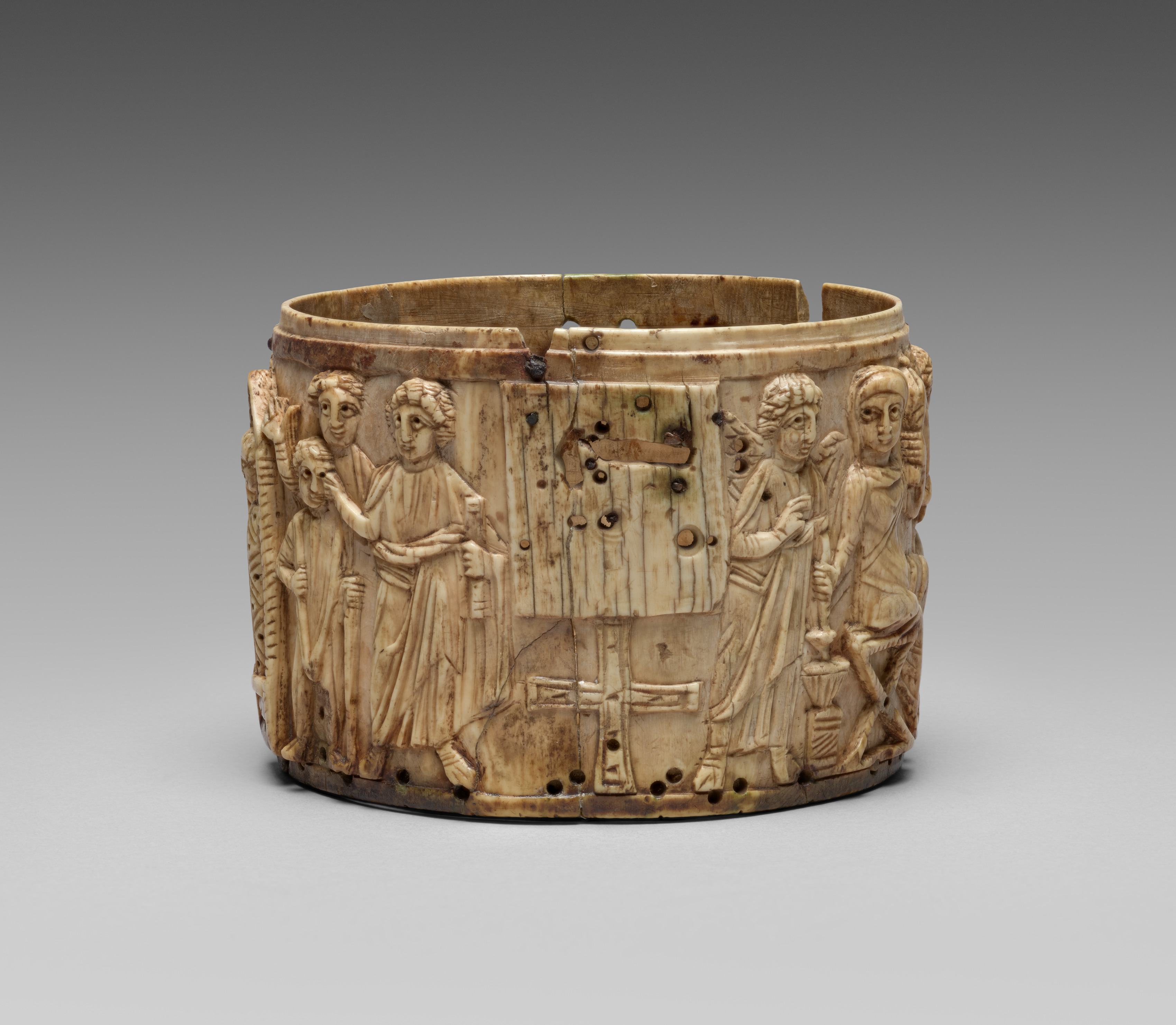
Ivory Pyx (Box)
Doctrinal reflection
This ivory pyx, dated to the sixth century AD and housed at the Cleveland Museum of Art, represents a characteristic product of late antique Christian luxury craft, most likely produced in a major eastern Mediterranean workshop, possibly Constantinople, Alexandria, or Antioch. Carved from a section of elephant tusk, the cylindrical vessel bears relief narratives arranged in registers or continuous frieze format, depicting four discrete New Testament episodes: the Annunciation, the Entry into Jerusalem, the Raising of Lazarus, and the Healing of the Man Born Blind. The inclusion of an altar with chalices on the surface strongly suggests the object functioned in a liturgical or para-liturgical capacity, perhaps as a container for the reserved Eucharist or consecrated oil. Iconographically, the selection of scenes follows an established typological logic: the Annunciation inaugurates the Incarnation, while the miracles of Lazarus and the blind man prefigure resurrection and spiritual illumination, themes theologically consonant with sacramental use. The Entry into Jerusalem positions Christ as eschatological king, linking the vessel's function to the eucharistic sacrifice commemorated at the altar depicted on its surface. Stylistically, the figures exhibit the squat proportions and heavy drapery folds characteristic of transitional late antique to early Byzantine carving, distinguishable from classicizing fifth-century work yet preceding the more hieratic flattening of middle Byzantine production. Comparable pyxes appear in Berlin (Staatliche Museen) and the Louvre, forming a well-studied corpus. Scholarly attention has focused on workshop identification, liturgical function, and the integration of narrative and symbolic programs in small-scale ivory carving. Sources: Gesta; Dumbarton Oaks Papers; Byzantine and Modern Greek Studies.