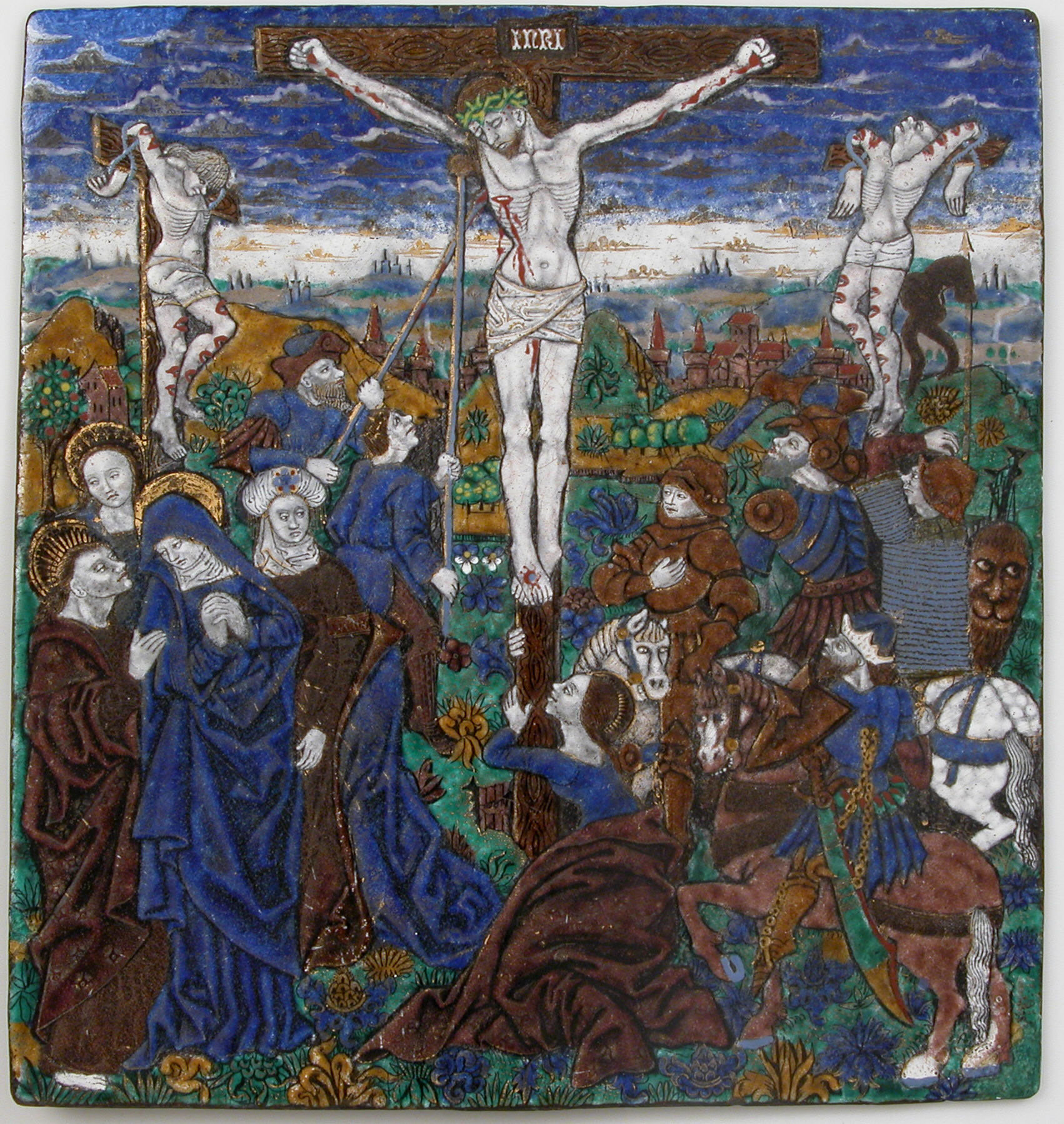
Plaque with the Crucifixion
Doctrinal reflection
This fifteenth-century French painted enamel plaque on copper depicts the Crucifixion of Christ, held in the Medieval Art collection of the Metropolitan Museum of Art (Gift of J. Pierpont Morgan, 1917). The technique—painted enamel on copper—represents a distinctive development in Limoges workshop production, in which powdered glass pigments were applied and fired onto a metal ground, displacing the earlier champlevé tradition while enabling greater pictorial nuance and narrative detail. The medium allowed craftsmen to approximate the modulated tonality of panel painting within a portable, durable format suited to private devotion and liturgical furnishing.
The Crucifixion is among the most theologically dense compositions in Western medieval art, grounded in the Gospel accounts (Matthew 27:32–56; Mark 15:21–41; Luke 23:26–49; John 19:17–37). Fifteenth-century French treatments typically arrange the scene with Christ on the cross at center, flanked by the Virgin Mary and the Apostle John as specified in John 19:25–27, often augmented by lamenting figures drawn partly from Gospel narrative and partly from later devotional elaboration. The titulus INRI (John 19:19–20) frequently appears; the wound in Christ's side (John 19:34) may be rendered with liturgical specificity, as it carried eucharistic and sacramental resonance in late medieval theology. The plaque's portable scale and refined technique situate it within the broader tradition of Limoges devotional objects circulated among aristocratic and ecclesiastical patrons in the later Gothic period. Iconographically it belongs to the Passion cycle, inheriting compositional conventions solidified through manuscript illumination, ivory carving, and altarpiece production across the preceding centuries. Scholarly analysis focuses on workshop identification, enamel chemistry, and the translation of Netherlandish pictorial influence into the Limoges idiom.
Sources: Marquet de Vasselot, Catalogue des émaux du Louvre; Gauthier, Émaux du moyen âge occidental; Metropolitan Museum of Art Bulletin.