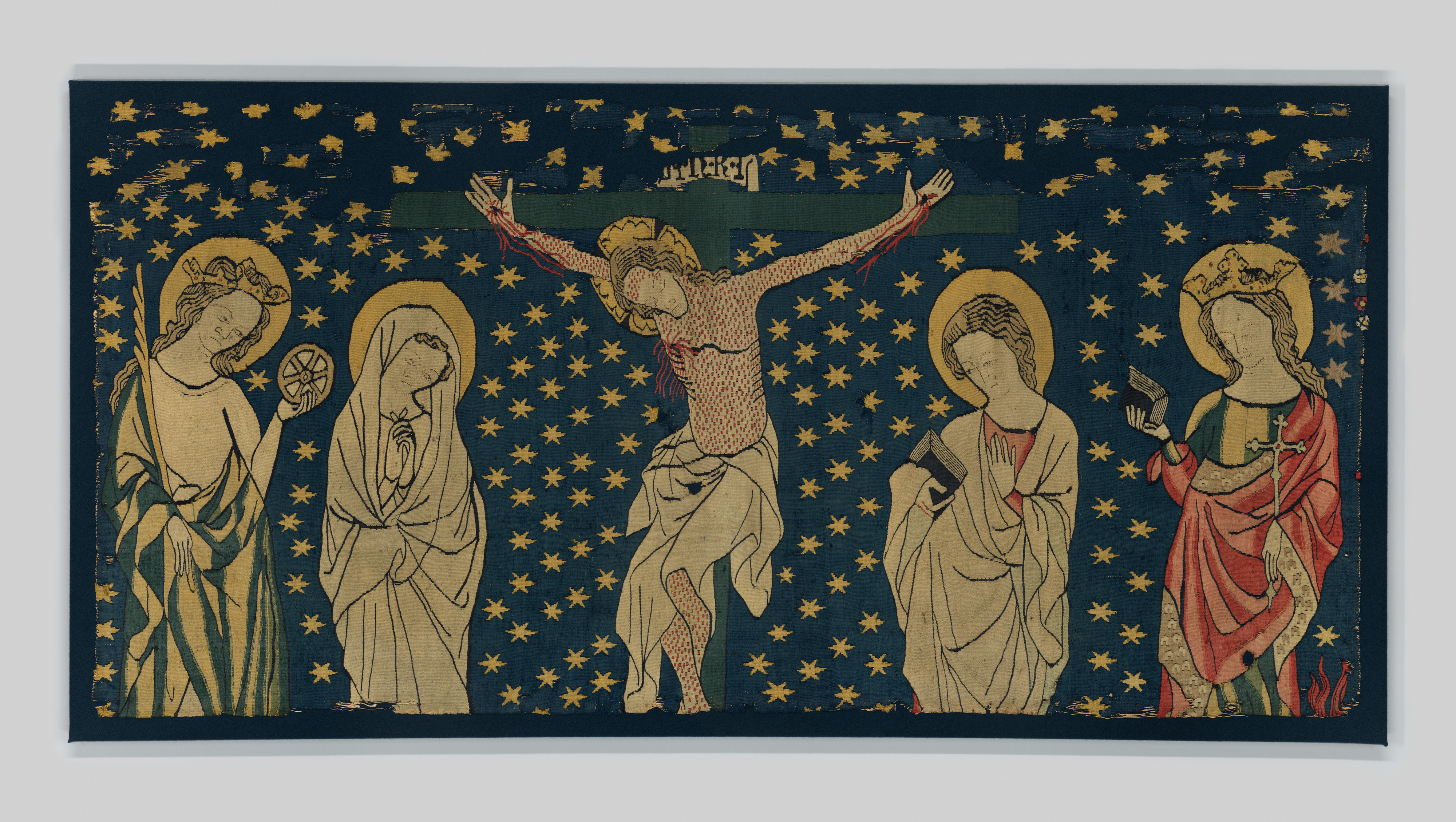
Crucifixion
Doctrinal reflection
This entry presents a notable challenge for the Scriptorium archive: the object in question is a German embroidered textile dated ca. 1325–1350 AD, executed in linen warp with wool wefts and embellished with wool and silk embroidery. It is held in the Medieval Art collection of the Metropolitan Museum of Art (acc. via Purchase, Francis L. Leland Fund and Mitchell Samuels Gift, 1916). The work depicts the Crucifixion, a ubiquitous devotional subject in fourteenth-century Central European devotional arts. While the Crucifixion iconography shares its theological program with Byzantine representations—emphasizing Christ's sacrificial death, the presence of the Virgin and Saint John the Evangelist, and typological fulfillment of Old Testament prophecy—the object itself is not Byzantine in origin, medium, or artistic tradition. It belongs to the Gothic Rhineland or broader German embroidery tradition, which drew selectively on Italo-Byzantine compositional conventions disseminated through panel painting and manuscript illumination. The linen-and-wool embroidery technique aligns with documented German opus teutonicum workshop production of the fourteenth century. Iconographically, the image likely presents the crucified Christ with attendant mourning figures, consistent with the Andachtsbild devotional mode gaining prominence in this period. As such, this entry falls outside the strict parameters of Byzantine art as defined by this archive but retains relevance as evidence of Byzantine iconographic diffusion into Latin medieval textile arts. Conservative scholarly attribution places production in the German-speaking lands. Sources: Bulletin of the Metropolitan Museum of Art; Parament und Paramenten-Stickerei, Theophilus; Embroideries of the Medieval Church, Mayer-Thurman.