Processional Cross
Doctrinal reflection
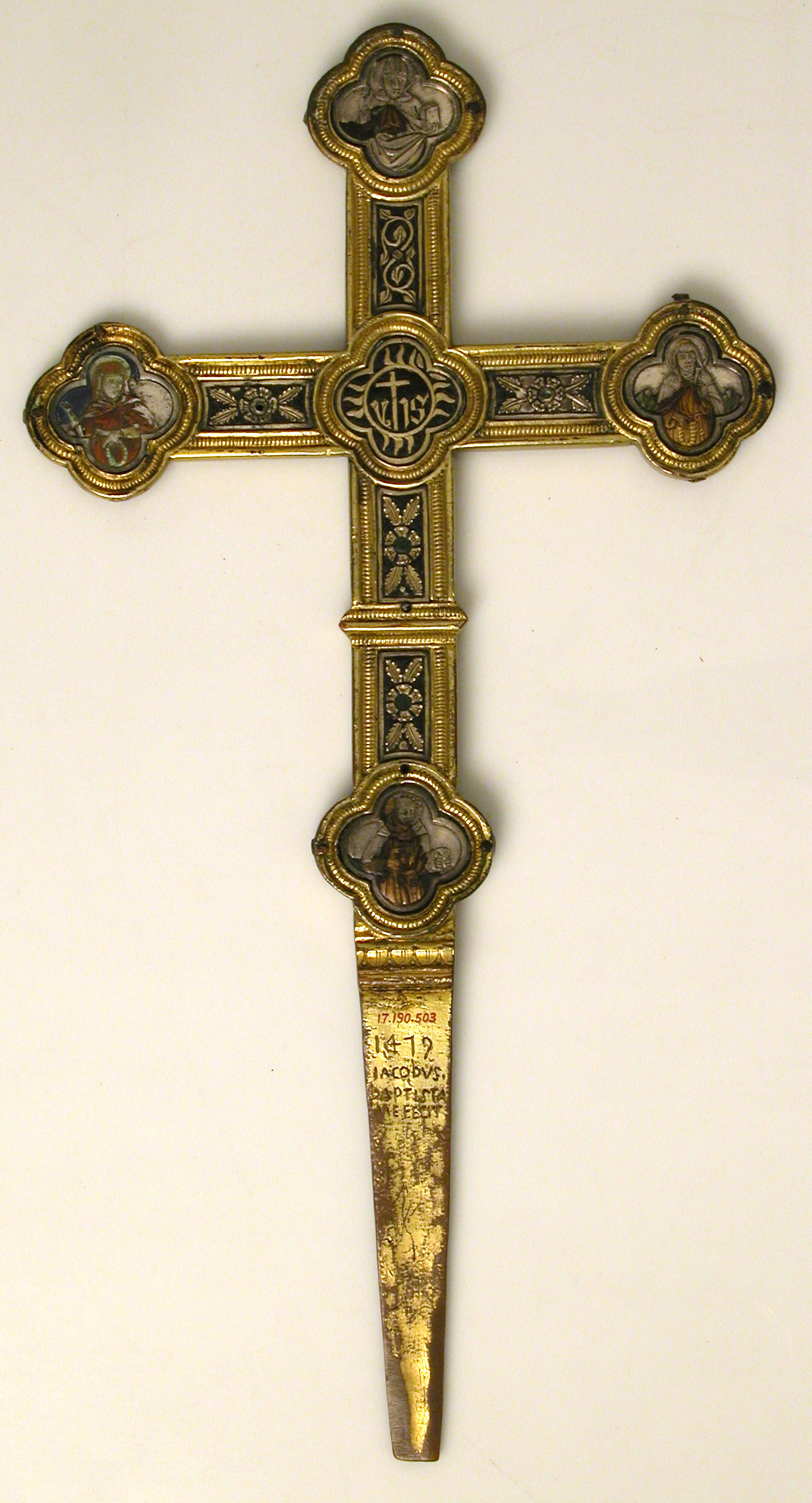
This processional cross, produced in Italy in 1479 AD, represents a refined example of late-medieval Italian metalwork combining basse-taille enamel, silver, niello, gilded silver, and gilded copper. Basse-taille (low-cut relief) enamel, a technique perfected in fourteenth-century Italian and French workshops, involves engraving or chasing shallow relief designs into a metal ground—typically silver—then flooding the recessed field with translucent enamel, allowing the modeled surface beneath to create subtle tonal gradations visible through the glaze. The niello inlay, a black sulfide compound worked into engraved lines, provides high-contrast linear detail complementing the luminous enamel fields. As an altar or processional cross, the object functioned within the Roman Catholic liturgical tradition: carried at the head of processions and stationed at the altar as the focal point of the Mass, its creation falling squarely within the late Palaiologan-adjacent period of Western Gothic-to-Renaissance stylistic transition. Iconographically, Italian processional crosses of this period characteristically depict the Crucifixion on the obverse, with the corpus of Christ (John 19:18–30), flanking figures of Mary and John, and sometimes a titulus inscription (John 19:19); the reverse typically bears a bust of the risen or glorified Christ, the Lamb of God (John 1:29, Revelation 5:6), or the Man of Sorrows. Scholarly evaluation of such objects focuses on workshop attribution, enamel chemistry, and the transition from Gothic figural conventions toward Renaissance naturalism observable in mid-to-late fifteenth-century Italian goldsmithing. The piece entered the Metropolitan Museum's collection as part of the 1917 gift of J. Pierpont Morgan, one of the foundational donations to its medieval holdings. Sources: Gesta (International Center of Medieval Art); Metropolitan Museum Journal; Jahrbuch der Berliner Museen.