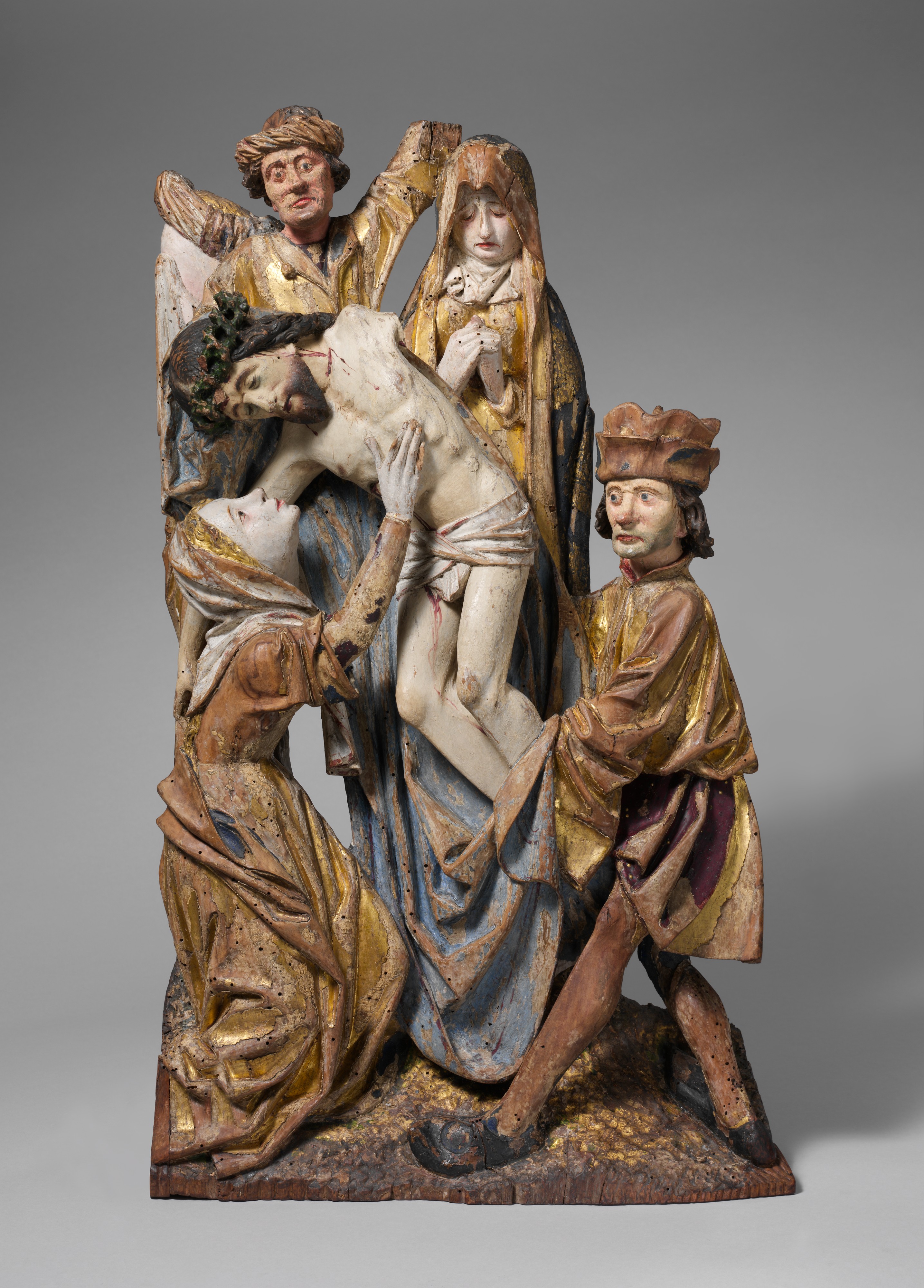
Descent from the Cross
Doctrinal reflection
This entry presents a classificatory difficulty for the Scriptorium archive: the object in question is a South Netherlandish carved fruitwood relief of the Descent from the Cross, dated approximately AD 1475–1500, now housed in the Medieval Art collection of the Metropolitan Museum of Art, New York (gift of J. Pierpont Morgan, 1916). The work falls outside the strict Byzantine mandate of this archive, belonging instead to the late medieval Northern European devotional tradition. No Byzantine provenance, Greek inscription, or Eastern iconographic program has been identified in the museum's documentation. The Netherlandish Descent from the Cross (Depositio) belongs to a well-developed Western typological sequence, indebted to Rogier van der Weyden's canonical 1435 panel and its workshop disseminations, rather than to Byzantine Epitaphios or Threnos iconography. The polychromed relief format—intimate in scale, privately devotional in function—reflects the booming Antwerp and Brabantine export trade in carved altarpieces and devotional objects during the last quarter of the fifteenth century AD. Iconographically, the scene typically deploys Joseph of Arimathea, Nicodemus, the Virgin, and the Magdalene in a compressed figural grouping around the deposed body of Christ. Conservation analysis of comparable fruitwood reliefs has addressed polychromy layering and wood species identification. Because this object does not conform to Byzantine or Eastern Christian parameters, a full theological program analysis under the Scriptorium schema is not applicable. Scholars of Flemish devotional sculpture and late medieval workshop practice remain the appropriate referents. Sources: Metropolitan Museum of Art Bulletin; Journal of the Walters Art Museum; Oud Holland.