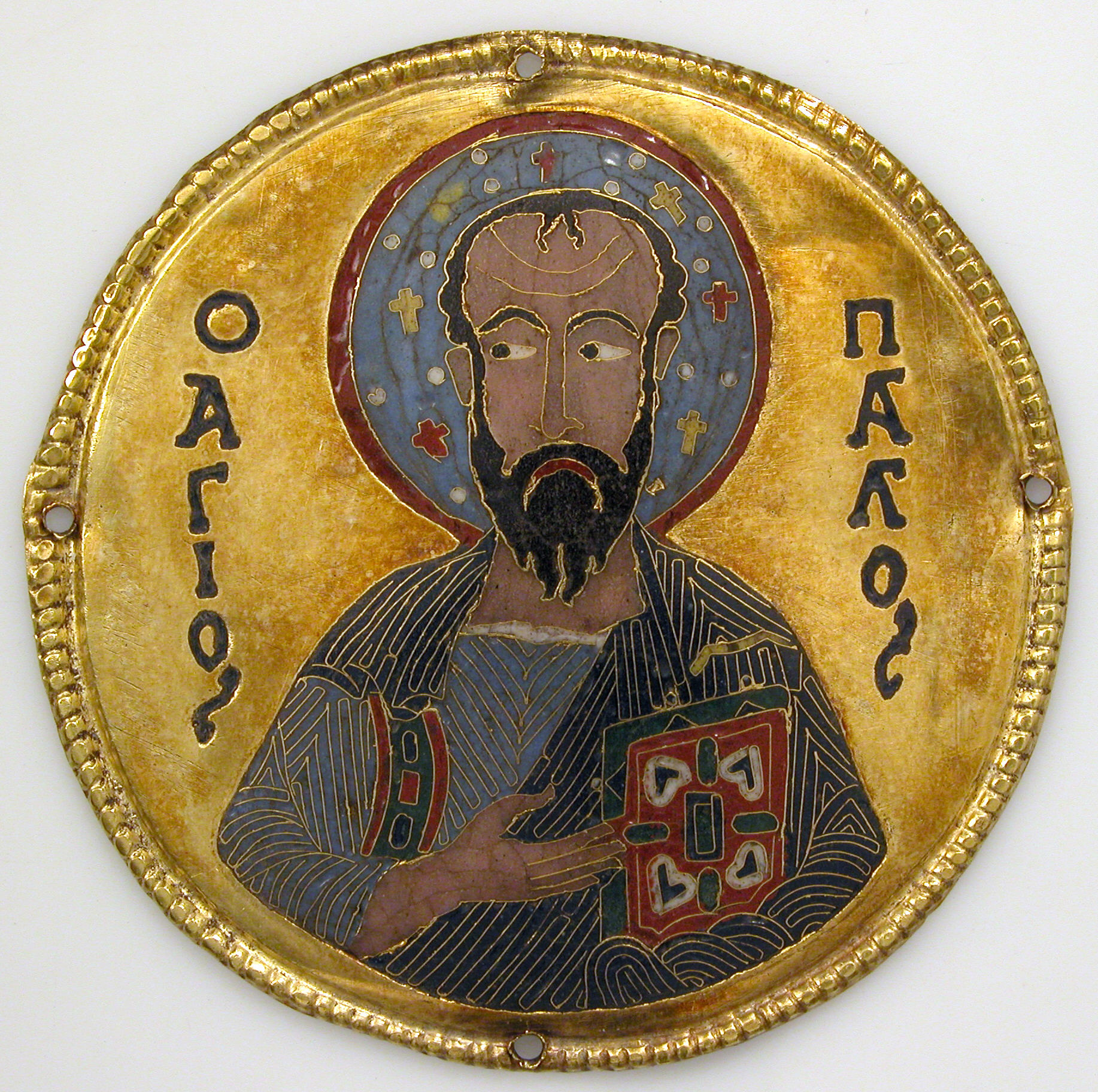
Medallion with Saint Paul from an Icon Frame
Doctrinal reflection
This medallion with Saint Paul, datable to circa 1100 AD, represents a cloisonné enamel roundel originally forming part of a larger icon frame (epistyle or border assembly), a format well attested in middle Byzantine luxury metalwork. Executed in gold and silver with vitreous enamel cells, the piece exemplifies the technical mastery of Byzantine goldsmiths during the Komnenian period, when Constantinople's workshops produced work of exceptional refinement for both court and ecclesiastical patronage. The cloisonné technique—thin metal strips soldered to a gold ground to form compartments filled with powdered glass fused at high temperature—achieves a jewel-like translucency consistent with surviving comparanda such as the Pala d'Oro in Venice and the Khakhuli triptych in Tbilisi. The medallion format for apostolic busts was a standard organizing principle for icon frames, where individual saints could be displayed in hierarchical sequence flanking a central devotional image, typically of Christ or the Virgin. Paul is identifiable through standard iconographic convention: a lean, dark-bearded figure with a high forehead, often holding a codex or scroll referencing his epistolary corpus. Theologically, Paul's inclusion underscores apostolic authority and the Pauline doctrinal foundations central to Byzantine Orthodox identity. The Gift of J. Pierpont Morgan in 1917 situates this object within the broader dispersal of Byzantine portable luxury arts to Western collections in the late nineteenth and early twentieth centuries. Scholarly analysis of such frame medallions has clarified workshop distribution networks and the economics of high-status commission in the Komnenian court milieu. Sources: Dumbarton Oaks Papers; Byzantine and Modern Greek Studies; Metropolitan Museum Journal.