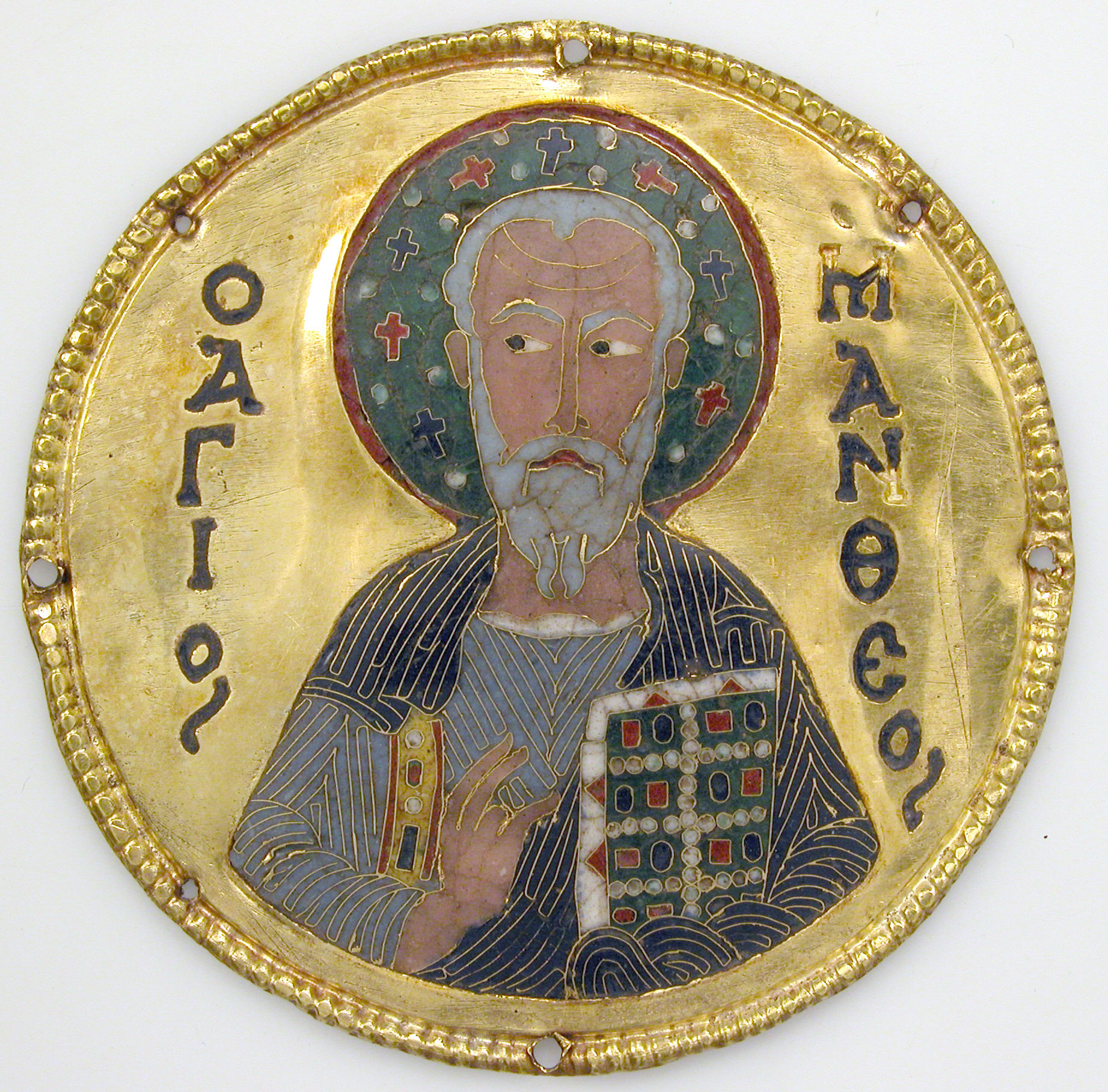
Medallion with Saint Matthew from an Icon Frame
Doctrinal reflection
This medallion depicting Saint Matthew originates from a Byzantine icon frame and is dated to approximately AD 1100, placing it firmly within the middle Byzantine period. It is held in the Medieval Art collection of the Metropolitan Museum of Art, New York, having entered the collection as a gift from J. Pierpont Morgan in 1917. The work is executed in cloisonné enamel on a gold and silver ground, a technique that reached its apogee in Constantinople during the eleventh and early twelfth centuries. Cloisonné enamel production of this caliber is associated with imperial workshops and high ecclesiastical patronage, as the technical demands—fusing vitreous pastes within fine wire compartments soldered onto precious-metal grounds—required extraordinary craft specialization. The medallion would have been one of a series of apostle or evangelist busts originally adorning the border frame of a large icon, a format well attested in surviving ensembles such as the Pala d'Oro in Venice and comparable frames preserved on Sinai. Saint Matthew is identifiable through inscription and likely depicted in bust form holding a codex or scroll, the standard evangelist attribute. Theologically, the placement of evangelist medallions on an icon frame reinforces the authority of scripture as witness to the sacred image at center, embedding the viewer within a hierarchy of revelation. Stylistically, the compact facial modeling, bold linear contours, and jewel-toned enamel palette conform closely to middle Byzantine conventions documented across the corpus of Constantinopolitan goldsmith work. The piece provides valuable evidence for the organization and dissemination of luxury sacred objects in the Komnenian period. Sources: Dumbarton Oaks Papers; Cahiers archéologiques; Metropolitan Museum of Art Bulletin.