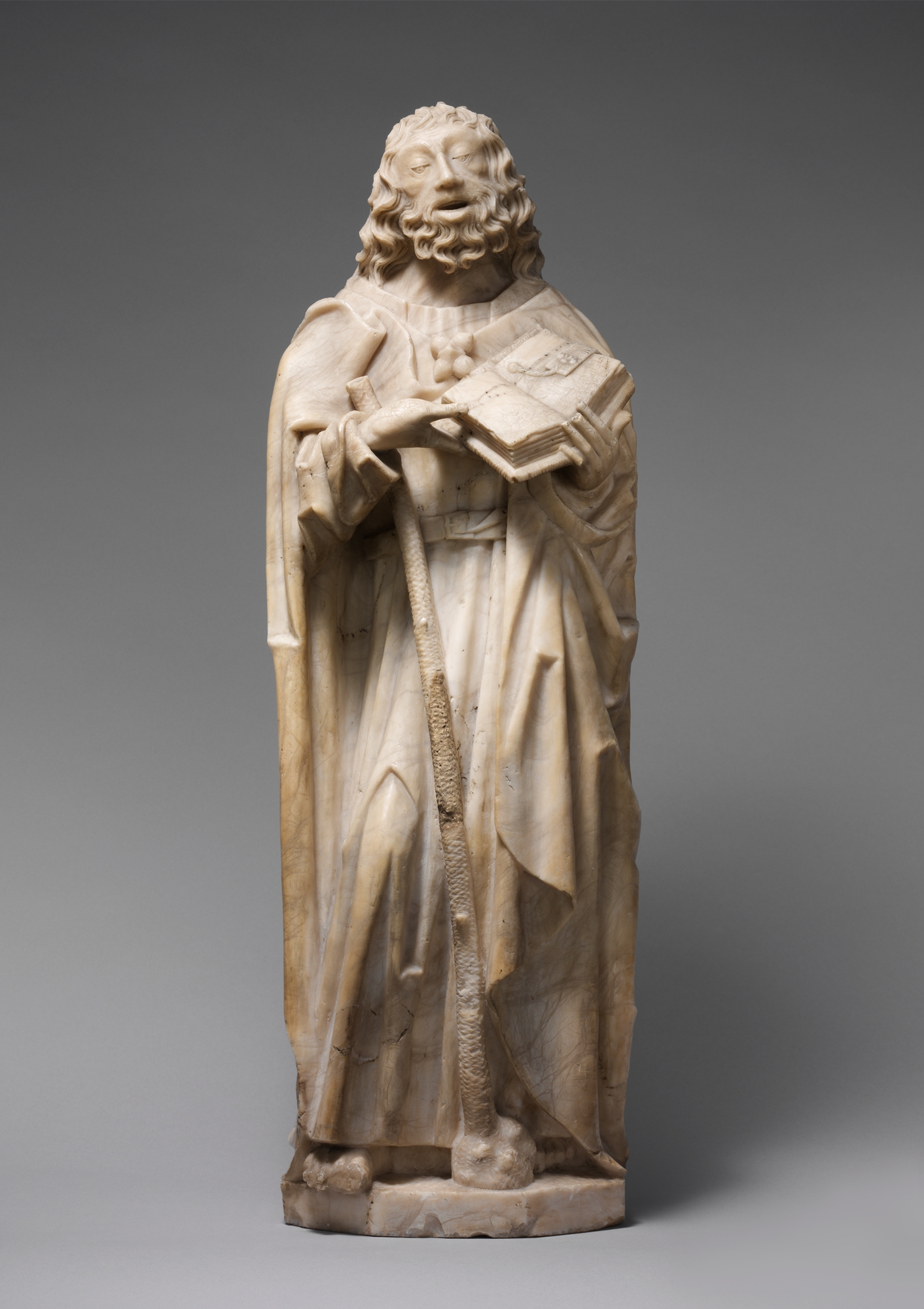
Saint James the Lesser
Doctrinal reflection
An alabaster statuette, small enough to hold in both hands, has survived five centuries. Carved in Spain around AD 1500, it depicts the apostle the Western church came to call James the Lesser — Jacobus Minor. The name reflects a long-standing Latin tradition that merged several New Testament figures named James into one. Scripture is more careful than the tradition: it names James son of Alphaeus among the Twelve, and separately names James the brother of the Lord, who led the Jerusalem church and wrote the epistle that bears his name. Whether these were the same man is a question the tradition answered but the text leaves open. The martyrdom this figure evokes — the fuller's club — belongs to James the brother of the Lord, whose death in Jerusalem around AD 62 was recorded by Hegesippus and preserved by Eusebius of Caesarea. He is not James the Greater, the pilgrim saint of Santiago de Compostela; the iconography separates them deliberately — no scallop shell, no staff. The piece entered documented history through J. Pierpont Morgan's gift of 1916. Stylistically it sits at a transitional moment — Gothic figural convention meeting early Renaissance naturalism, characteristic of workshops in Aragon and Castile. Alabaster was chosen deliberately: its translucency caught candlelight in private chapel settings. This is not Byzantine work despite its archive classification — it is Western Latin devotional sculpture. But the memory it encodes reaches back to one of the first leaders of the church, and to the price he paid. Sources: Gesta: International Center of Medieval Art; Anuario del Departamento de Historia y Teoría del Arte (UAM).