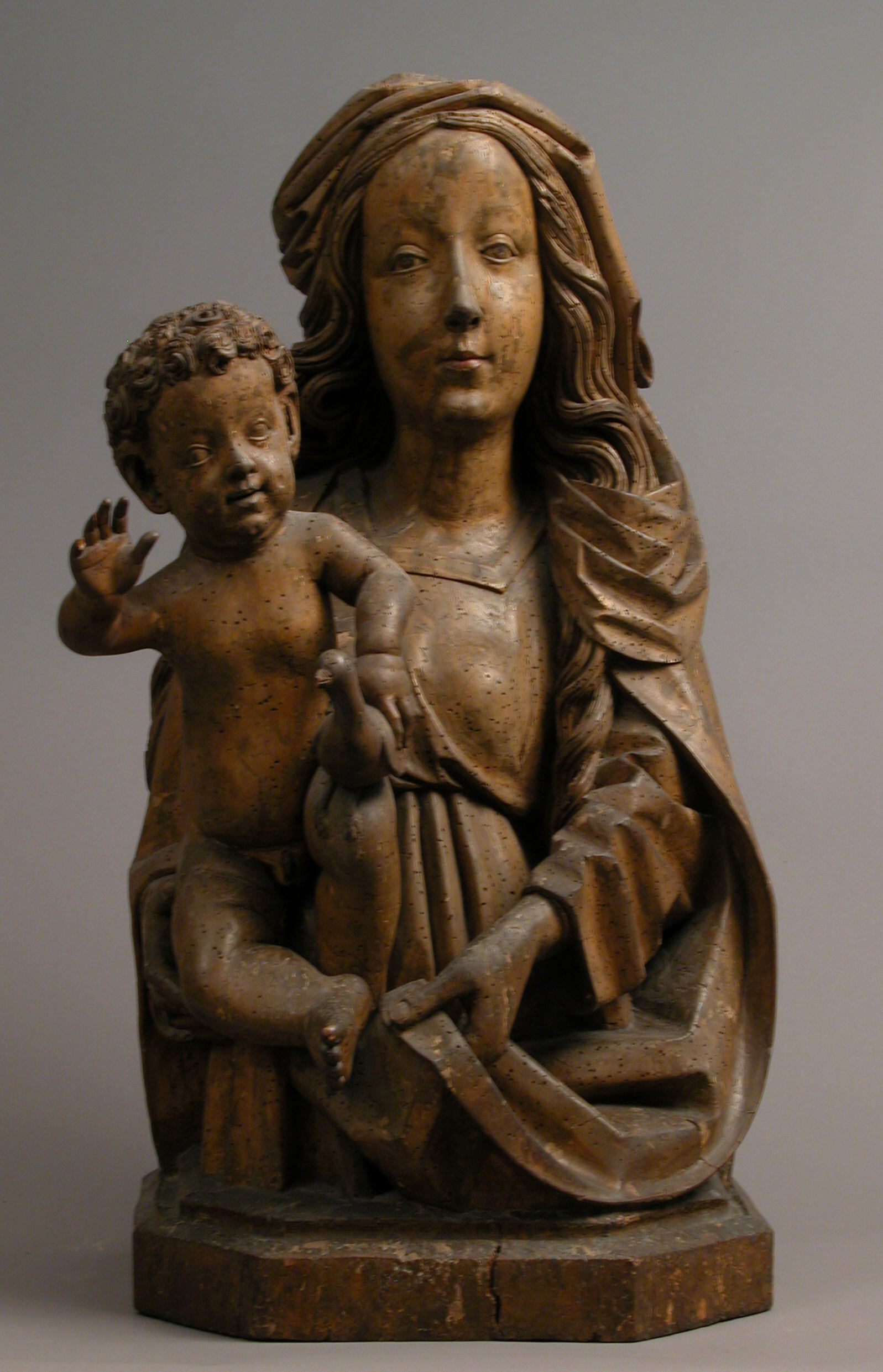
Madonna and Child
Doctrinal reflection
This entry presents a fundamental curatorial challenge: the described object — a German limewood statuette of the Madonna and Child, sixteenth century, acquired via the Frederick C. Hewitt Fund in 1911 — is a Western European carved sculpture, not a Byzantine artwork. As such, it falls outside the canonical parameters of Byzantine art history, which encompasses the Greek-speaking Eastern Roman tradition and its liturgical icon production, mosaic programs, and fresco cycles. No legitimate scholarly basis exists for classifying a German limewood statuette within the Byzantine corpus, regardless of its Marian subject matter. The object belongs properly to the tradition of German late Gothic and early Renaissance wood sculpture, a lineage associated with workshops in Swabia, Franconia, and the Rhine Valley, and with masters such as Tilman Riemenschneider and Veit Stoss. The Marian iconographic type — the Virgin enthroned or standing with the Christ Child — does share formal ancestry with Byzantine Theotokos imagery, including the Hodegetria and Eleoussa types, but the transmission and transformation through Western medieval piety, Franciscan devotional culture, and Northern European sculptural technique render this a distinctly Latin object. An archival entry for this piece would be more appropriately situated within a corpus of late medieval German devotional sculpture. Inclusion here under a Byzantine Scriptorium schema is not supportable. Scholars wishing to pursue the Byzantine antecedents of Western Marian iconography may consult relevant comparative literature. Sources: Metropolitan Museum of Art collection records; Schiller, Gertrud, Iconography of Christian Art, vol. 1 (1971); Williamson, Paul, Gothic Sculpture 1140–1300 (1995).