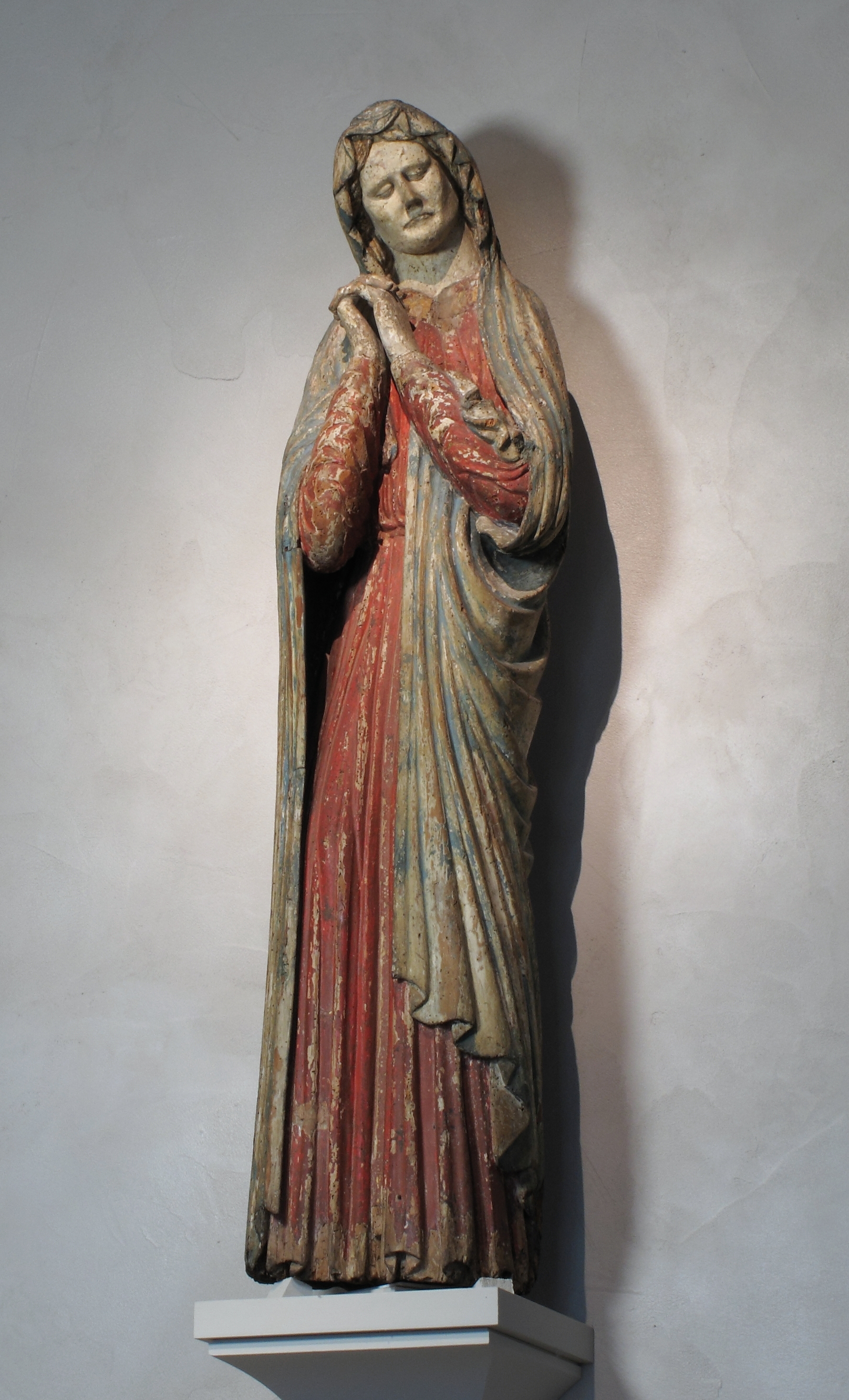
Mourning Virgin
Doctrinal reflection
This entry presents a classificatory challenge for the Scriptorium archive: the object described is an Austrian wooden polychrome sculpture of the Mourning Virgin dating to the thirteenth century AD, held in the Medieval Art collection of the Metropolitan Museum of Art (Gift of Thomas F. Ryan, 1912). As a carved and painted wood statue produced in the Latin West, it falls outside the strict parameters of Byzantine art—mosaic, fresco, icon, or manuscript production within the Eastern Roman or Post-Iconoclast Orthodox tradition. Austrian devotional sculpture of this period belongs to the Romanesque-Gothic transitional idiom of the Holy Roman Empire, not to Byzantine workshop practice or theological aesthetics. Nevertheless, the iconographic type—the grieving Virgin, likely excerpted from a Crucifixion or Deposition group (Vesperbild or Calvary ensemble)—shares conceptual ancestry with Byzantine representations of the Theotokos in Lamentation contexts, particularly the Threnos compositions documented in middle and late Byzantine fresco programs. The Marian theology expressed, emphasizing co-suffering (compassio), parallels though diverges doctrinally from Orthodox hesychast interpretations of Theotokos imagery. Scholarly treatment of such transitional figures appears in studies of Gothic devotional sculpture and Andachtsbild typology. For archival integrity, this object is flagged as a Western medieval work processed under protest of category mismatch; iconographic cross-references to Byzantine Threnos imagery are noted for comparative purposes only. Sources: Metropolitan Museum of Art Bulletin; Hamburger & Bouché, The Mind's Eye: Art and Theological Argument in the Middle Ages (2006); Schiller, Iconography of Christian Art, vol. 2 (1972).