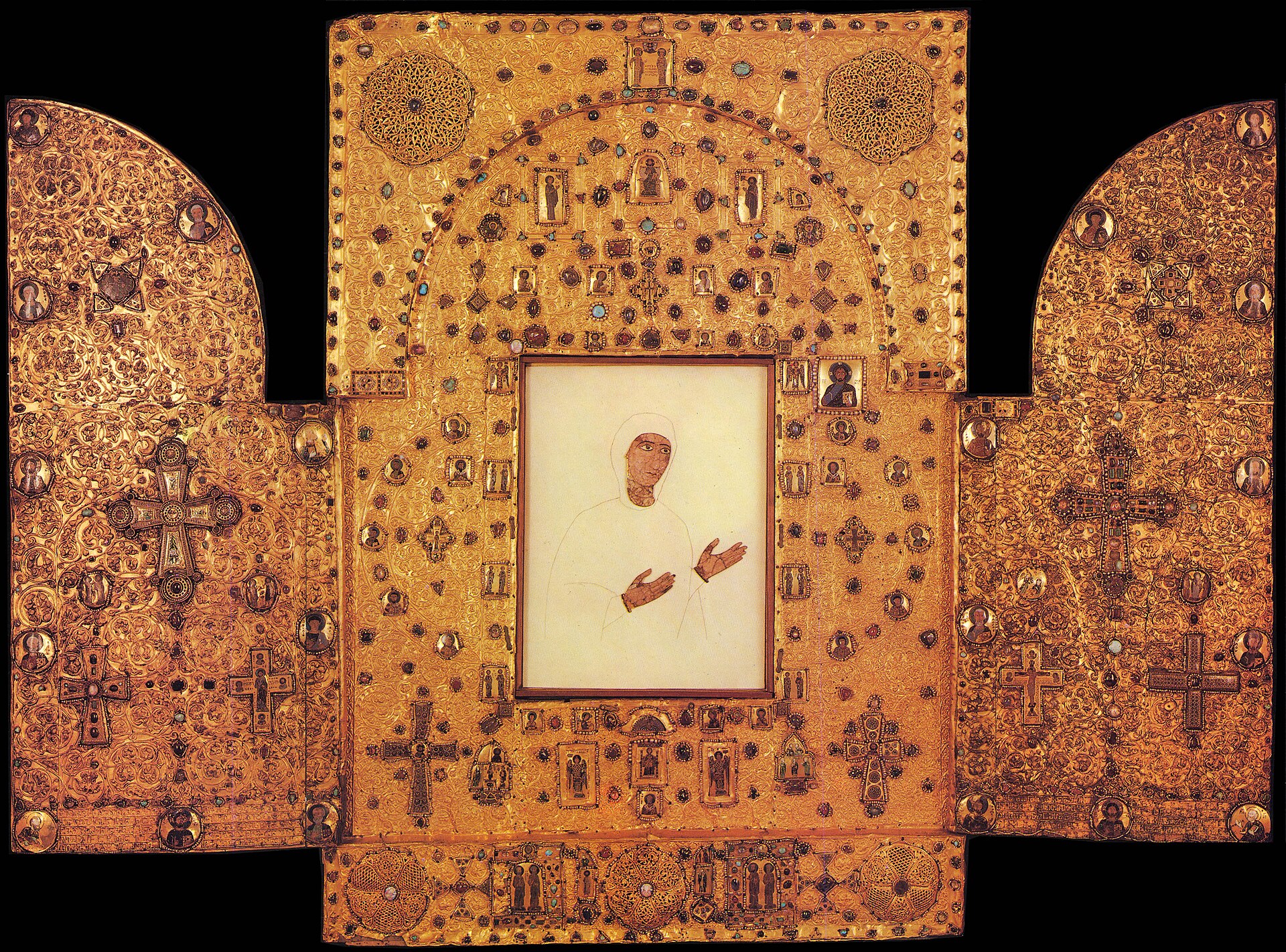
Khakhuli Triptych
Doctrinal reflection
The Khakhuli Triptych is a monumental gold-and-enamel icon of the Theotokos, currently housed in the Georgian National Museum, Tbilisi (S. Janashia Museum collection). Its construction spans several centuries, with the earliest cloisonné enamel panels dateable to the 8th–9th century AD, Byzantine workshops contributing medallions through the 10th–11th century AD, and Georgian royal patronage—most prominently under King Demetre I (r. 1125–1156 AD)—integrating additional panels and the present triptych framework in the 12th century AD. The central image deploys the Hodegetria type, presenting the Theotokos in three-quarter turn directing the viewer's gaze toward the Christ Child, who offers a blessing gesture (dexiokratousa variant in some readings). The surrounding wings accommodate approximately one hundred cloisonné enamel medallions depicting apostles, archangels, holy warriors, and Church Fathers, rendering the triptych a condensed visual theology of heavenly hierarchy. Technically, the ensemble exemplifies Byzantine cloisonné at its most sophisticated: gold cloisons confine vitreous enamel pastes fired to translucent brilliance, achieving chromatic depth unattainable in fresco or tempera. The triptych's dual Georgian-Byzantine identity makes it a primary document for understanding artistic exchange across the Caucasus corridor, particularly the transmission of Constantinopolitan court workshop practices to Bagratid and later Georgian royal patronage. Its scale—no comparable cloisonné assemblage survives—gives it exceptional art-historical weight for reconstructing lost Byzantine metalwork traditions. Sources: Zaza Skhirtladze, Revue des études géorgiennes et caucasiennes; Anthony Eastmond, Royal Imagery in Medieval Georgia (Penn State UP, 1998); Dumbarton Oaks Papers.