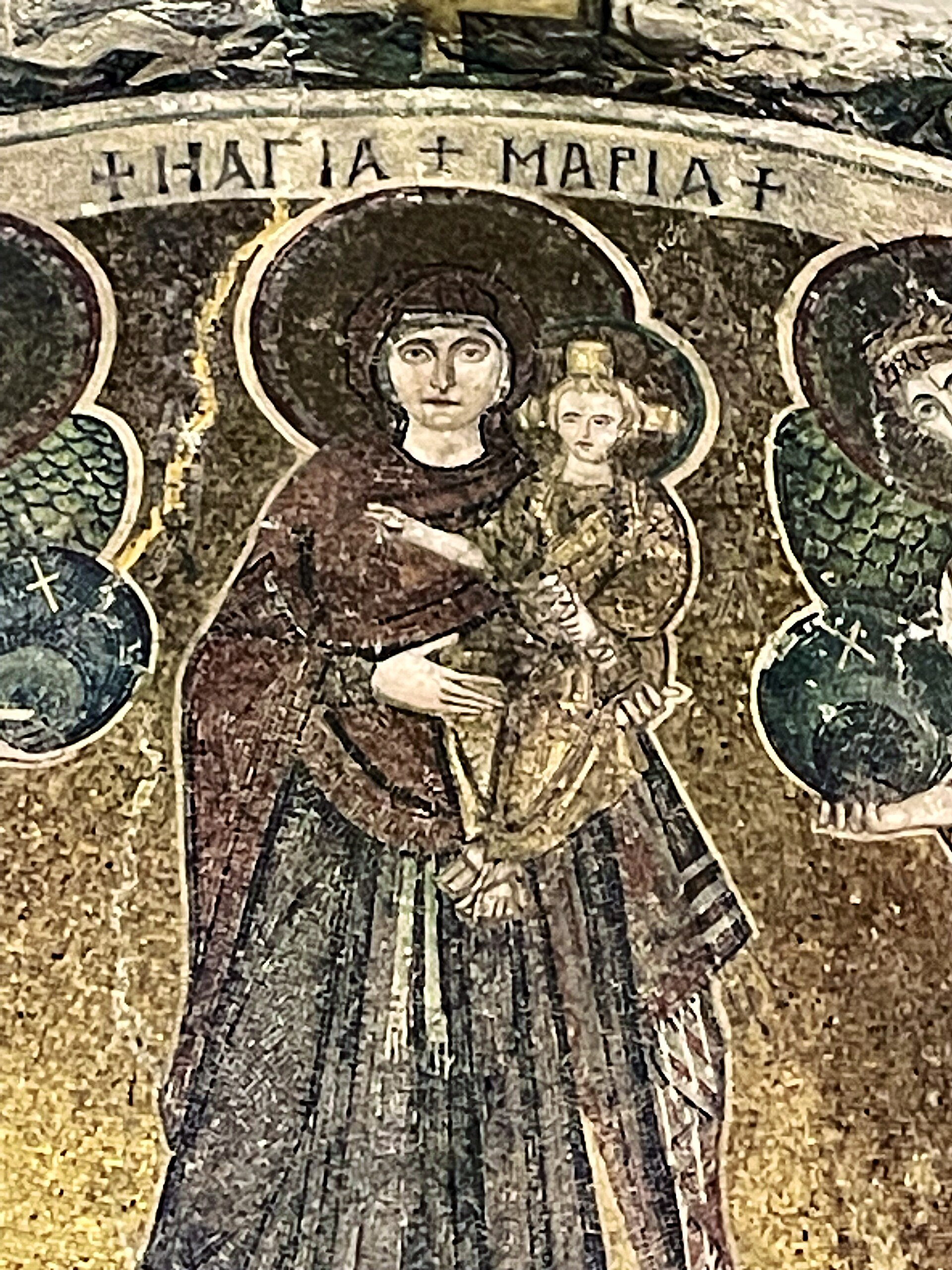
Panagia Angeloktisti Apse Mosaic, Kiti
Doctrinal reflection
The apse mosaic of the Church of Panagia Angeloktisti at Kiti, Cyprus, dates to the sixth century AD and ranks among the most significant surviving examples of pre-Iconoclastic monumental mosaic art. Executed in tessellated glass and stone cubes against a gold ground, the composition presents the Virgin Theotokos in a strict frontal Hodegetria pose, holding the Christ Child before her chest while the archangels Michael and Gabriel flank her symmetrically, each bearing imperial orbs and scepters. The Greek inscription identifying the Virgin as 'Hagia Maria' is an early and notable epigraphic witness to Marian veneration on Cyprus. The drapery treatment reflects a refined late antique classicism consistent with Justinianic workshop production, visible comparanda including the apse mosaics at Sant'Apollinare in Classe and the Sinai Transfiguration. Theologically, the program articulates the dual register of Incarnation Christology and angelological hierarchy: the archangels present the enthroned or standing Christ-bearing Virgin as the fulcrum between the celestial court and the terrestrial church, signaling both the Theotokos's intercessory role and Christ's cosmic lordship. The mosaic survived Iconoclasm likely due to Cyprus's relative administrative distance from Constantinople, making it an invaluable control specimen for reconstructing the pre-843 iconographic repertoire. Its preservation has informed scholarly debates on the origins of the apse Deesis and on early Cypriot ecclesiastical patronage. Conservation campaigns in the twentieth century have stabilized the tessellation, though losses in the lower register remain. Sources: Dumbarton Oaks Papers; Cahiers Archéologiques; Annual Report of the Department of Antiquities of Cyprus.