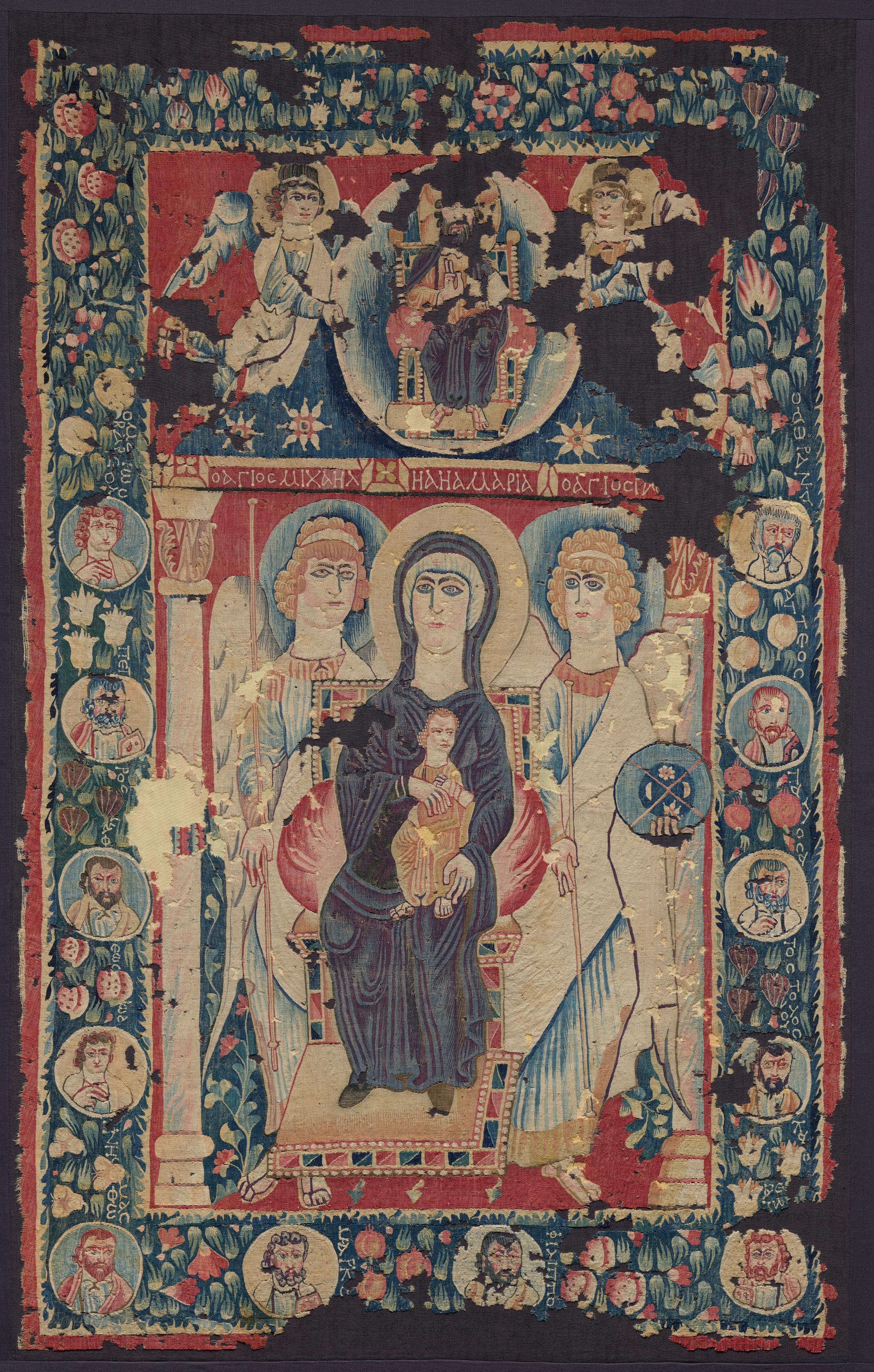
Icon of the Virgin and Child
Doctrinal reflection
This woven tapestry icon of the Virgin and Child, dateable to the sixth century AD, originates from Byzantine Egypt and is preserved in the Cleveland Museum of Art. Executed in wool with more than twenty distinct colors, it belongs to a rare category of textile icons that commanded premium market prices relative to painted panel icons, a valuation reflecting the considerable technical labor of pictorial tapestry weaving. The medium situates this object within the broader Egyptian tradition of Coptic textile production, which flourished under Byzantine administration and drew on established Hellenistic pictorial conventions adapted to Christian iconographic programs. The central composition presents the Theotokos—the Virgin as God-Bearer—enthroned with the Christ Child, a configuration anticipating the Hodegetria and Kyriotissa types that would be codified more fully in the middle Byzantine period. Surrounding figures identified by Greek inscriptions as angels and apostles create a hierarchical sacred court, underscoring both the celestial status of the Virgin and the ecclesial community of witness. The inscription practice reflects the Byzantine theological insistence that images must be legible and identifiable to function as legitimate icons. The fidelity to established visual convention noted in the museum's description corresponds directly to the doctrinal principle, later formalized at the Seventh Ecumenical Council of Nicaea II in 787 AD, that iconographic tradition guarantees theological authenticity. As a pre-Iconoclast object, this textile provides material evidence for Marian veneration and multi-figure devotional formats before the crisis that would reshape image theology in the eastern Mediterranean. Sources: Dumbarton Oaks Papers; Byzantine and Modern Greek Studies; Coptica.