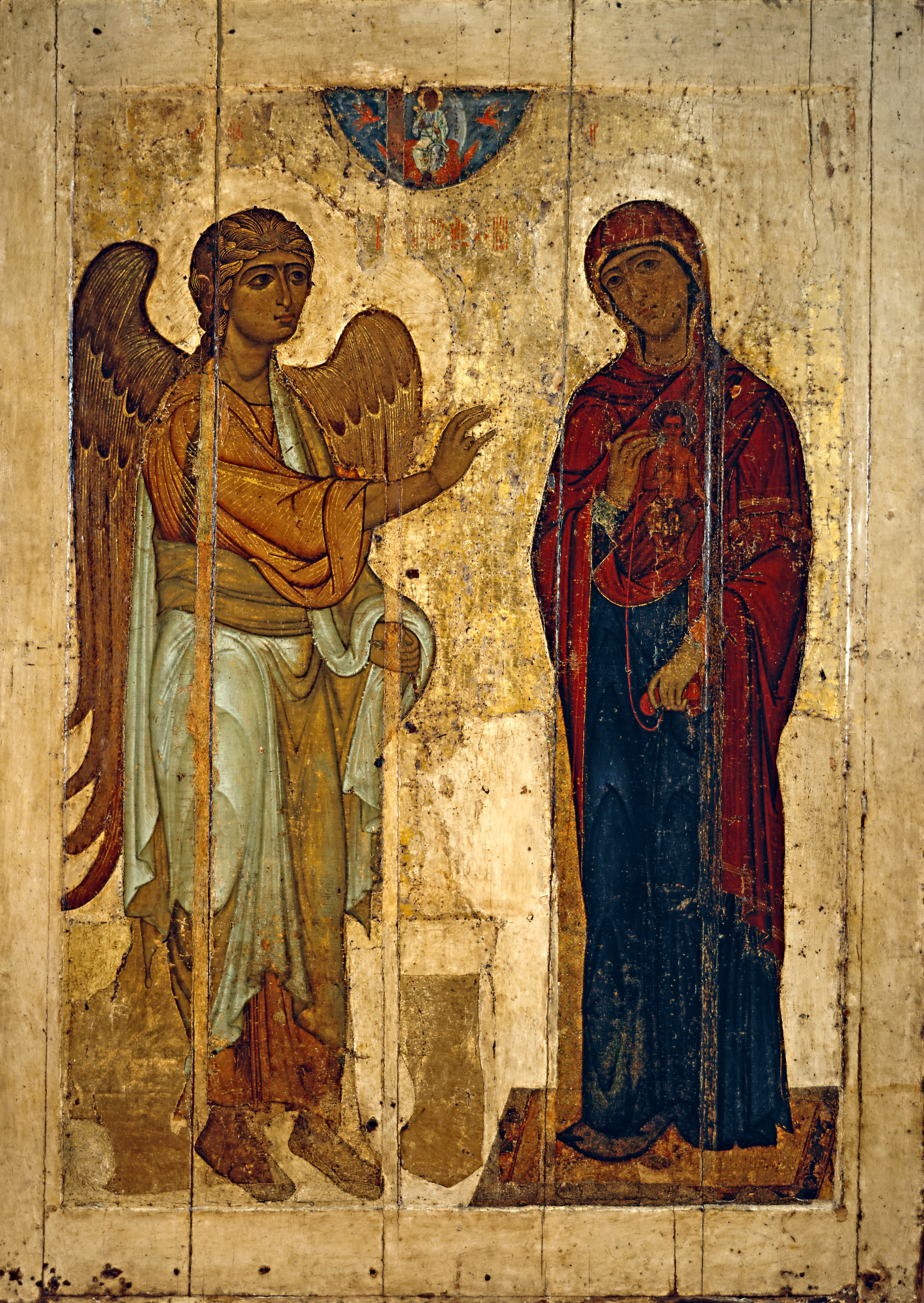
The Annunciation of Ustyug
Doctrinal reflection
The Annunciation of Ustyug (c. AD 1130–1140) is among the oldest surviving panel icons produced in Rus', and represents a pivotal monument in the transmission of Byzantine pictorial conventions to the northern workshops of Novgorod. The icon, now housed in the State Tretyakov Gallery, Moscow, takes its popular designation from the city of Veliky Ustyug, though current scholarly consensus situates its production firmly within Novgorod's artistic milieu, likely reflecting strong Constantinople-trained influence. The tempera-on-wood panel depicts the Archangel Gabriel's announcement to the Virgin Mary, adhering closely to the Byzantine iconographic formula: Gabriel strides from the left with a staff of divine authority, while the Virgin stands in a posture of receptive acceptance, a red skein of temple thread in hand—a detail drawn from the Protevangelium of James rather than the Lukan narrative alone. The most theologically distinctive feature is the representation of the Christ-child Emmanuel within a mandorla on the Virgin's chest, visualizing the moment of Incarnation rather than merely its announcement. This Incarnationist emphasis connects the image directly to Constantinopolitan theological concerns of the twelfth century, particularly debates over the precise moment of the hypostatic union. The palette—dominated by ochre, vermilion, and deep green—and the elongated figural canon both confirm Byzantine metropolitan prototypes. The icon's condition, despite subsequent overpainting revealed through twentieth-century conservation, preserves sufficient original surface to confirm its extraordinary antiquity within the East Slavic tradition. Sources: Lazarev, Viktor N., Novgorodian Icon-Painting (Moscow, 1969); Rodley, Lyn, Byzantine Art and Architecture (Cambridge, 1994); Dumbarton Oaks Papers, vol. 41 (1987).