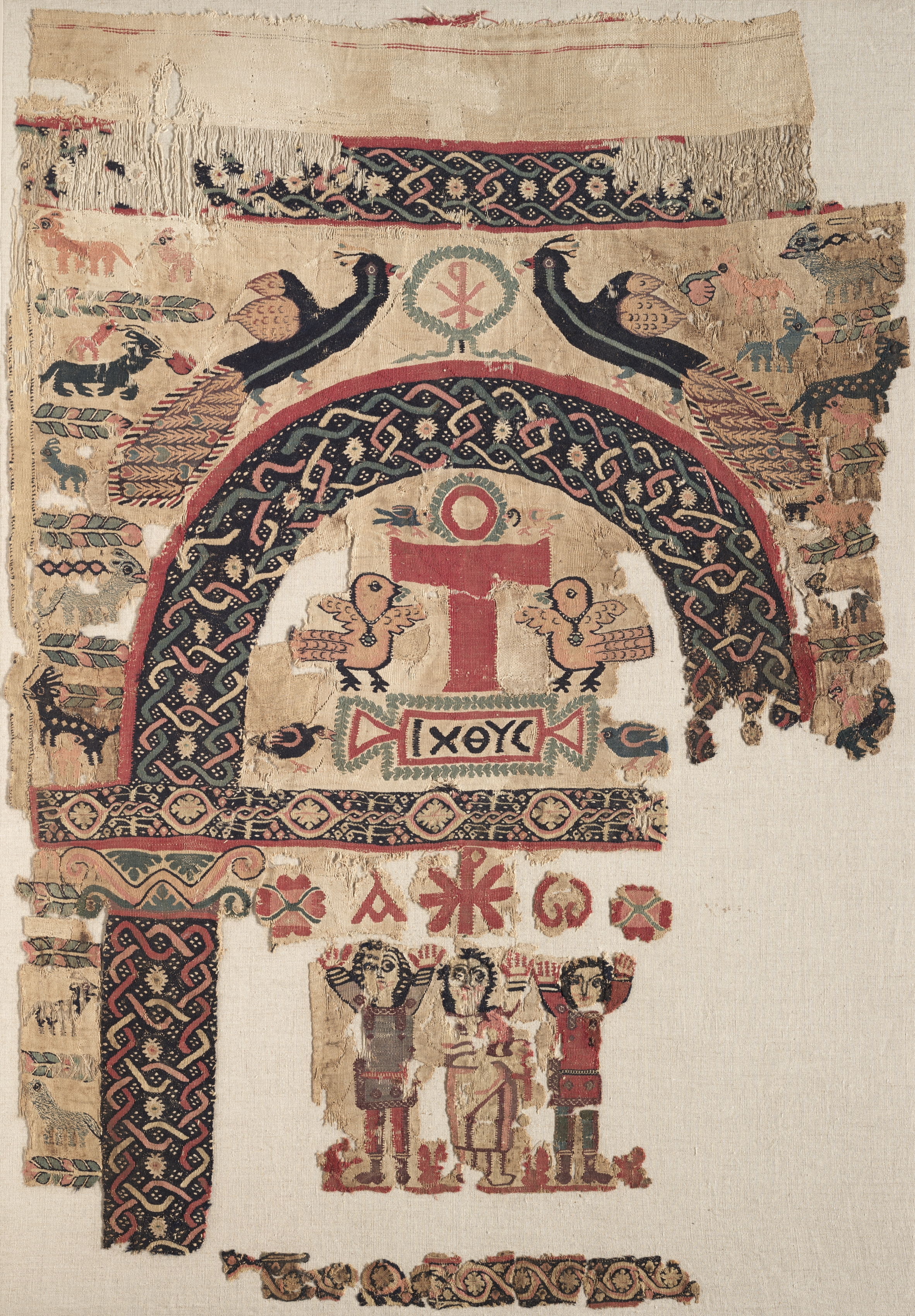
Hanging with Christian Images
Doctrinal reflection
This Coptic textile hanging, dated to the sixth century AD and preserved in the Cleveland Museum of Art, exemplifies the syncretistic visual vocabulary of Byzantine Egypt. Executed in dyed wool on undyed linen ground using inwoven tapestry weave, the object belongs to a well-documented category of Egyptian late antique textiles in which Christian iconography is woven into domestic or ecclesiastical furnishings. The compositional program centers on two Chi-Rho Christograms (☧) flanked by Alpha and Omega, asserting Christ's identity as cosmic beginning and end (Revelation 1:8). The central arch shelters three standing figures almost certainly identifiable as the Three Hebrew Youths—Shadrach, Meshach, and Abednego—whose miraculous preservation in Nebuchadnezzar's furnace (Daniel 3:19–30) constituted a standard Early Christian typological prefiguration of resurrection and divine protection. Beneath the arch, an ankh framed by two birds represents a notable instance of Egyptian hieroglyphic resemanticization: the life-symbol absorbed into Christian iconographic discourse as a crux ansata, signifying eternal life through Christ. Peacocks flanking the upper Christogram carry standard patristic connotations of incorruptibility and paradise. The object thus encodes a layered theological statement: typological salvation history, Christological title-proclamation, and eschatological promise of immortality. Scholarly significance lies in the textile's demonstration of continuity between pharaonic visual culture and Christian symbolic systems in late antique Egypt, as well as its witness to non-monumental devotional contexts outside the formal apse programs of Justinianic church decoration. Sources: Dumbarton Oaks Papers; Journal of Coptic Studies; Annual of the Department of Antiquities of Jordan.