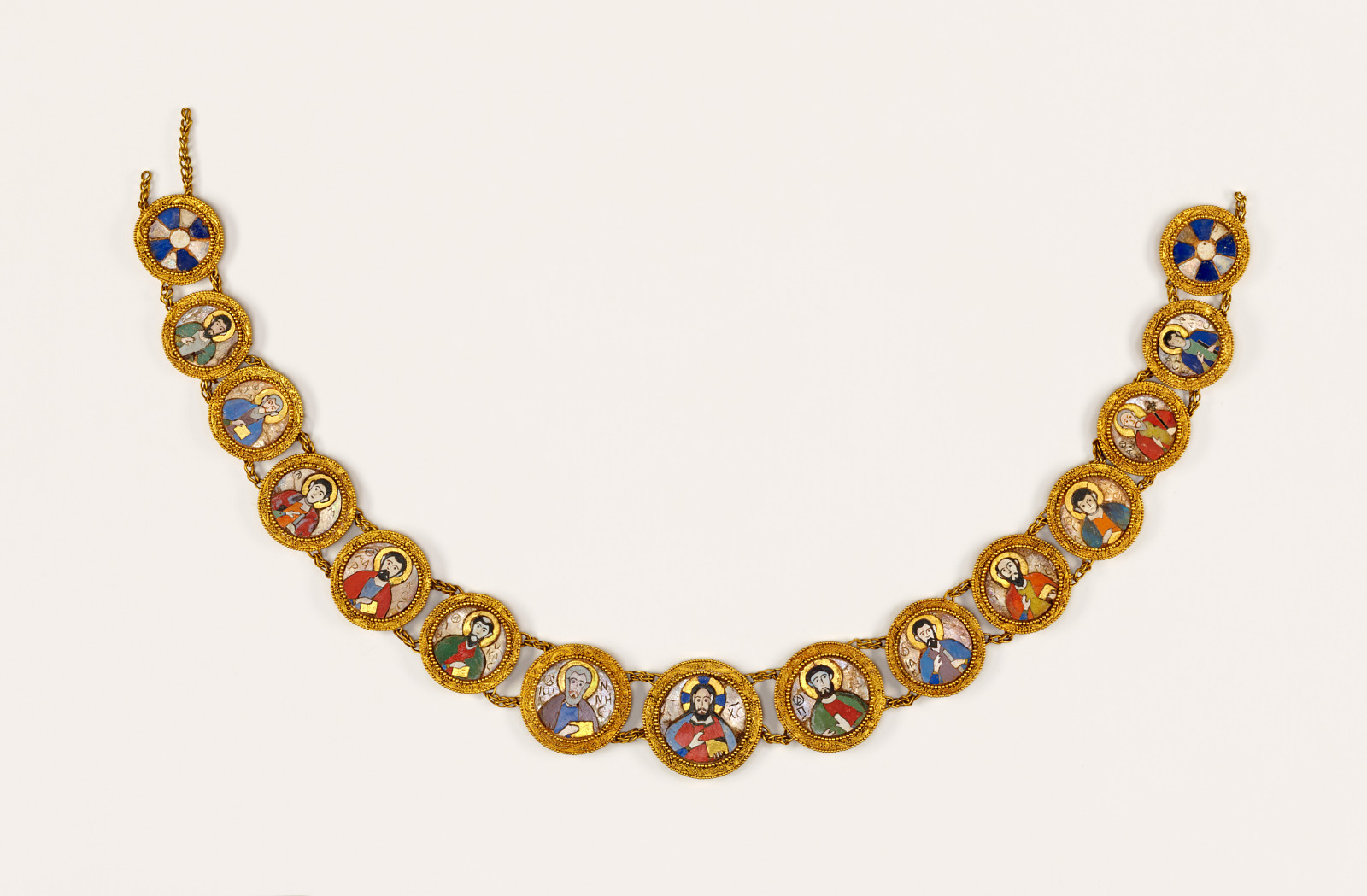
Byzantine-Style Mosaic Necklace with Christ and Twelve Apostles
Doctrinal reflection
This mosaic necklace, held in the Smithsonian American Art Museum, presents a series of small portrait medallions depicting Christ and the twelve apostles, each constructed from cut mother-of-pearl and Venetian glass tesserae. The museum's own assessment places its probable origin in late nineteenth-century Italy, identifying it as a revival piece rather than a genuine medieval artifact. Iconographically, the medallion format—frontal bust portraits of sacred figures against neutral or gilded grounds—draws directly on the micro-mosaic and cloisonné traditions visible in the Treasury of San Marco, Venice, where tenth- and eleventh-century Byzantine reliquaries, book covers, and chalices display analogous apostolic portrait cycles. The use of mother-of-pearl alongside Venetian glass may reflect deliberate antiquarian simulation, with some components possibly repurposed from fragmentary antique objects to enhance apparent age. Theologically, the program of Christ enthroned or in bust form surrounded by the Twelve encodes the Dodekaorton and apostolic college, a standard hierarchical arrangement in Byzantine sacred art affirming Christ's sovereignty and the church's apostolic foundation. Art-historically, the piece is significant not as a Byzantine primary source but as evidence of nineteenth-century European historicism, when Italian craftsmen produced Byzantine-revival luxury objects for collectors, ecclesiastical patrons, and the antiquities market. Its uncertain provenance—the museum description breaks off mid-sentence—raises questions about commercial intent and possible deceptive marketing. Scholarly assessment must therefore treat it within the framework of Victorian-era Byzantinism rather than medieval material culture. Sources: Journal of the Walters Art Museum; Gesta (International Center of Medieval Art); Studies in the Decorative Arts.