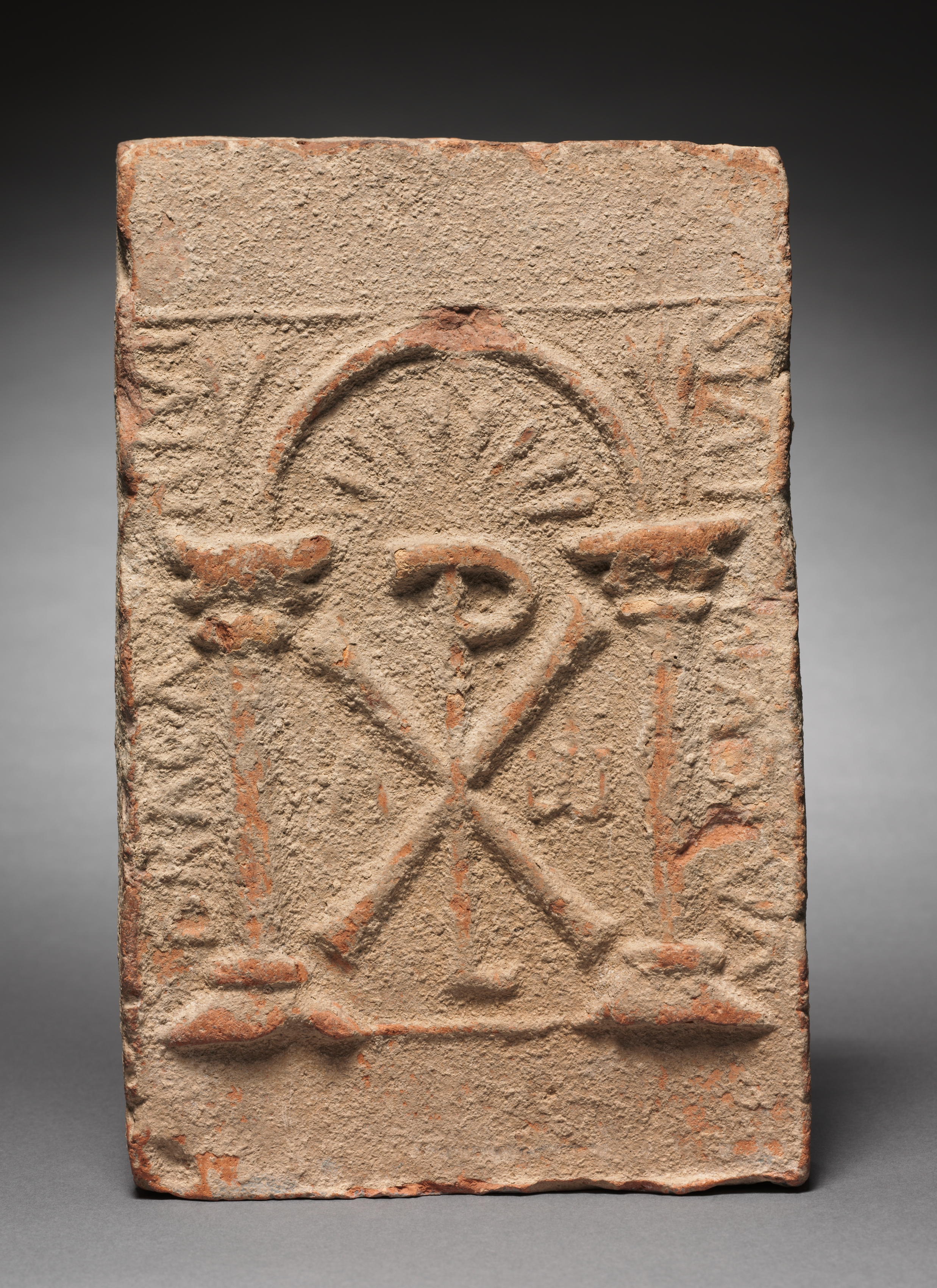
Columbarium Tomb Plaque with the Monogram of Christ
Doctrinal reflection
This terracotta burial niche plaque, dated broadly between AD 400 and 800 and attributed to either Visigothic or Byzantine Spain, exemplifies the funerary epigraphic tradition adapted for Christian communal interment structures. The columbarium context—a Roman-derived collective tomb form reappropriated by Christian communities across the Iberian Peninsula—situates this object at the intersection of late antique mortuary practice and emergent Christian iconographic convention. The central chi-rho monogram (☧), formed by the superimposition of the Greek letters chi (Χ) and rho (Ρ), the first two letters of ΧΡΙΣΤΟΣ, constitutes one of the earliest and most durable Christological symbols in the Mediterranean world, gaining imperial sanction following Constantine's campaigns in the early fourth century AD. Its flanking alpha (Α) and omega (Ω) characters invoke the Johannine and Apocalyptic identification of Christ as the absolute boundaries of existence, amplifying the soteriological program appropriate to a burial context. The plaque's thick, utilitarian clay construction reflects vernacular workshop production rather than court or ecclesiastical patronage, yet the theological literacy encoded in its imagery suggests a literate Christian community or clerical oversight. The attribution to Visigothic or Byzantine Spain acknowledges the complex cultural overlap in the peninsula during this period, wherein Roman administrative, Germanic political, and Eastern Mediterranean ecclesiastical influences converged. Scholarly interest lies in the object's contribution to mapping the geographic diffusion of Christological monogram use in funerary contexts beyond the Italian and Eastern Mediterranean cores. Sources: Gesta: Medieval and Early Modern Art (College Art Association); Hortus Artium Medievalium; Archivo Español de Arqueología.