Eustace
Eustathius / Placidas
Life and Ministry
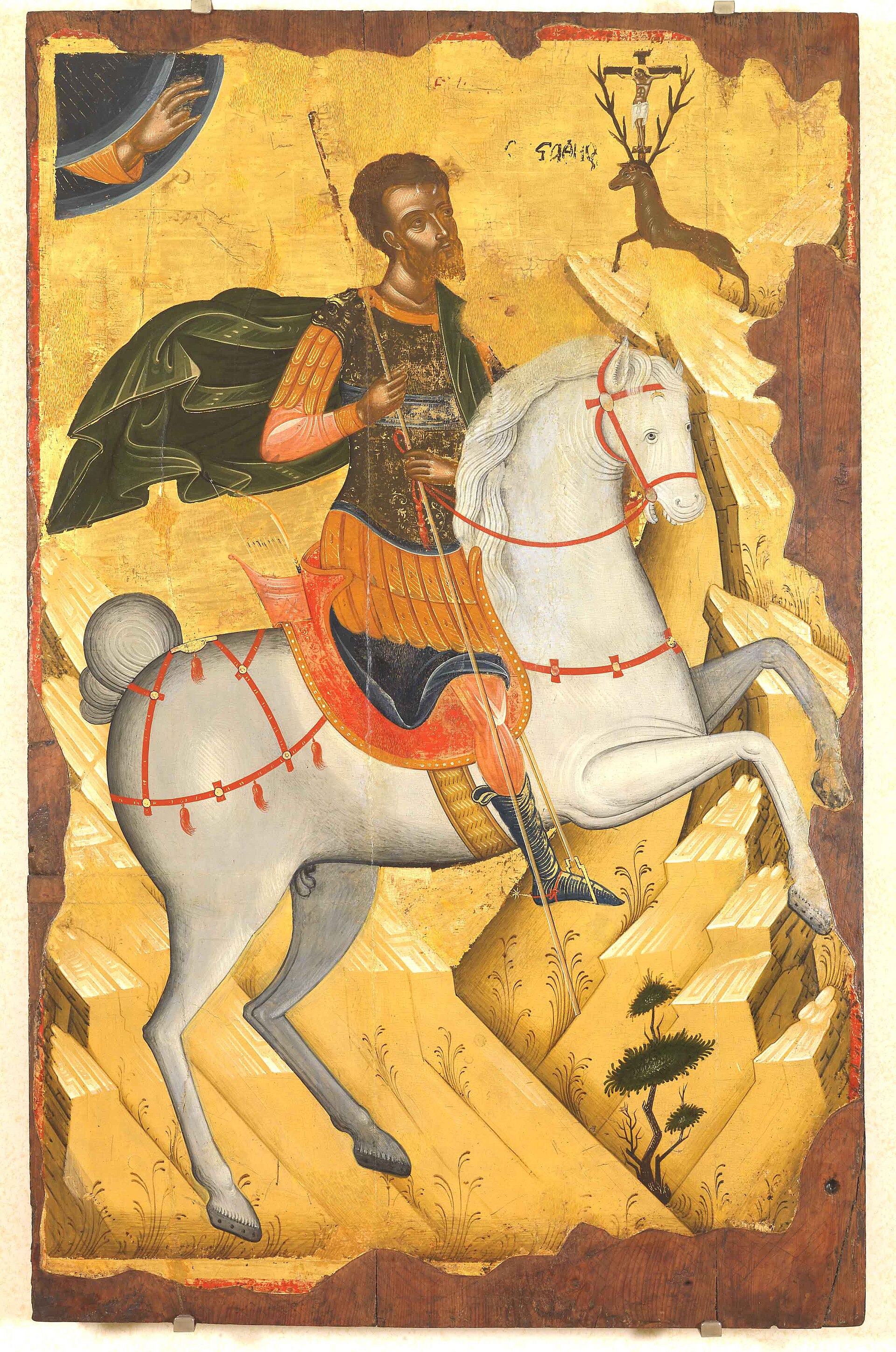
Eustace, born Placidas, is identified in hagiographical tradition as a Roman military commander who served under Emperor Trajan. According to the received account, Placidas was a pagan general renowned for his virtue and charitable disposition prior to his conversion. The pivotal episode in his legendary biography holds that while hunting, he pursued a stag and encountered a vision of a luminous crucifix suspended between the animal's antlers, accompanied by a voice identifying itself as Christ. Placidas subsequently received baptism along with his wife Theopista and their two sons, taking the Christian name Eustace. The narrative that follows closely parallels the biblical figure of Job: Eustace is said to have suffered the loss of his wealth, the apparent death of his wife, and separation from his children before a military recall under Trajan led to a partial restoration of his family. Upon the accession of Emperor Hadrian, Eustace and his family allegedly refused imperial commands to offer sacrifice to the Roman gods. The historicity of these events is regarded with considerable skepticism by modern hagiographers, and no contemporaneous documentary or epigraphic evidence corroborates the narrative. The story belongs to a recognizable genre of conversion legend circulating in late antique and early medieval Christian literature. The earliest textual witnesses are Greek, with Latin versions proliferating from the early medieval period onward. Eustace was incorporated into the grouping known as the Fourteen Holy Helpers, a set of saints whose intercession was particularly invoked during the medieval period, especially in the context of the Black Death. Sources: Bibliotheca Hagiographica Graeca (BHG 641); David Farmer, Oxford Dictionary of Saints (5th ed., 2003); Hippolyte Delehaye, Les légendes hagiographiques (1906).
Circumstances of Death
According to the traditional account, Emperor Hadrian ordered the execution of Eustace and his reunited family after they collectively refused to participate in a public sacrifice to the Roman gods following a military triumph. The mode of execution described in the hagiographical sources is death by suffocation and burning inside a hollow brazen bull heated from beneath. The precise date given is approximately AD 118. No independent historical documentation corroborates this specific account, and the brazen bull motif appears in other martyrological narratives of the period.
Legacy
Eustace is venerated as a martyr in both the Roman Catholic and Eastern Orthodox traditions. His feast day is observed on September 20 in the Roman Rite and on November 2 in the Byzantine calendar. He was formally included among the Fourteen Holy Helpers, a grouping accorded particular liturgical prominence in medieval central Europe. His patronage of hunters derives directly from the stag-vision narrative. Numerous churches, including Sant'Eustachio in Rome, are dedicated to him. The Bollandist critical tradition has consistently flagged the legendary character of his Acts.
Sources
["Bibliotheca Hagiographica Graeca (BHG 641), Soci\u00e9t\u00e9 des Bollandistes", "David Farmer, The Oxford Dictionary of Saints, 5th ed. (Oxford University Press, 2003)", "Hippolyte Delehaye, Les l\u00e9gendes hagiographiques (Soci\u00e9t\u00e9 des Bollandistes, 1906)"]