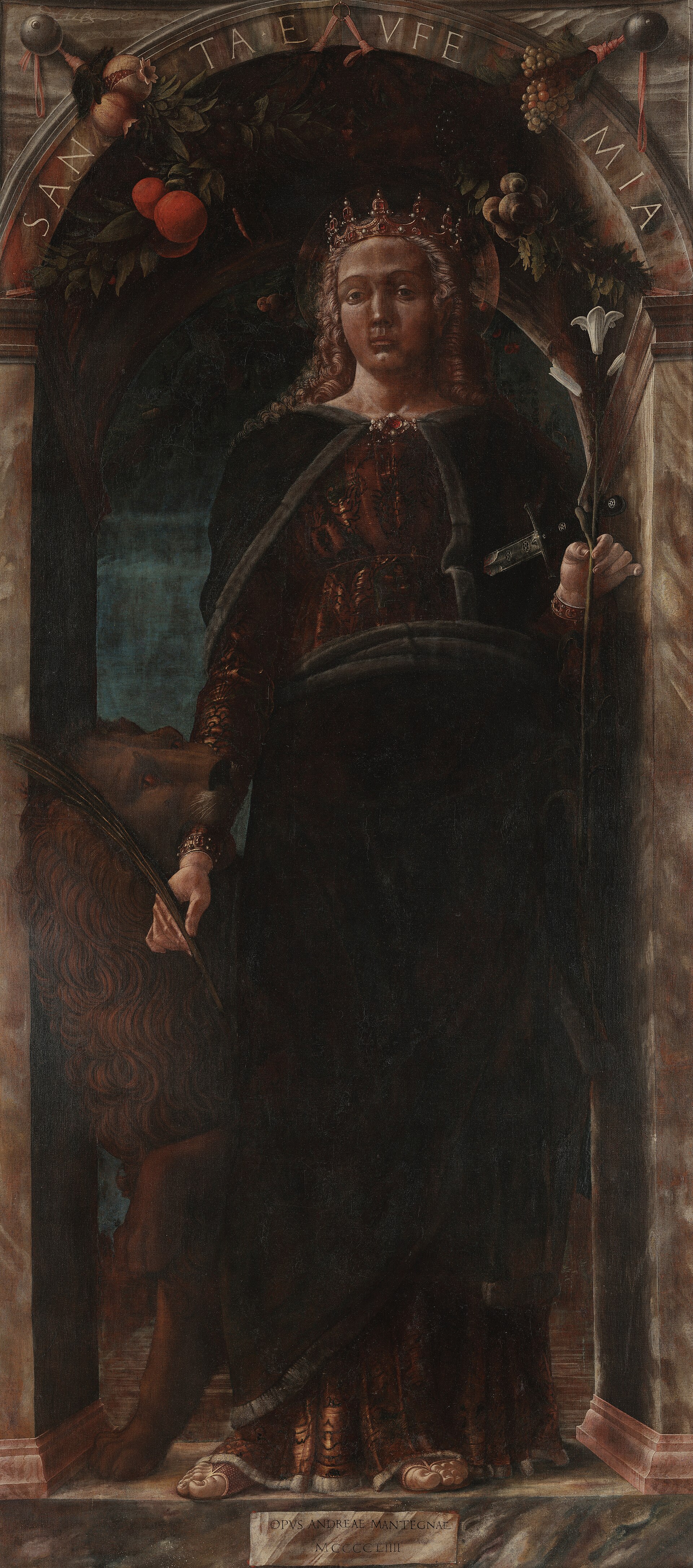
Euphemia of Chalcedon
Life and Ministry
Euphemia of Chalcedon was a Christian virgin martyr who suffered death during the Diocletianic persecution, traditionally dated to AD 303, in the city of Chalcedon in Bithynia, on the Asian shore of the Bosphorus opposite Byzantium. The historical record concerning her personal biography is sparse, and the surviving accounts are substantially hagiographical in character, having been elaborated over several centuries. According to the tradition preserved in Greek martyrological sources, she was brought before the magistrate Priscus during the general imperial persecution and refused to offer sacrifice to the gods, enduring successive torments before dying. The specific mechanics of her death vary across sources, though exposure to wild beasts in an arena context is the most consistently reported element. What is historically more certain is the early and widespread veneration attached to her memory at Chalcedon. A substantial martyrium and subsequently a basilica were constructed over her reputed tomb, and this shrine became one of the most prominent pilgrimage sites in the eastern Mediterranean by the late fourth and early fifth centuries. Emperors, including Marcian and Pulcheria, demonstrated active patronage of her cult. The theological and ecclesiastical significance of her shrine reached its apex in AD 451, when the Fourth Ecumenical Council, the Council of Chalcedon, convened within the basilica dedicated to her. Contemporary conciliar documents explicitly reference the setting, lending the location an unusual degree of independent historical attestation. Her cult thus occupies a rare intersection of hagiographical tradition and verifiable ecclesiastical history. Sources: Acta Sanctorum (September, Vol. V); F. Halkin, Bibliotheca Hagiographica Graeca; R. Price and M. Gaddis, The Acts of the Council of Chalcedon (Liverpool University Press, 2005).
Circumstances of Death
Euphemia is reported to have been martyred at Chalcedon during the Diocletianic persecution, conventionally dated to AD 303. Hagiographical accounts describe her subjection to multiple torments, including fire, iron implements, and exposure to wild animals in an arena, with the last element most consistently preserved across Greek and Latin sources. She is said to have died from wounds inflicted by a bear or other beast. Independent contemporary documentation of the precise circumstances does not survive; the accounts date from considerably later hagiographical composition.
Legacy
Euphemia was venerated as a saint from an early period in both the Eastern and Western churches, with feast days established on 16 September in the Roman Martyrology and in the Byzantine calendar. Her basilica at Chalcedon served as the venue for the Council of Chalcedon in AD 451, a circumstance that permanently elevated her standing in ecumenical memory. Her cult influenced church dedications across the Byzantine world and in Rome. She is recognized as a saint in the Roman Catholic, Eastern Orthodox, and Oriental Orthodox traditions, with her cult remaining liturgically active.
Sources
["R. Price and M. Gaddis, The Acts of the Council of Chalcedon, 3 vols. (Liverpool University Press, 2005)", "F. Halkin, Bibliotheca Hagiographica Graeca, 3rd ed. (Soci\u00e9t\u00e9 des Bollandistes, 1957)", "Acta Sanctorum, September, Vol. V (Soci\u00e9t\u00e9 des Bollandistes)"]