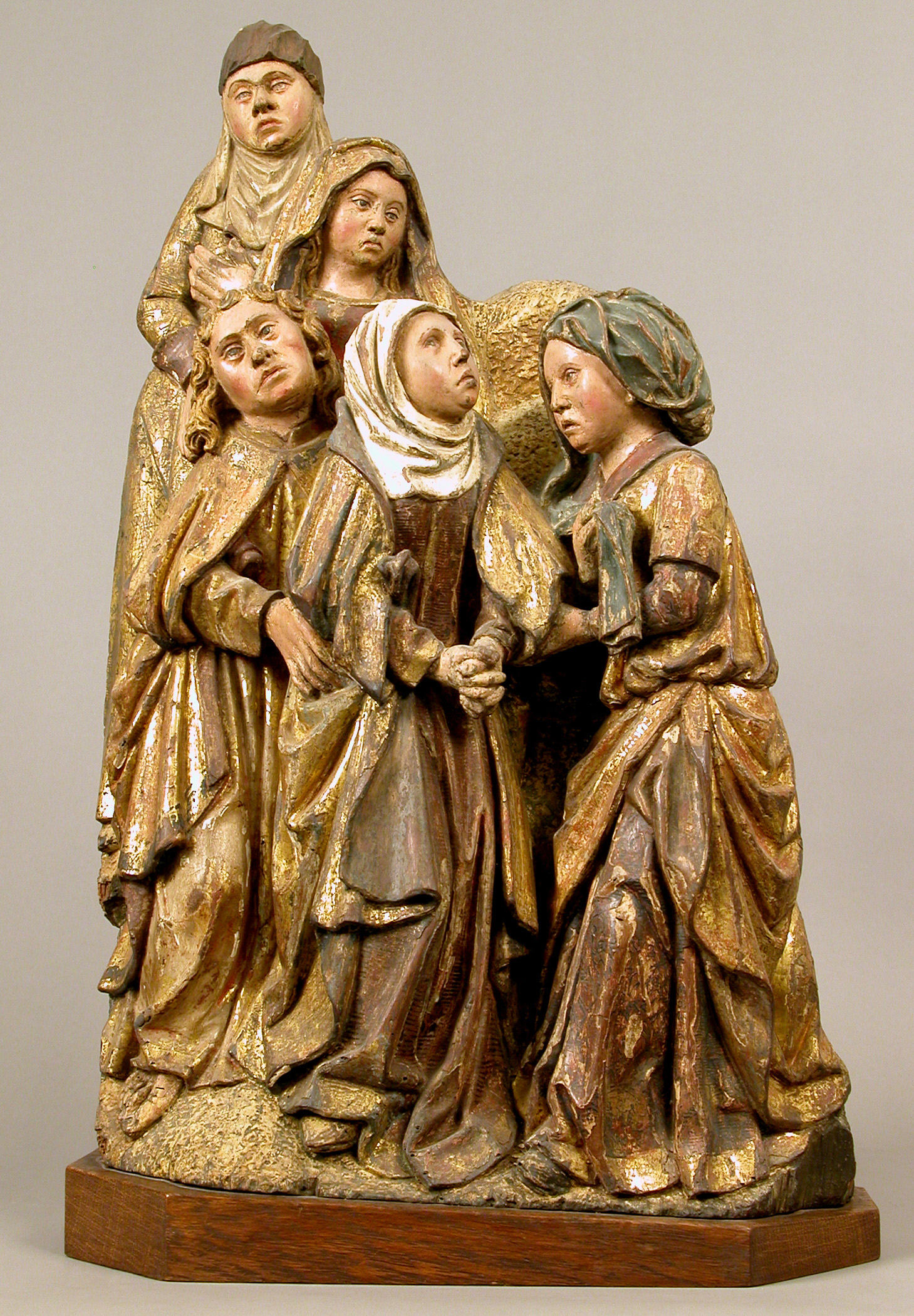
Virgin, Saint John, and Three Holy Women from a Crucifixion
Doctrinal reflection
This entry presents a challenge for the Scriptorium Byzantine archive: the object in question is a South Netherlandish oak relief with polychromy and gilding, dated to the late fifteenth century AD, and now held in the Medieval Art collection at the Metropolitan Museum of Art (Gift of J. Pierpont Morgan, 1916). While it depicts figures standard to Byzantine Crucifixion iconography — the Virgin Mary, Saint John the Evangelist, and three holy women (the Myrrhbearers) — the work is unambiguously a product of Northern European Gothic workshop tradition, not Byzantine manufacture. The carved oak medium, the polychrome and gilded surface treatment, and the South Netherlandish attribution place it firmly within the Franco-Flemish sculptural corpus. Byzantine Crucifixion imagery would employ mosaic, fresco, or egg-tempera panel technique, and the figural style — likely exhibiting the angular drapery folds and expressive pathos characteristic of late Gothic Netherlandish carving — diverges substantially from Byzantine formal conventions. The iconographic grouping of the Theotokos, the Beloved Disciple, and the Myrrhbearers does echo shared Christian typological tradition rooted in Gospel narrative. Scholarly treatment of this object belongs to Northern European medieval sculpture studies rather than Byzantine art history. Its inclusion here is noted as a classification anomaly. Sources: The Burlington Magazine (for Northern European medieval sculpture); Speculum: A Journal of Medieval Studies; Metropolitan Museum of Art Bulletin.