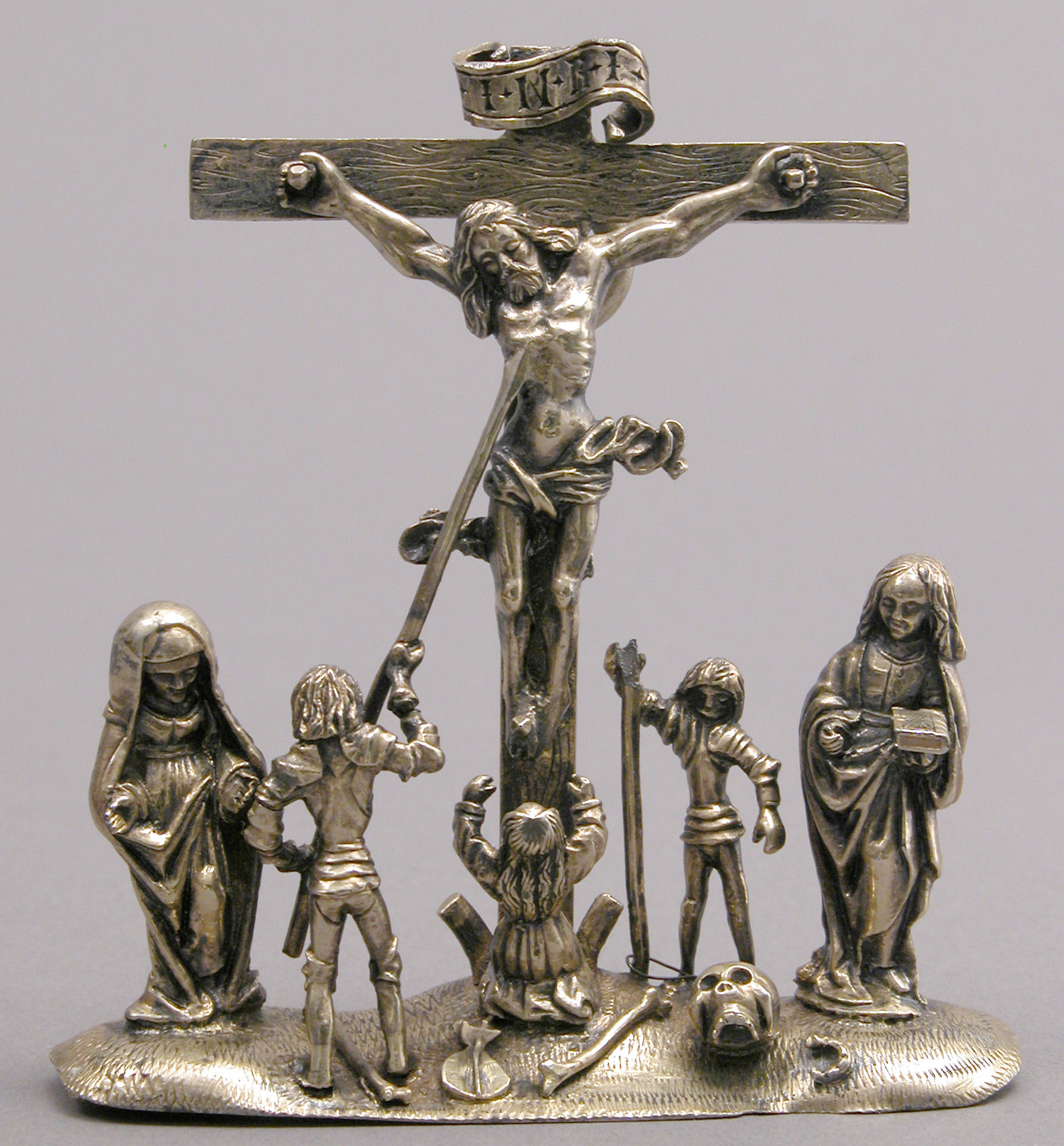
Pendant with the Crucifixion and Attendant Figures
Doctrinal reflection
This entry presents a Pendant with the Crucifixion and Attendant Figures, catalogued as German gilded silver work dating to approximately AD 1520. The object falls outside the chronological and geographic boundaries of Byzantine art proper, representing instead a product of late German Gothic or early Renaissance metalwork traditions. Housed in the Medieval Art collection of the Metropolitan Museum of Art (Gift of W. R. Valentiner, 1911), it is a devotional luxury object rather than a Byzantine icon, mosaic, or fresco. The Crucifixion iconography—Christ on the cross flanked by attendant figures, likely the Virgin Mary and the Evangelist John, following the Deesis-adjacent Western compositional schema—does share iconographic ancestry with Byzantine Passion imagery, particularly the Stavrotheotokos type and related Eastern typologies that transmitted westward through pilgrimage objects and diplomatic exchange. However, the gilded silver repoussé or cast technique, the approximate dating of AD 1520, and the German provenance firmly situate this object within the Western medieval devotional arts tradition, beyond the Palaiologan period's terminus of AD 1453. Scholarly assessment must note that while Byzantine influence on Western portable devotional metalwork is well documented across the medieval period, this particular pendant reflects Germanized Crucifixion conventions. Its archival placement within this Byzantine Scriptorium represents a classification anomaly warranting curatorial review. Sources: Spatharakis, I., The Portrait in Byzantine Illuminated Manuscripts (Leiden, 1976); Buckton, D., ed., Byzantium: Treasures of Byzantine Art (London, 1994); Wentzel, H., 'Mittelalterliche Gemmen,' Zeitschrift des Deutschen Vereins für Kunstwissenschaft (1952).