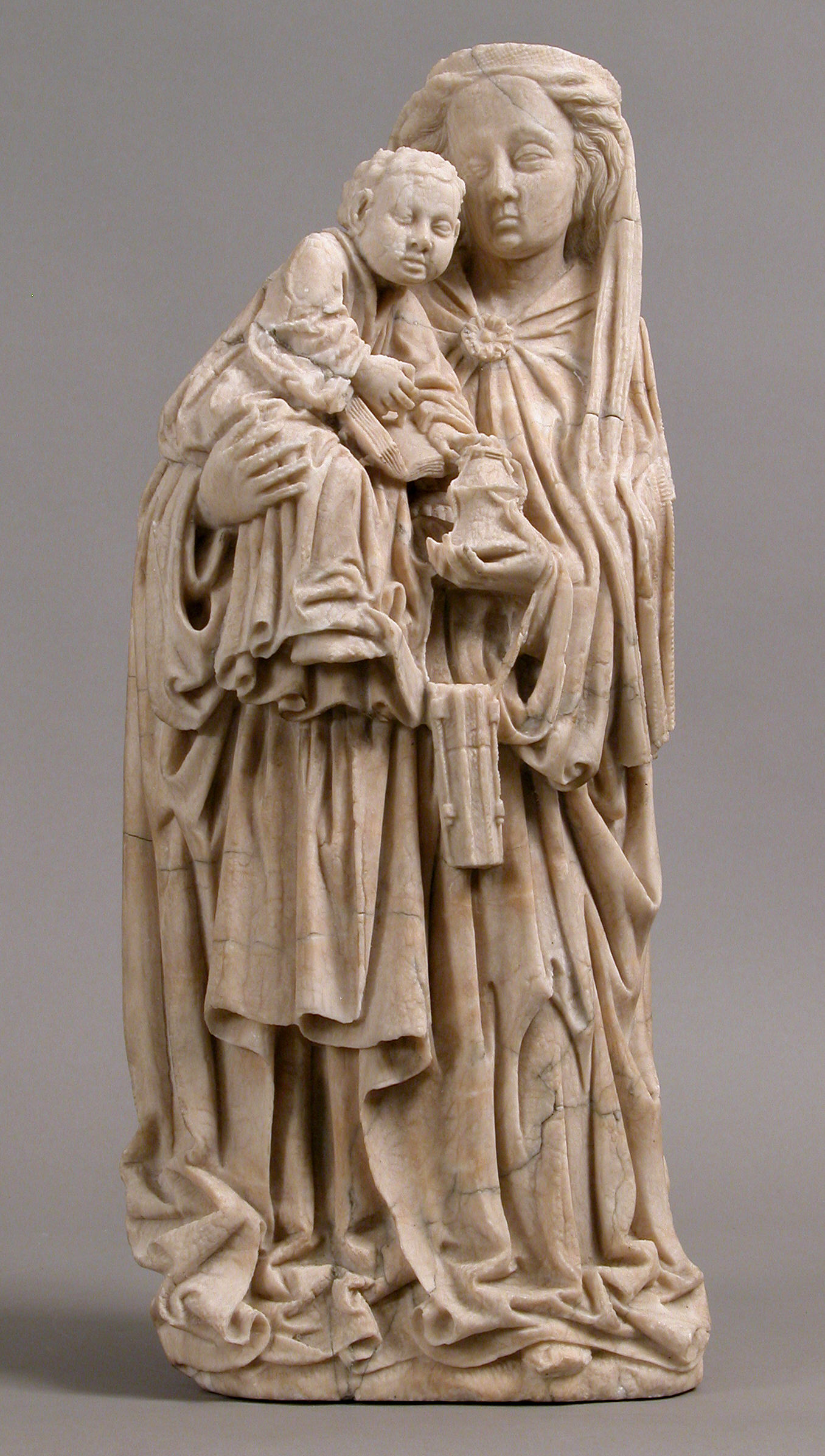
Virgin and Child
Doctrinal reflection
This French alabaster statuette of the Virgin and Child dates to the second half of the fifteenth century AD and is held in the Medieval Art collection of the Metropolitan Museum of Art (Gift of J. Pierpont Morgan, 1916). It belongs to a prolific category of French and English alabaster production — centered in Paris and Nottingham — that supplied portable devotional objects for private and ecclesiastical use across the Latin West, and its iconography intersects with the Byzantine Hodegetria and Eleusa types that shaped Marian imagery across medieval Europe. The mother holds the Christ Child on her arm; crown and scepter present her as Queen of Heaven. Two titles meet in such works, and they deserve to be kept distinct. Theotokos — 'God-bearer' — was affirmed at the Council of Ephesus in AD 431 as a statement about Christ: the child Mary bore is God the Son, one person, truly God and truly man, a confession standing on solid biblical ground (Luke 1:43; Matthew 1:23). 'Queen of Heaven,' by contrast, is a later Western devotional title with no biblical foundation — Scripture never crowns Mary, and the only 'queen of heaven' the text itself mentions is a pagan goddess whose cult Jeremiah condemned (Jeremiah 7:18; 44:17-25). The statuette teaches the fifteenth-century Catholic devotion of its makers; the text does not. Stylistically the work reflects late Gothic elegance — elongated proportions, soft drapery exploiting alabaster's translucency, the lyrical tilt of the Virgin's head — and scholarship on the corpus has concentrated on workshop identification, trade networks, and devotional function. Sources: Williamson, P., Gothic Sculpture 1140–1300 (Yale University Press, 1995); Cheetham, F., English Medieval Alabasters (Phaidon, 1984); Gesta, International Center of Medieval Art.