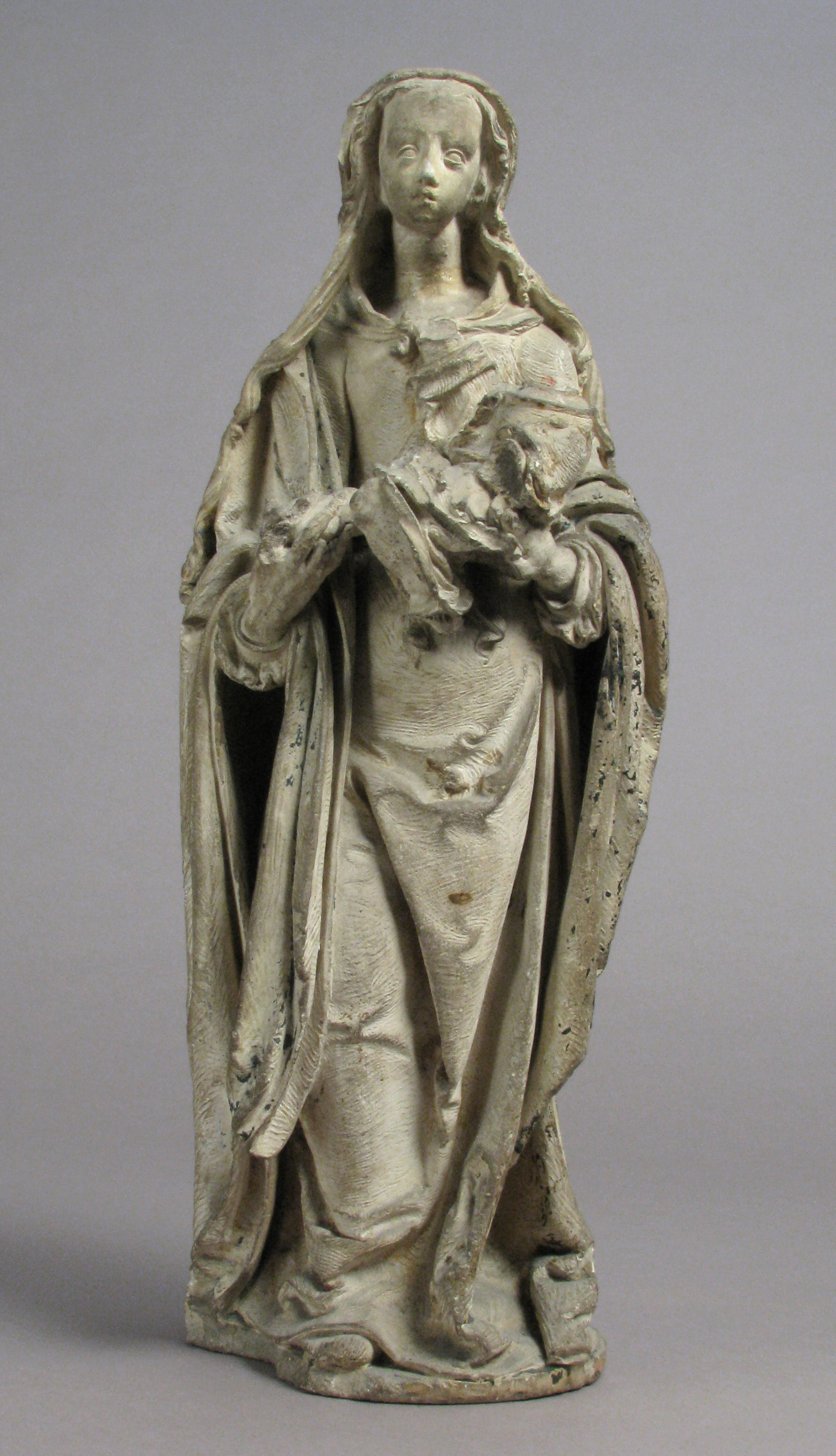
Virgin and Child
Doctrinal reflection
This French limestone statuette of the Virgin and Child, dated approximately AD 1550–1560, is held in the Medieval Art collection of the Metropolitan Museum of Art (Gift of J. Pierpont Morgan, 1916). It must be identified at the outset as Western European devotional sculpture of the early modern period — a full century after the fall of Constantinople in AD 1453 — though its iconographic type, the Virgin presenting the Christ Child, descends from the Byzantine Hodegetria and Eleusa formulae through Gothic intermediaries. Stylistically the work reflects the Mannerist influence of the Fontainebleau school alongside lingering Gothic elongation, with traces of polychromy consistent with French workshop practice. The date makes the theology pointed. This statuette was carved while the Reformation debate over exactly its subject was tearing Europe apart: Rome's developed tradition presented Mary as heavenly intercessor, and Counter-Reformation devotion doubled down on Marian imagery as a mark of Catholic identity, while the Reformers pressed the scriptural claim that 'there is one mediator between God and men, the man Christ Jesus' (1 Timothy 2:5). The confession the type began with remains sound: Theotokos, affirmed at Ephesus in AD 431, says the child is God (Luke 1:43; Matthew 1:23). The intercessory office later devotion assigned the mother is tradition's addition, not the text's teaching — Scripture shows Mary directing attention to her son: 'whatsoever he saith unto you, do it' (John 2:5). Scholarly significance lies in the object's documentation of Marian imagery's persistence in sixteenth-century France, and the Morgan provenance ties it to a major collecting history. Sources: Gaborit-Chopin, Danielle, Sculpture française, Paris; Metropolitan Museum of Art Bulletin; Williamson, Paul, Gothic Sculpture 1140–1300, Yale UP.