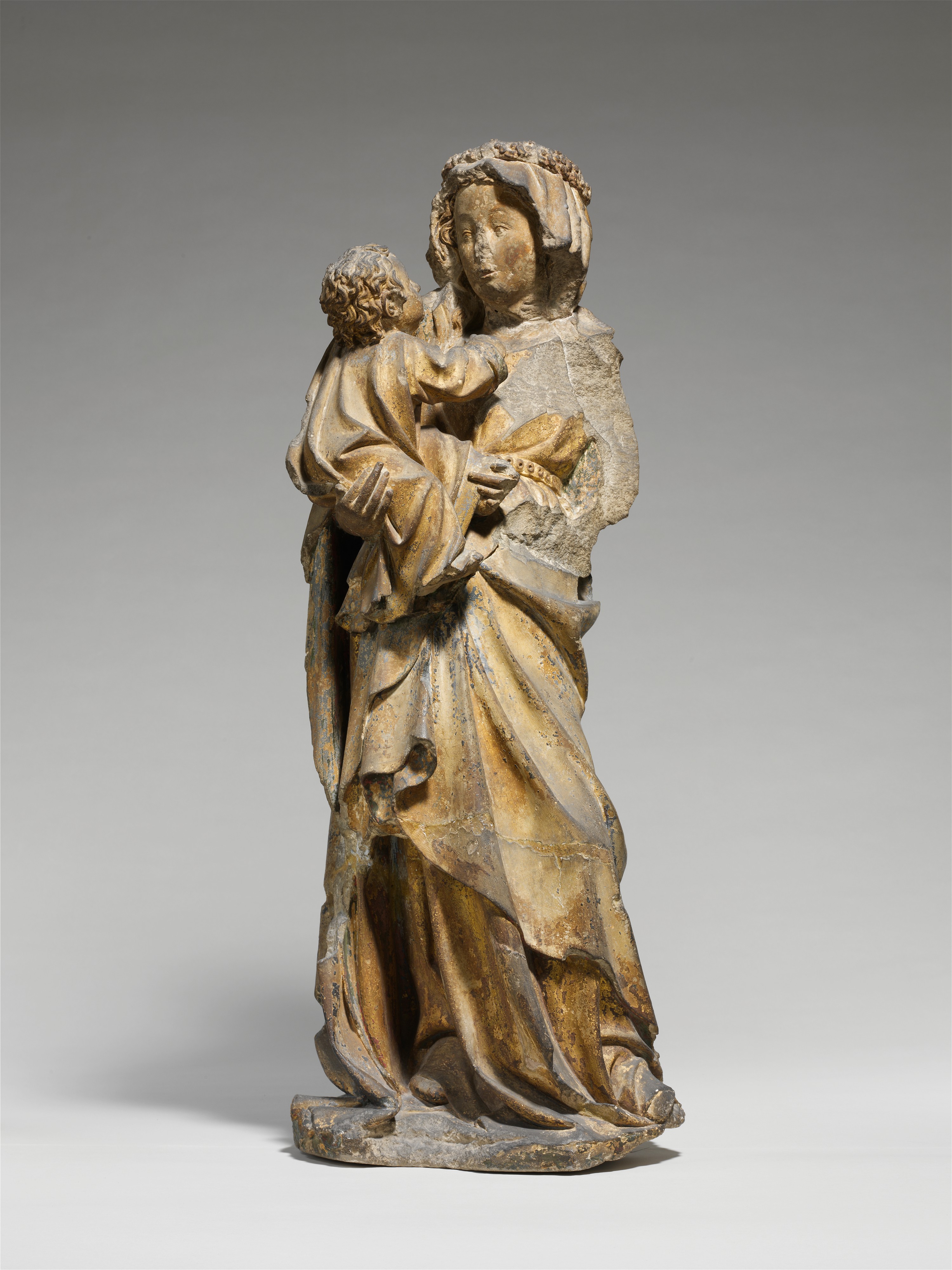
Virgin and Child
Doctrinal reflection
This entry presents an immediate classificatory challenge: the submitted work is a French limestone statue of the Virgin and Child, dated approximately AD 1400–1425, held in the Medieval Art collection of the Metropolitan Museum of Art (Gift of J. Pierpont Morgan, 1916). It is unambiguously a work of Western Gothic sculpture, not a Byzantine artifact in any medium. The Scriptorium archive is specifically designed for Byzantine icons, mosaics, and frescoes; this piece falls entirely outside that mandate in terms of geography, confessional tradition, workshop practice, and artistic language. Gothic sculptural Marian imagery of this period belongs to the Franco-Flemish courtly tradition, characterized by the characteristic S-curve contrapposto (the 'Gothic sway'), naturalistic drapery folds, and an increasingly tender affective relationship between Mother and Child distinct from Byzantine Hodegetria or Eleusa conventions. Traces of polychromy indicate original painted surfaces, a standard feature of Gothic limestone sculpture. While Marian theological programs are shared across Eastern and Western Christianity, the iconographic vocabulary, material culture, and devotional context differ substantially from Byzantine practice. No responsible scholarly framing can retrofit this object into Byzantine art-historical categories. Accordingly, the fields below are populated with the most defensible approximations, but curators should note this record represents a misalignment between the submitted entry and the archive's defined scope. Reclassification to a Western medieval sculpture database is recommended. Sources: Metropolitan Museum of Art Bulletin; Ilene Forsyth, 'The Throne of Wisdom' (1972); Paul Williamson, 'Gothic Sculpture 1140–1300' (1995).