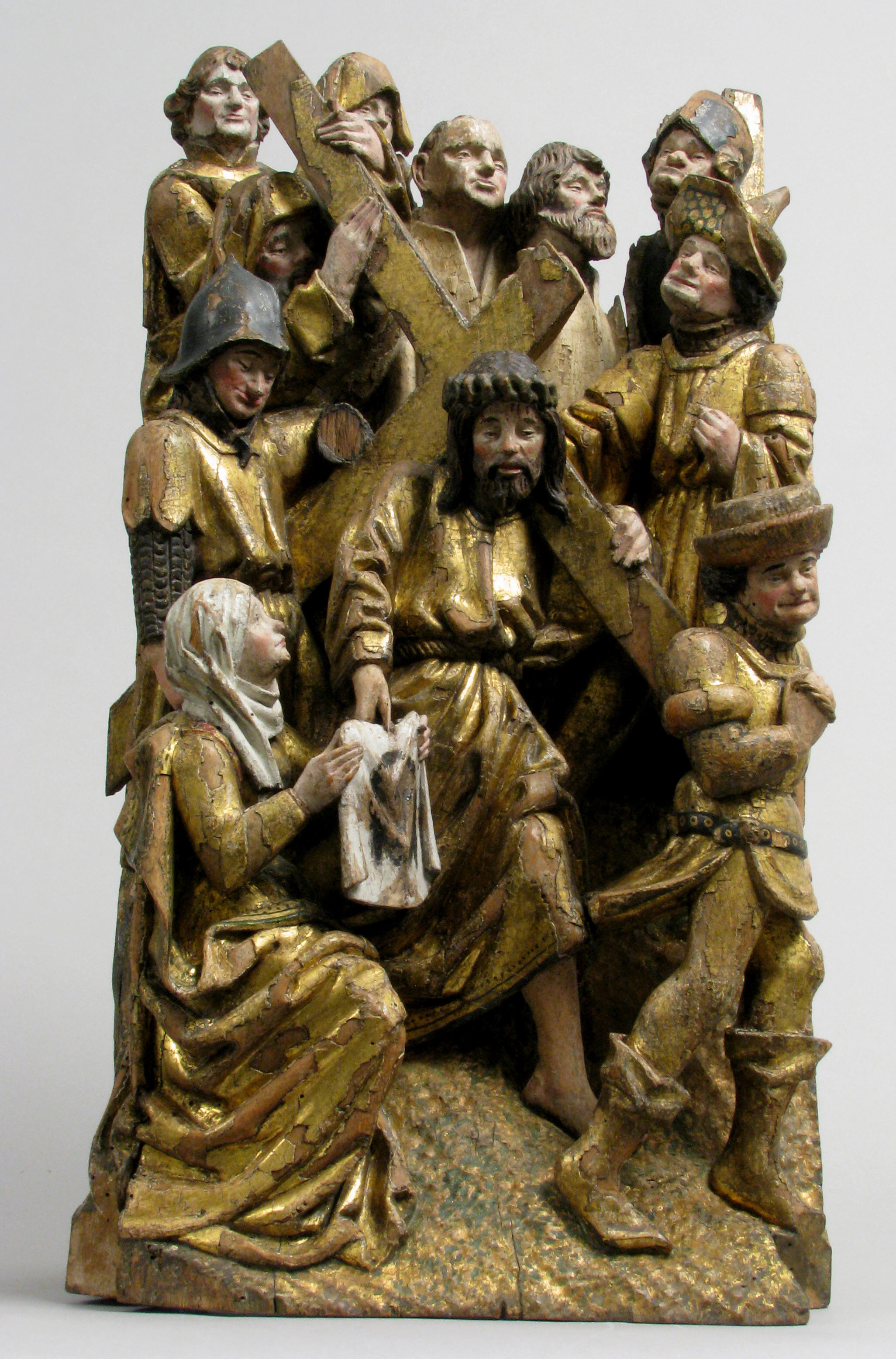
The Way to Calvary, with Saint Veronica Receiving the Veil Imprinted with the Face of Christ
Doctrinal reflection
This entry presents a taxonomic challenge for the Scriptorium archive: the object in question—a South Netherlandish walnut relief with paint and gilding, dated circa 1510 AD—falls outside the canonical boundaries of Byzantine art production. It is a product of late Gothic Netherlandish workshop tradition, likely associated with the sculptural centers of Brussels or Antwerp, which by the early sixteenth century were producing elaborately carved devotional reliefs for export across Catholic Europe. The work depicts the Via Crucis episode in which Veronica proffers her veil to Christ en route to Golgotha, receiving in return the miraculous imprint of his face—the Vera Icon—a subject with deep resonance in Western late medieval piety but treated quite differently from Eastern iconographic conventions of the Mandylion. The Veronica legend, largely absent from canonical Byzantine programs, circulated in the Latin West through the Legenda Aurea and papal relic veneration at Saint Peter's Basilica. Iconographically, the relief likely features a compressed narrative crowd scene with naturalistic drapery, expressive pathos, and the characteristic technical virtuosity of Brabantine wood-carvers. Theologically, it engages Passion devotion and acheiropoietos image theology as mediated through Western channels. As a Byzantine archive entry, no valid classification is possible: the object is Northern European Gothic/early Renaissance in medium, geography, date, and iconographic tradition. Archivists should redirect this record to a Western Medieval corpus. Sources: Steyaert, J., Late Gothic Sculpture (1994); Williamson, P., Gothic Sculpture 1140–1300 (1995); Chapuis, J., in Metropolitan Museum Bulletin (2004).