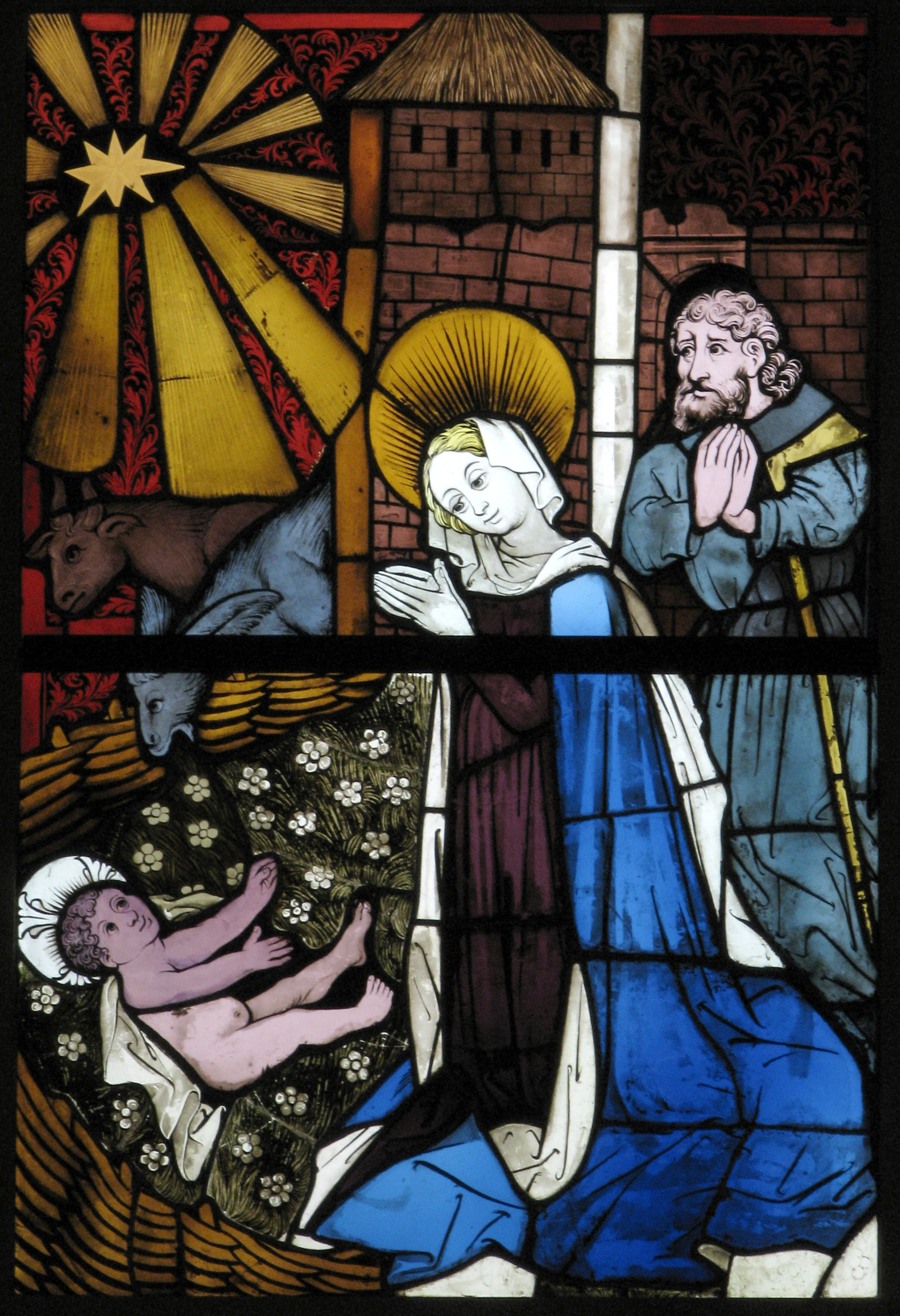
Stained Glass Panel with the Nativity
Doctrinal reflection
This entry presents a classificatory challenge for the Scriptorium archive: the object in question is a fifteenth-century German stained glass panel depicting the Nativity, held in the Medieval Art collection of the Metropolitan Museum of Art (acquired via the Francis L. Leland Fund, 1913). Its technique—pot metal, white glass, vitreous paint, silver stain, and olive-green enamel—is characteristic of late medieval German glazing workshops, placing it firmly within Western European Gothic production rather than the Byzantine tradition this archive is designed to document. Stained glass as a monumental medium did not form part of Byzantine ecclesiastical practice; the Eastern church relied instead on mosaic, fresco, and portable panel icons to fulfill analogous theological and didactic functions. The Nativity iconography, however, shares deep roots with Byzantine prototypes: the swaddled Christ in the manger, the attending Virgin, the ox and ass, and the adoration of the Magi or shepherds are conventions transmitted westward from Byzantine and Eastern Christian sources over centuries. The theological program of a Nativity panel centers on the Incarnation—the enfleshment of the Logos—evoking Christological doctrines formalized at the Councils of Ephesus (431 AD) and Chalcedon (451 AD). Despite iconographic resonances with Byzantine art, this object cannot be catalogued as Byzantine by any conservative scholarly standard. Researchers interested in transmission and comparative iconography between Byzantine and Western medieval Nativity cycles should consult the relevant literature directly. Sources: Journal of Glass Studies (Corning Museum of Glass); Gesta (International Center of Medieval Art).