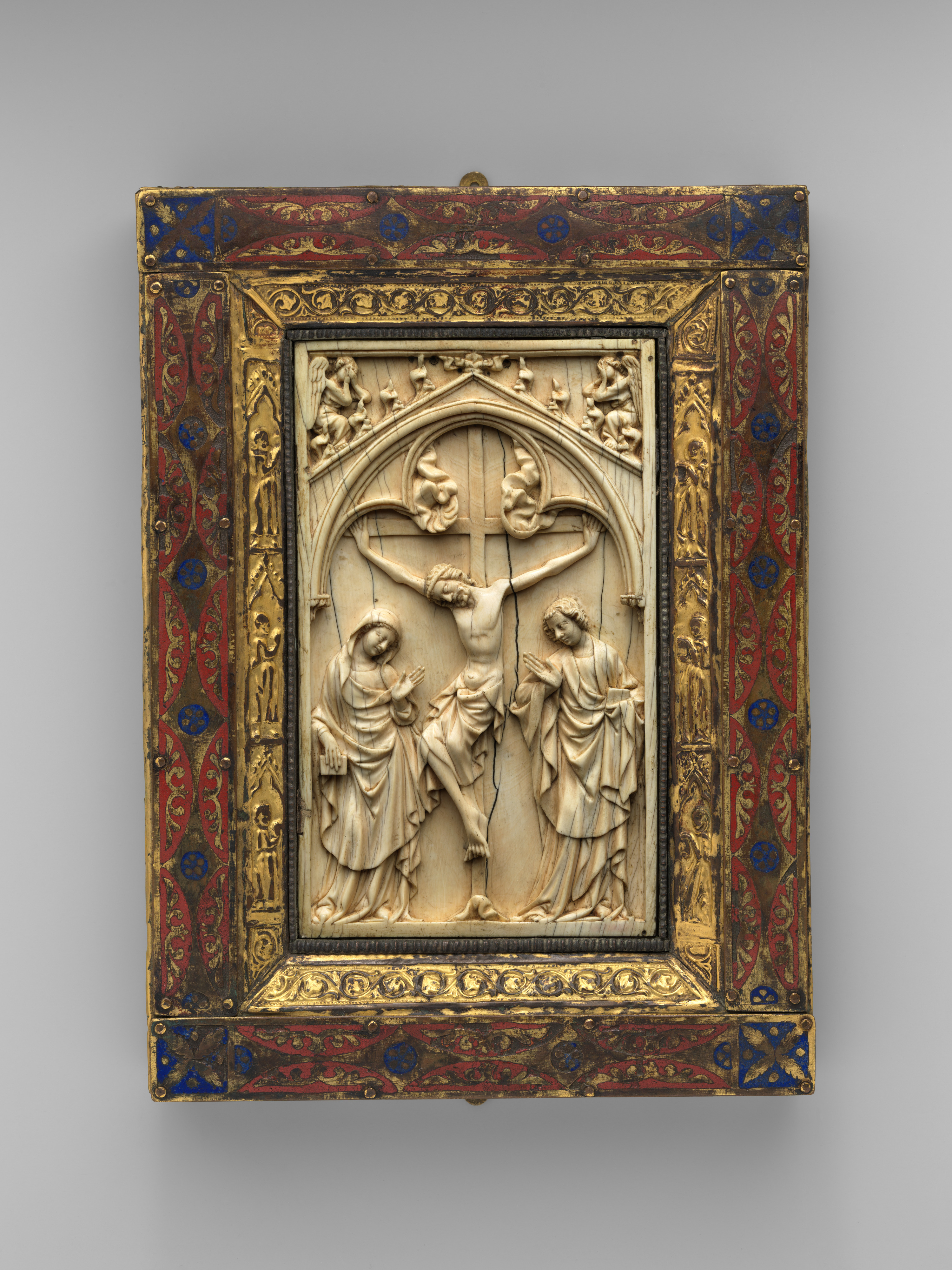
Book Cover with Crucifixion Panel
Doctrinal reflection
This book cover with Crucifixion panel presents an immediate classificatory challenge for the Scriptorium archive: the object is French Gothic rather than Byzantine in origin, produced in the second quarter of the fourteenth century AD and held in the Medieval Art collection of the Metropolitan Museum of Art (Gift of J. Pierpont Morgan, 1917). Its materials—elephant ivory, champlevé enamel, and gilded copper on a wood support—reflect Parisian luxury craft production of the Valois period rather than any Eastern Mediterranean workshop tradition. The Crucifixion iconography, while sharing certain theological programs with Byzantine Stavrosis imagery (the presence of the Virgin and John the Evangelist flanking the cross, the titulus, the suppedaneum), is executed in the Western Gothic idiom: the corpus exhibits the characteristic S-curve of French ivory carving, with a three-nail crucifixion and naturalistic pathos foreign to the hieratic Byzantine convention. Champlevé enamel on gilded copper for the surrounding frame aligns with Limoges or Parisian metalwork traditions. Scholarly significance lies in comparative iconographic study: the Crucifixion program shares scriptural roots with Byzantine Passion cycles but diverges formally and liturgically. This entry is therefore flagged as Western medieval rather than Byzantine, and the archive fields below are populated on the basis of iconographic parallel rather than production context. Consensus scholarship would assign the object to the French Gothic corpus documented in Koechlin's corpus of medieval ivories and Gauthier's enamel studies. Sources: Koechlin, R., Les ivoires gothiques français (Paris, 1924); Gauthier, M.-M., Émaux du moyen âge occidental (Fribourg, 1972); Williamson, P., Gothic Ivory Carving in England (London, 1982).