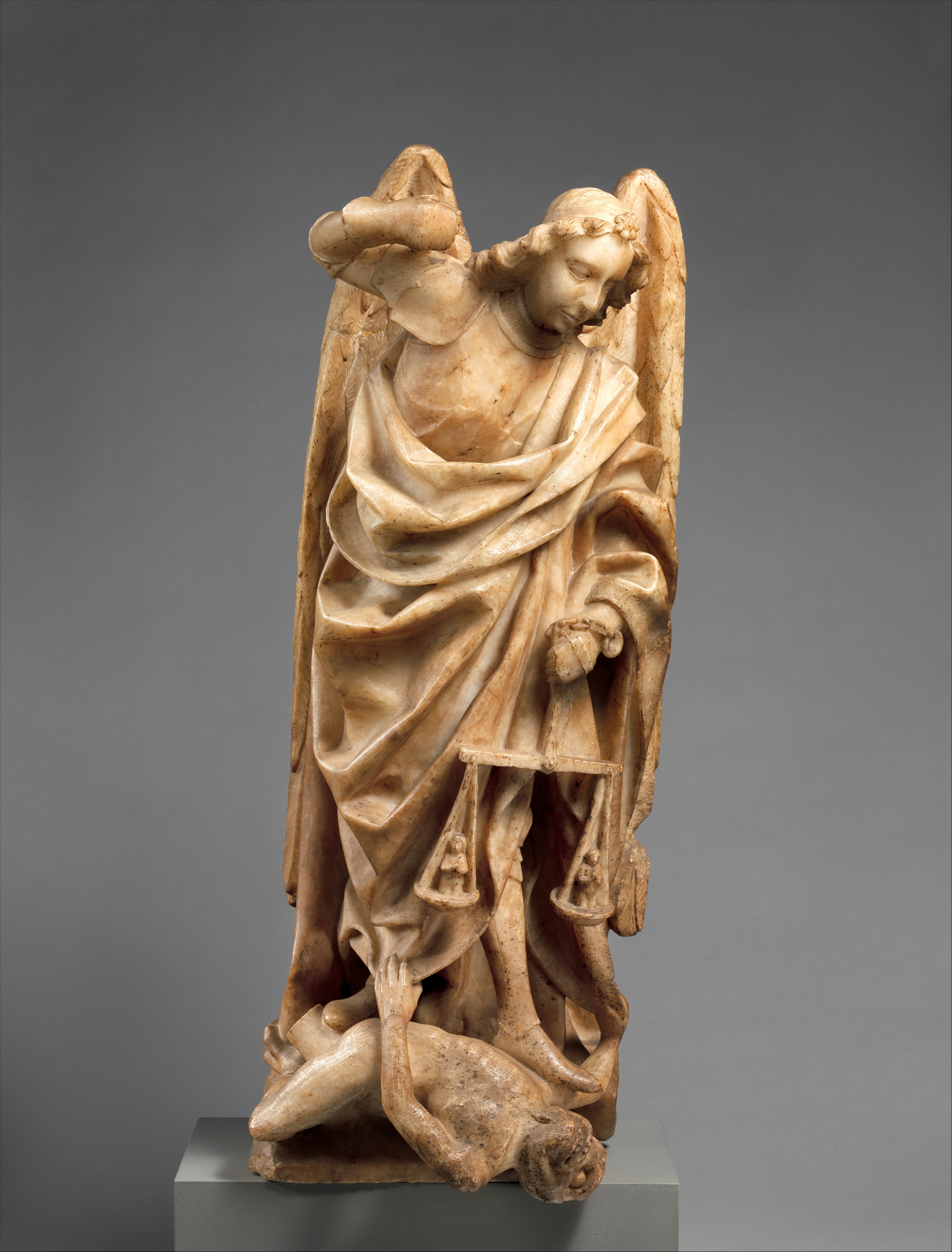
St. Michael
Doctrinal reflection
This entry presents a challenge for the Scriptorium archive: the object described is a Spanish alabaster statuette of St. Michael dating to the late fifteenth century AD, accessioned at the Metropolitan Museum of Art as a gift of J. Pierpont Morgan in 1916. As a carved sculptural work in alabaster produced in the Iberian Peninsula, it falls outside the strict parameters of Byzantine art production — which encompasses mosaic, fresco, panel icon, and manuscript illumination within the Eastern Mediterranean and Orthodox cultural sphere. Spanish late medieval devotional sculpture, even when depicting subjects shared with Byzantine iconography, operates within a distinct Western Catholic artistic tradition shaped by Gothic and nascent Renaissance formal vocabularies rather than the Constantinopolitan or post-Palaiologan pictorial conventions this archive documents. St. Michael as archangel and psychopomp appears prominently in both traditions, associated with the weighing of souls, cosmic battle against Satan, and eschatological judgment; iconographically these themes draw on Revelation 12 and Daniel 10. However, the alabaster medium, Spanish workshop practice, and sculptural three-dimensionality place this object firmly within Western European art history. Scholarly assessment of comparable Iberian alabaster production is documented in studies of Nottingham and Aragonese workshop output. Archival placement here is provisional and flagged for reclassification outside the Byzantine corpus. Sources: Williamson, P., Gothic Sculpture 1140–1300, Yale University Press; Cheetham, F., English Medieval Alabasters, Phaidon; Barral i Altet, X., L'Art Medieval, Flammarion.