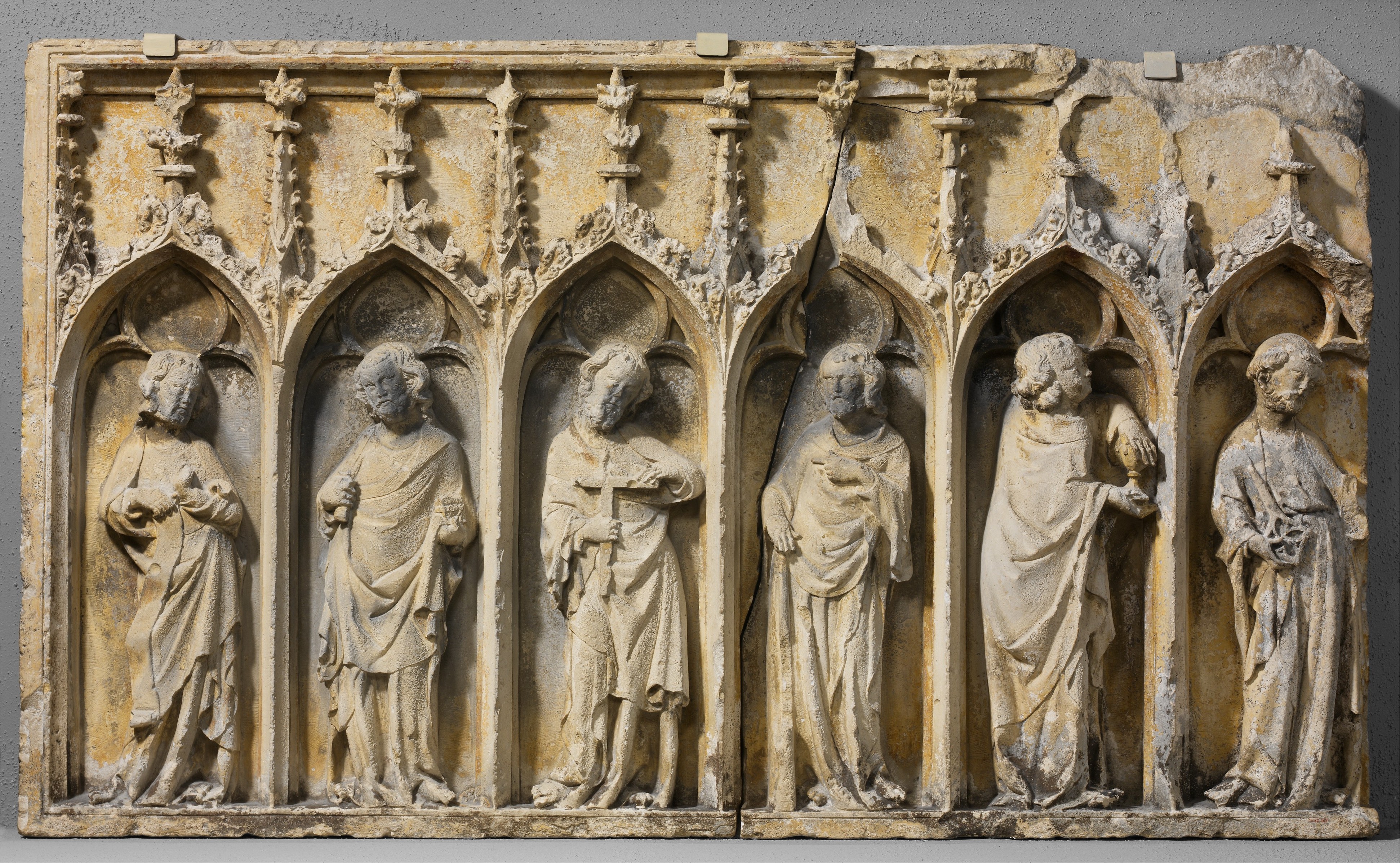
Six Apostles from Retable
Doctrinal reflection
This entry presents a limestone relief panel depicting six apostles, identified as a fragment from a retable (altar screen or altarpiece backing), attributed to French manufacture and dated to the late fourteenth century AD. While the Metropolitan Museum of Art catalogues this work within its Medieval Art holdings—donated by J. Pierpont Morgan in 1916—the object falls outside the strict Byzantine geographic and cultural orbit, originating from the Gothic sculptural tradition of France rather than from the Eastern Mediterranean or Byzantium proper. As a Scriptorium archive entry for Byzantine artwork, this piece does not qualify under the canonical parameters of Byzantine production: it employs Western Gothic figural conventions, French limestone carving techniques, and retable architectural framing characteristic of Latin Christendom rather than Eastern Orthodox devotional programs. The six apostles depicted likely follow the standard iconographic roster drawn from the Twelve, possibly including Peter and Paul in prominent positions, arranged in hierarchical registers typical of French Gothic altar furnishings of the Rayonnant and International Gothic periods. Theologically, such retable programs reinforce apostolic succession and eucharistic legitimacy within the Latin rite context. Scholarly comparison would situate this relief within the broader corpus of French Gothic architectural sculpture and altar furnishings rather than Byzantine icon theology or Constantinopolitan workshop traditions. No valid Byzantine classification can be responsibly assigned. Researchers are directed to Gothic sculpture studies for appropriate contextual analysis. Sources: Metropolitan Museum of Art Bulletin; Gesta (International Center of Medieval Art); Speculum (Medieval Academy of America).