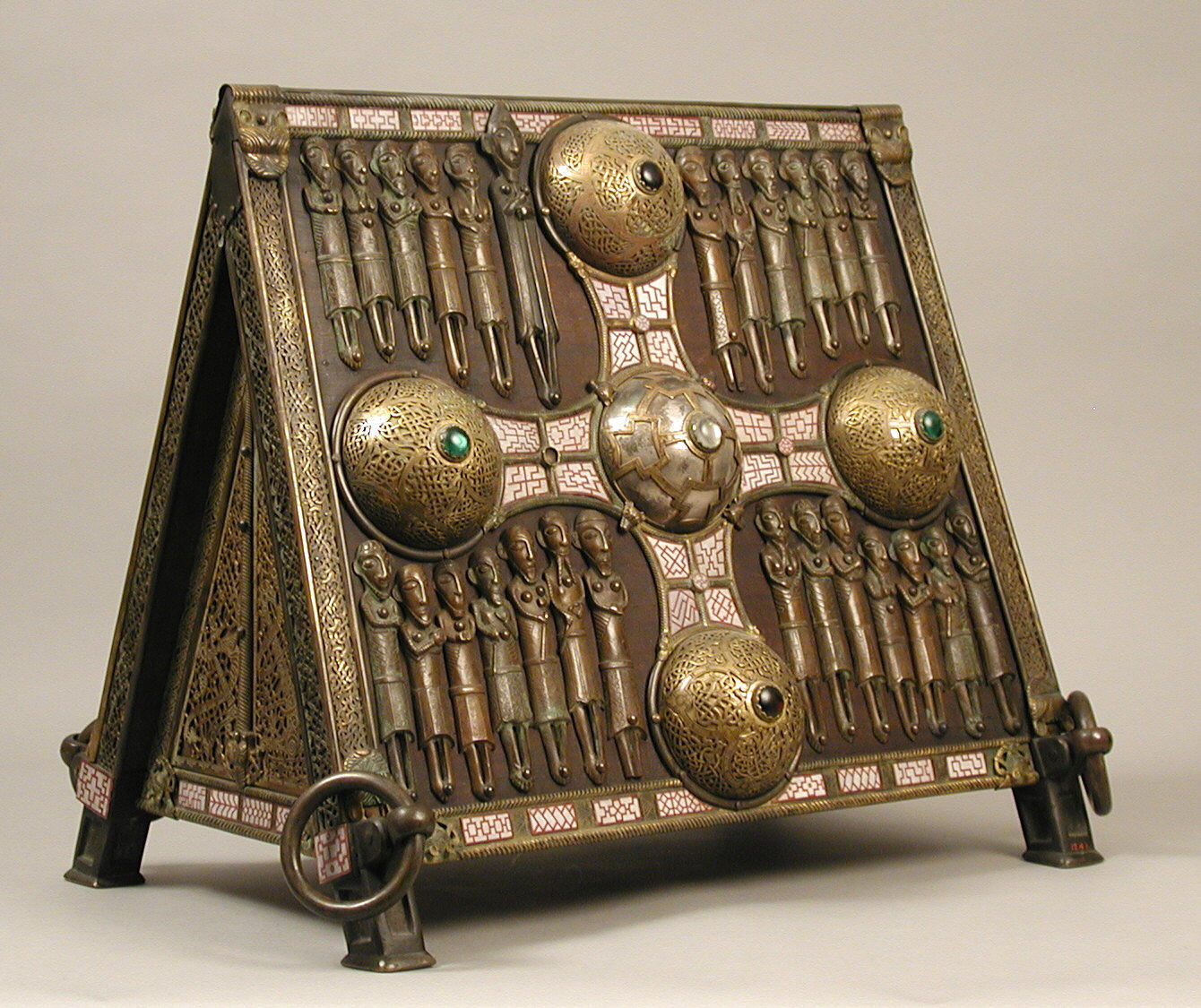
Shrine, Saint Manchan
Doctrinal reflection
The Shrine of Saint Manchan is one of the most significant surviving examples of Irish Romanesque metalwork, conventionally dated to the twelfth century AD, likely produced circa 1130–1150 AD, and associated with the monastic community of Lemanaghan (Liath Manchain), County Offaly, Ireland. The object is a house-shaped reliquary of wooden core construction, sheathed in bronze and ornamented with applied brass and enamel mounts. The Metropolitan Museum holds a cast or facsimile reproduction acquired via the Rogers Fund in 1911, with the original remaining in Boher parish, County Offaly. The shrine's architectural form—a gabled lid imitating a church roof—situates it within the broader insular and continental tradition of house-shaped reliquaries, paralleled by the slightly earlier Emly Shrine and the Monymusk Reliquary. The front face displays a large cruciform arrangement of gilt-bronze figures in high relief, with a central Christ figure flanked by subordinate ecclesiastical figures, reflecting the hierarchical theological program typical of Hiberno-Romanesque sacred art. Interlace ornament and zoomorphic elements characteristic of the late Insular style integrate with Romanesque figural conventions, marking a transitional moment in Irish ecclesiastical art following the Synod of Rathbreasail (1111 AD) and the broader reform movement. The enamel work employs champlevé technique in red, blue, and yellow, consistent with twelfth-century Irish and Anglo-Norman workshops. Scholarly debate persists regarding the precise workshop origin and the relationship of its figural style to continental Romanesque influence via English intermediaries. Sources: Journal of the Royal Society of Antiquaries of Ireland; Proceedings of the Royal Irish Academy.