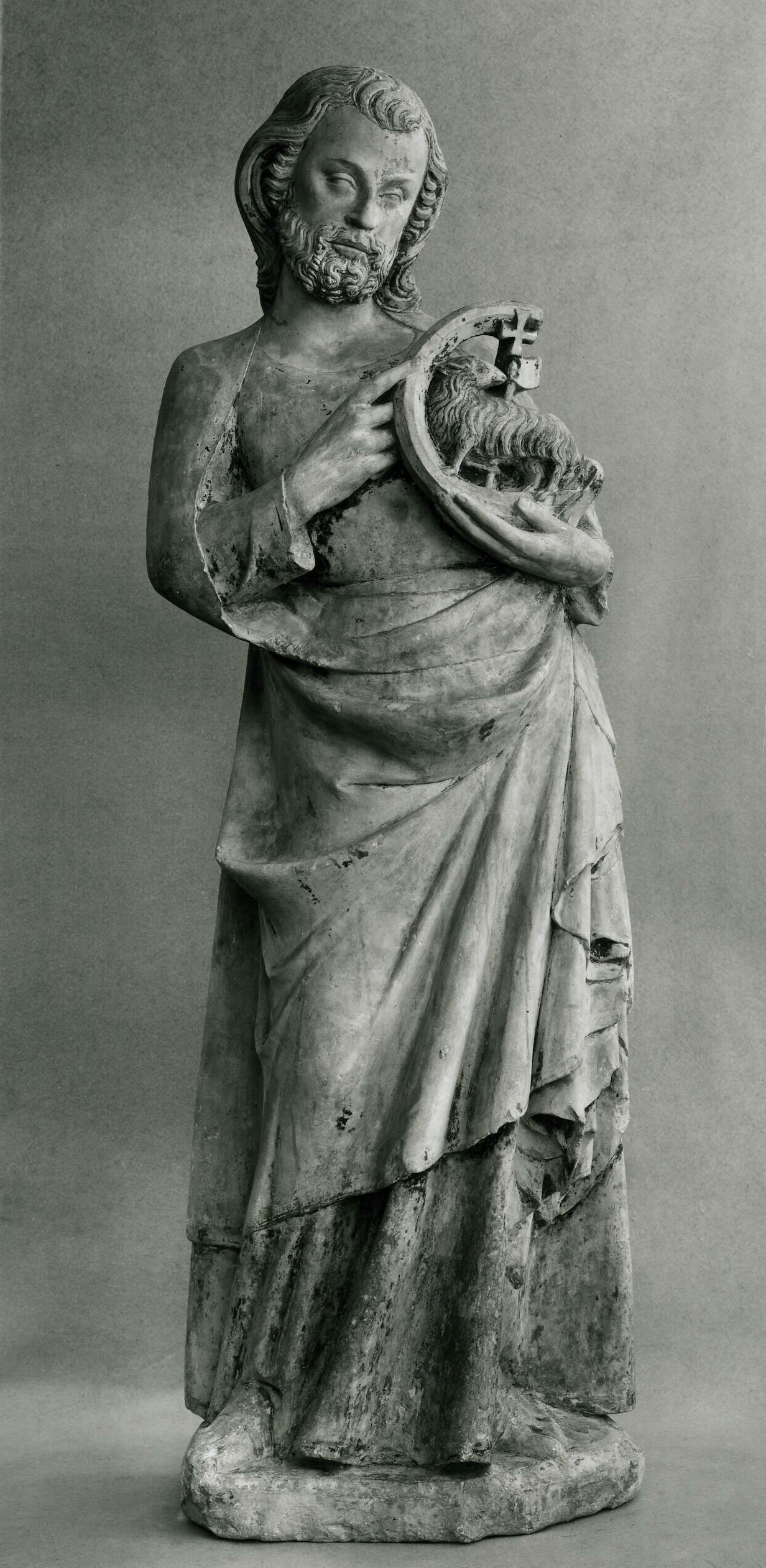
Saint John the Baptist
Doctrinal reflection
This entry presents a significant methodological challenge for the Scriptorium archive: the object in question is a North French limestone statue of Saint John the Baptist, dateable to the fourteenth century AD with evidence of later recarving, currently held in the Medieval Art collection of the Metropolitan Museum of Art (Gift of J. Pierpont Morgan, 1916). As a three-dimensional carved sculpture in limestone, this work falls outside the defined Byzantine media categories of this archive — mosaic, fresco, icon, and manuscript — and represents instead the Gothic sculptural tradition of northern France, a distinct artistic milieu from the Byzantine Commonwealth. Gothic limestone sculpture of this type belongs to the Western Latin tradition, with formal conventions — naturalistic drapery, contrapposto tendencies, and portal-program iconography — that diverge substantially from Byzantine two-dimensional or encaustic practice. The figure of John the Baptist (Prodromos) does carry theological resonance across both traditions: as forerunner and witness to the Incarnation, his iconography draws on Luke 1:5–25, 57–80, the Johannine Prologue, and apocalyptic imagery from Revelation. The later recarving noted in the museum description complicates precise stylistic attribution and raises issues of workshop continuity familiar to Gothic sculpture scholarship. This entry is filed as an anomalous accession: the object does not meet the Byzantine medium or geographic criteria for a standard Scriptorium record and should be cross-referenced with Gothic sculpture catalogues rather than Byzantine icon studies. Sources: Metropolitan Museum of Art Bulletin; Gesta (International Center of Medieval Art); Speculum: A Journal of Medieval Studies.