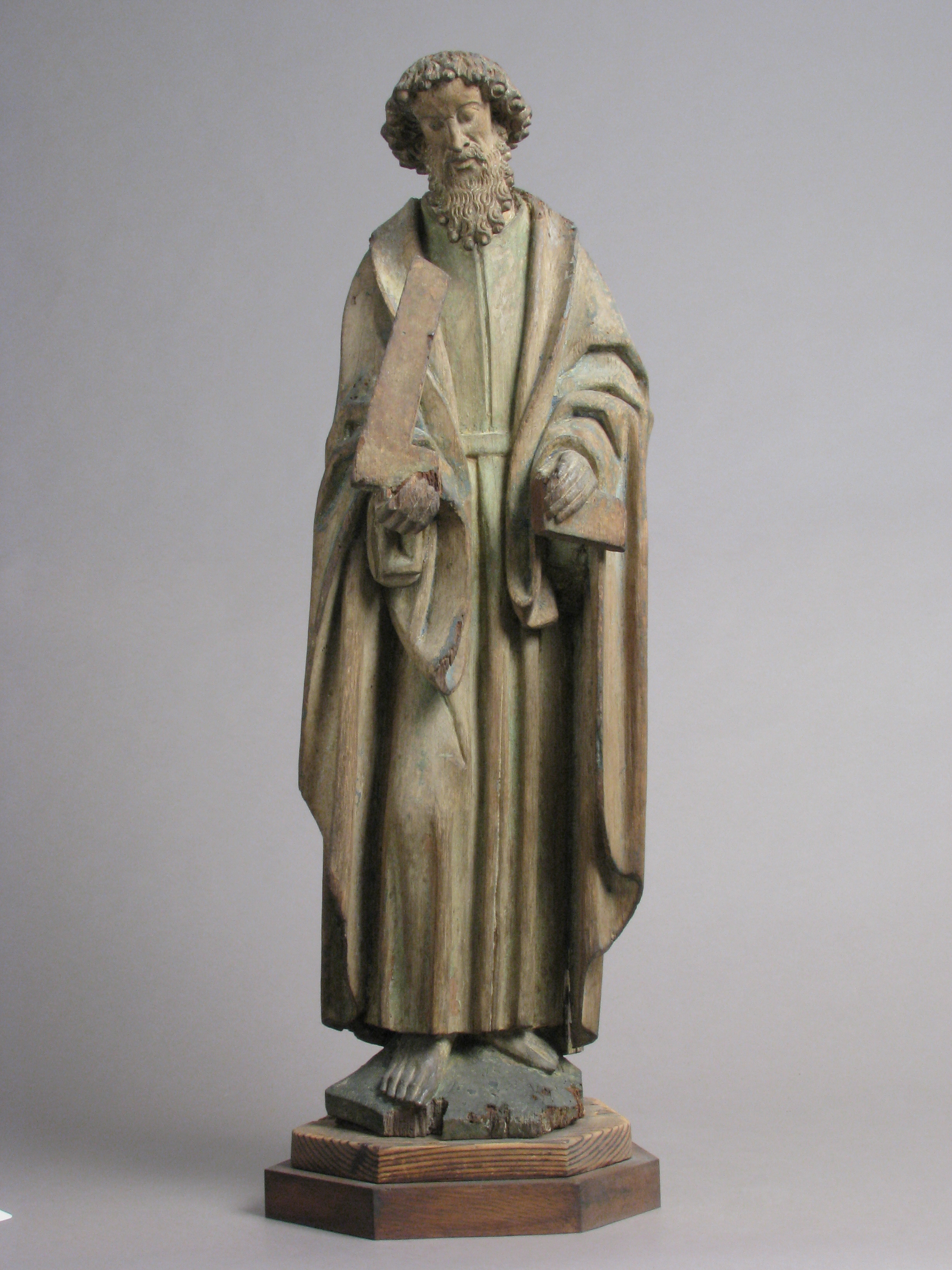
Saint Thomas
Doctrinal reflection
This entry presents an interpretive challenge: the object in question — a North Netherlandish oak statuette of Saint Thomas, ca. 1500 AD, with traces of polychromy and gilding, gifted by J. Pierpont Morgan to the Metropolitan Museum of Art in 1916 — is a Late Gothic sculptural work, not a Byzantine artwork in any conventional art-historical sense. The Scriptorium archive protocol requires Byzantine media (icon, mosaic, fresco, manuscript); this object falls outside that corpus. Nonetheless, certain analytical frameworks apply comparatively. The statuette belongs to the late Palaiologan-contemporary period (ca. 1500 AD) but reflects entirely distinct Western devotional and material traditions. Iconographically, Saint Thomas is typically identified through his attribute of the carpenter's square, referencing his legendary missionary activity in India, or alternatively through the wound-probing gesture evoking the Incredulity narrative (John 20:24–29). North Netherlandish production circa 1500 was characterized by refined oak carving, guild workshop organization, and polychrome finishing that paralleled but did not derive from Byzantine programs. Theologically, Thomas functions as an apostolic witness whose doubt paradoxically confirms resurrection faith — a program consistent across Eastern and Western traditions. For Scriptorium purposes, the object cannot be responsibly classified under Byzantine media categories; it is more properly housed within Gothic sculptural archives. Scholarly treatment would engage Steyaert's surveys of Netherlandish sculpture and Williamson's work on Gothic sculpture at the V&A. Sources: John W. Steyaert, 'Late Gothic Sculpture' (Ghent, 1994); Paul Williamson, 'Gothic Sculpture 1140–1300' (Yale, 1995); Metropolitan Museum of Art Bulletin, Medieval collection catalogues.