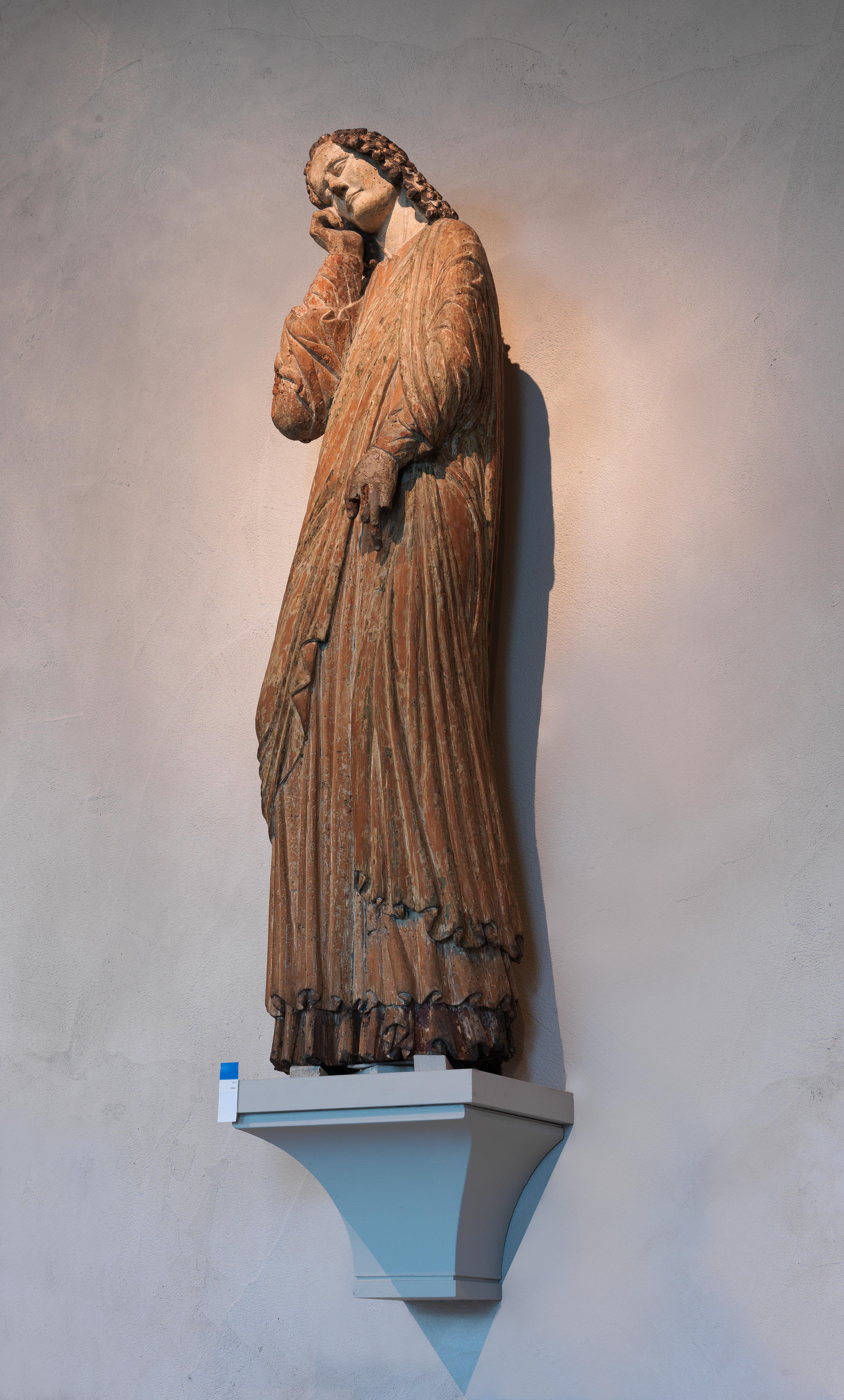
Saint John the Evangelist
Doctrinal reflection
This entry presents an immediate classificatory challenge: the object in question is a wooden polychrome statue of Saint John the Evangelist, produced in Austria in the thirteenth century AD. As a three-dimensional sculpted work in wood with painted surface treatment, it falls outside the canonical Byzantine media of mosaic, fresco, panel icon, and illuminated manuscript. Austrian Romanesque and early Gothic wood sculpture of this period belongs to the Western Latin tradition, governed by distinct workshop practices, theological emphases, and formal conventions that diverge substantially from Byzantine iconographic programs. The figure of John the Evangelist in Western medieval sculpture of this era typically derives from Gospel-book imagery: the youthful, beardless type associated with Carolingian and Ottonian precedent, or the bearded elder type reflecting patristic authority. Iconographic attributes would conventionally include the eagle symbol of the Fourth Gospel, a codex, or the chalice associated with hagiographic legend. The polychrome surface—wood with applied paint and possible gilding—situates the work within Alpine craft traditions rather than Byzantine encaustic or tempera panel painting. Conservative scholarly assessment holds that Austrian Romanesque wood sculpture of the thirteenth century AD, though sharing certain typological roots with Byzantine figural art through intermediary channels such as ivory carving and manuscript illumination, constitutes a distinct tradition requiring separate methodological frameworks. This Scriptorium archive, focused exclusively on Byzantine art forms, cannot responsibly classify this object under its established schema without scholarly distortion. The entry is noted but flagged as non-Byzantine. Sources: Metropolitan Museum of Art Bulletin; Kahsnitz, R., studies in Romanesque sculpture; Williamson, P., Gothic Sculpture 1140–1300.