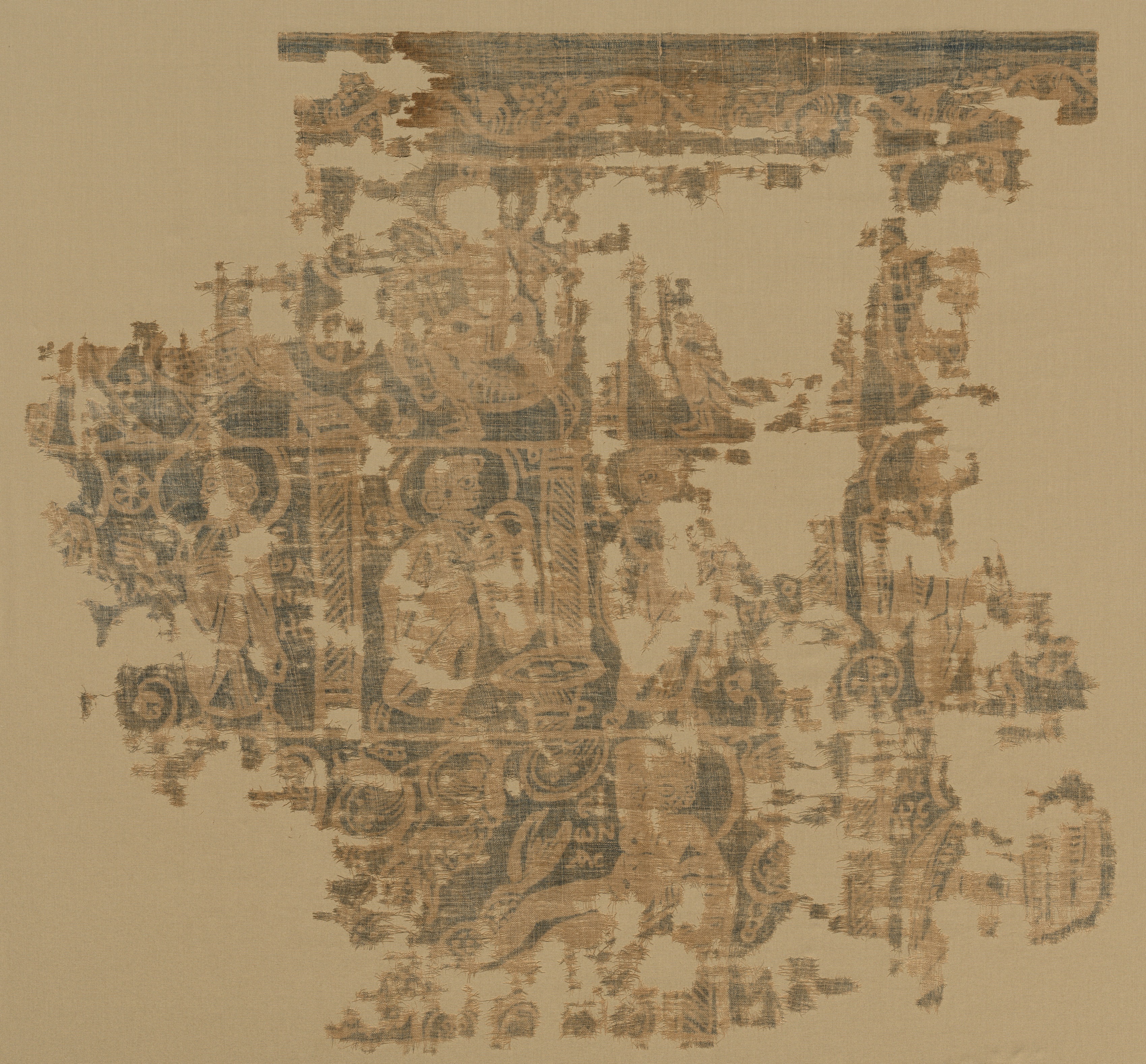
Resist-Dyed Hanging with Biblical Scenes
Doctrinal reflection
This resist-dyed linen hanging, dated to approximately AD 500–550 and attributed to Byzantine-period Egypt, represents an important example of early Coptic textile production employing a wax- or starch-resist technique on plain-weave linen to achieve patterned figural scenes in multiple registers. The hanging is preserved in the Cleveland Museum of Art and demonstrates the adaptation of monumental iconographic programs—more commonly associated with apse mosaics and catacomb frescoes—to the domestic or liturgical textile medium. The three-register compositional scheme organizes a typologically coherent theological program: the upper register presents the Adoration of the Magi before the enthroned Theotokos with the Christ Child, confirmed by a Coptic inscription, situating the object within an Egyptian Christian linguistic milieu and reflecting the post-Ephesine (AD 431) elevation of Marian imagery. The middle register pairs the Baptism of Christ, a theophanic scene of considerable liturgical weight in Eastern Christian praxis, with the Multiplication of the Loaves and Fishes, a Eucharistic type well established in early Christian catechetical and visual tradition. The lower register depicts Jonah and the sea creature, among the most frequently employed prefigurative types for death and resurrection in Early Christian art, attested extensively in catacomb painting and sarcophagal sculpture from the third century onward. The Coptic inscription grounds the object in the distinctive documentary and linguistic context of Egyptian Christianity. Scholarly interest centers on the survival of figural resist-dyeing at this scale, the typological coherence of the scene selection, and its evidence for domestic or paraecclesial devotional practice in late antique Egypt. Sources: Dumbarton Oaks Papers; Bulletin of the Cleveland Museum of Art; Journal of Coptic Studies.