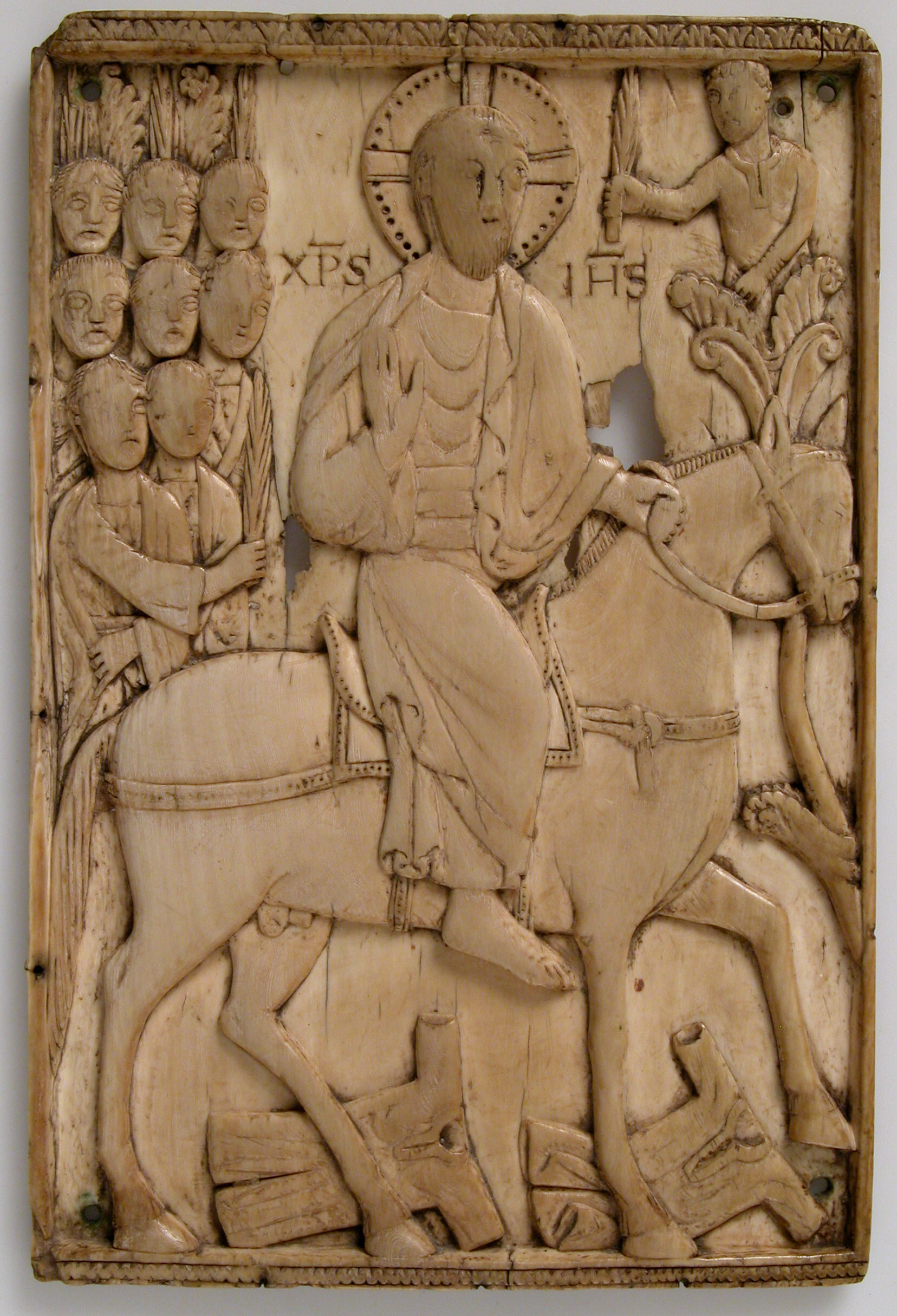
Plaque with Jesus’ Entry into Jerusalem
Doctrinal reflection
This Ottonian ivory plaque, dated to approximately AD 900–925 and now held in the Medieval Art collection of the Metropolitan Museum of Art (Gift of J. Pierpont Morgan, 1917), depicts the Entry of Jesus into Jerusalem — the event recorded in all four Gospels (Matthew 21:1–11; Mark 11:1–10; Luke 19:28–44; John 12:12–19). Carved from elephant ivory, the plaque exemplifies the high technical refinement of Ottonian court workshops, which revived Carolingian models while introducing a new monumentality to small-scale liturgical and devotional objects. The scene typically renders Christ astride a donkey, fulfilling the Zechariah 9:9 prophecy cited explicitly in Matthew 21:4–5 and John 12:14–15, while crowds spread garments and palm branches along the road and figures appear in or descend from a sycamore-fig tree — a detail drawn from the Lukan Zacchaeus episode that manuscript and ivory traditions sometimes conflate with the Entry crowd. The architectural backdrop, rendered in low relief with schematic city gates, signals Jerusalem as the eschatological destination. Iconographically, the composition descends from Late Antique ivories, particularly the tradition visible in the fifth-century Passion ivories, and the Ottonian workshop demonstrates awareness of both Byzantine compositional norms and Carolingian narrative cycles. The piece functioned most plausibly as a liturgical book cover plaque or a devotional object within a palatine or episcopal context. Scholarly interest centers on workshop localization — northern Italian, Rhenish, and Lorraine attributions have each attracted support — and on the object's role in mapping Christological narrative across the Ottonian reform milieu. Sources: Arte Medievale; Gesta; Metropolitan Museum Journal.