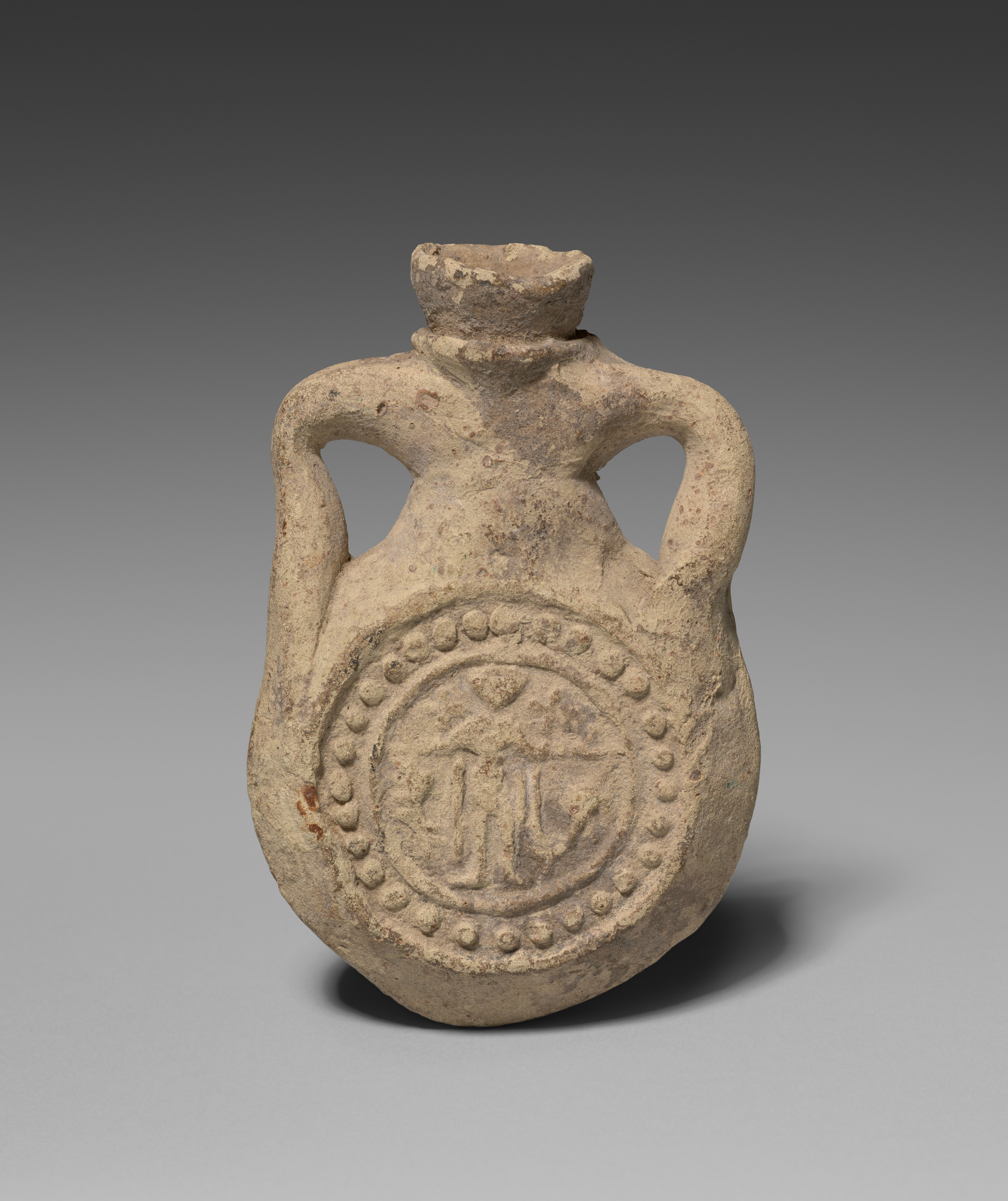
Pilgrim's Flask with Saint Menas
Doctrinal reflection
This pilgrim's flask (ampulla) bearing the image of Saint Menas dates to approximately 400–600 AD and originates from Abu Mena, the major pilgrimage complex located in the Egyptian desert southwest of Alexandria. Manufactured in terracotta, almost certainly in workshops adjacent to the shrine itself, the object belongs to a well-documented category of eulogiai—blessed objects distributed to pilgrims as material tokens of sanctity and intercessory contact. The iconographic program is canonical for Menas ampullae: the martyr is typically depicted orans, flanked by two kneeling camels, a motif specific to the Abu Mena cult that may reference either the legendary discovery of his burial site by a camel or broader associations with desert sanctity. These flasks functioned as containers for sanctified oil drawn from the lamp burning above the saint's tomb, transforming the vessel itself into a relic-by-contact. Abu Mena was one of late antiquity's most prominent pilgrimage destinations, attracting devotees from across the Mediterranean world, and the wide distribution of Menas ampullae—recovered from Egypt, Palestine, Italy, France, and Spain—attests to the shrine's international reach. Scholarly analysis of these objects has been central to discussions of popular piety, pilgrimage economy, and the material culture of early Byzantine Christianity. The ampullae also provide evidence for workshop standardization and the commodification of sacred contact in the late antique period. Their iconographic consistency across thousands of surviving examples offers a rare case study in the replication and dissemination of a fixed sacred image outside monumental contexts. Sources: Dalton, O.M., Byzantine Art and Archaeology (1911); Vikan, Gary, Early Byzantine Pilgrimage Art (2010); Dumbarton Oaks Papers.