Touch Me Not (Noli Me Tangere)
Doctrinal reflection
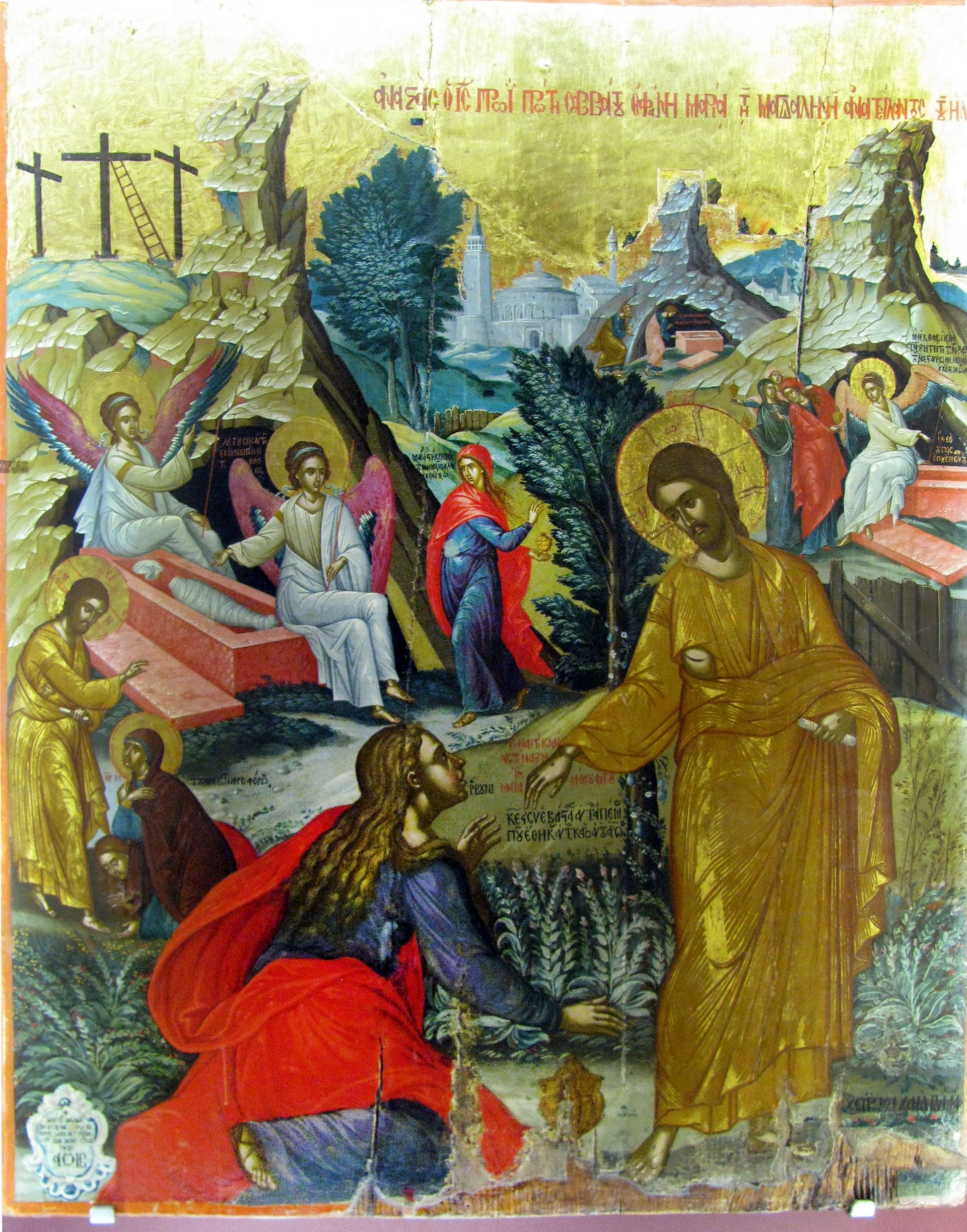
The Noli Me Tangere icon attributed to Michael Damaskinos (c. 1530/35–1592/93 AD) represents a pivotal work of the late Cretan school, a tradition operating at the intersection of Byzantine theological convention and Western Renaissance naturalism. Damaskinos, who spent formative years in Venice alongside El Greco and within the orbit of Theophanes the Cretan, synthesizes post-Byzantine iconographic formulae with Italianate spatial depth, atmospheric landscape, and volumetric figure modeling—visible in Christ's luminous white garment and the graduated recession of the garden setting. The composition follows John 20:14–17, depicting the moment Mary Magdalene recognizes the risen Christ, who raises his hand in a gesture simultaneously commanding restraint and conferring blessing. The iconographic program integrates three temporally distinct events within a single pictorial field: the empty tomb at left (alluding to Luke 24:2–3), the central encounter, and a distant Crucifixion silhouette on a hill, compressing Passion and Resurrection into typological simultaneity. This condensation reflects the Byzantine theological insistence on the Cross and Resurrection as a unified salvific mystery rather than sequential historical episodes. Mary Magdalene's kneeling posture and reaching gesture encode her patristic designation as 'apostle to the apostles,' while Christ's gardener-like appearance (John 20:15) is rendered legible only through the nimbus. The icon exemplifies the Cretan school's commercial and devotional reach, produced for both Orthodox and Catholic Venetian markets. Damaskinos's handling of drapery reveals direct engagement with Titian's workshop conventions without abandoning the flattened gold-ground hierarchy of Byzantine tradition. Sources: Dελτίον της Χριστιανικής Αρχαιολογικής Εταιρείας; Dumbarton Oaks Papers; Byzantine and Modern Greek Studies.