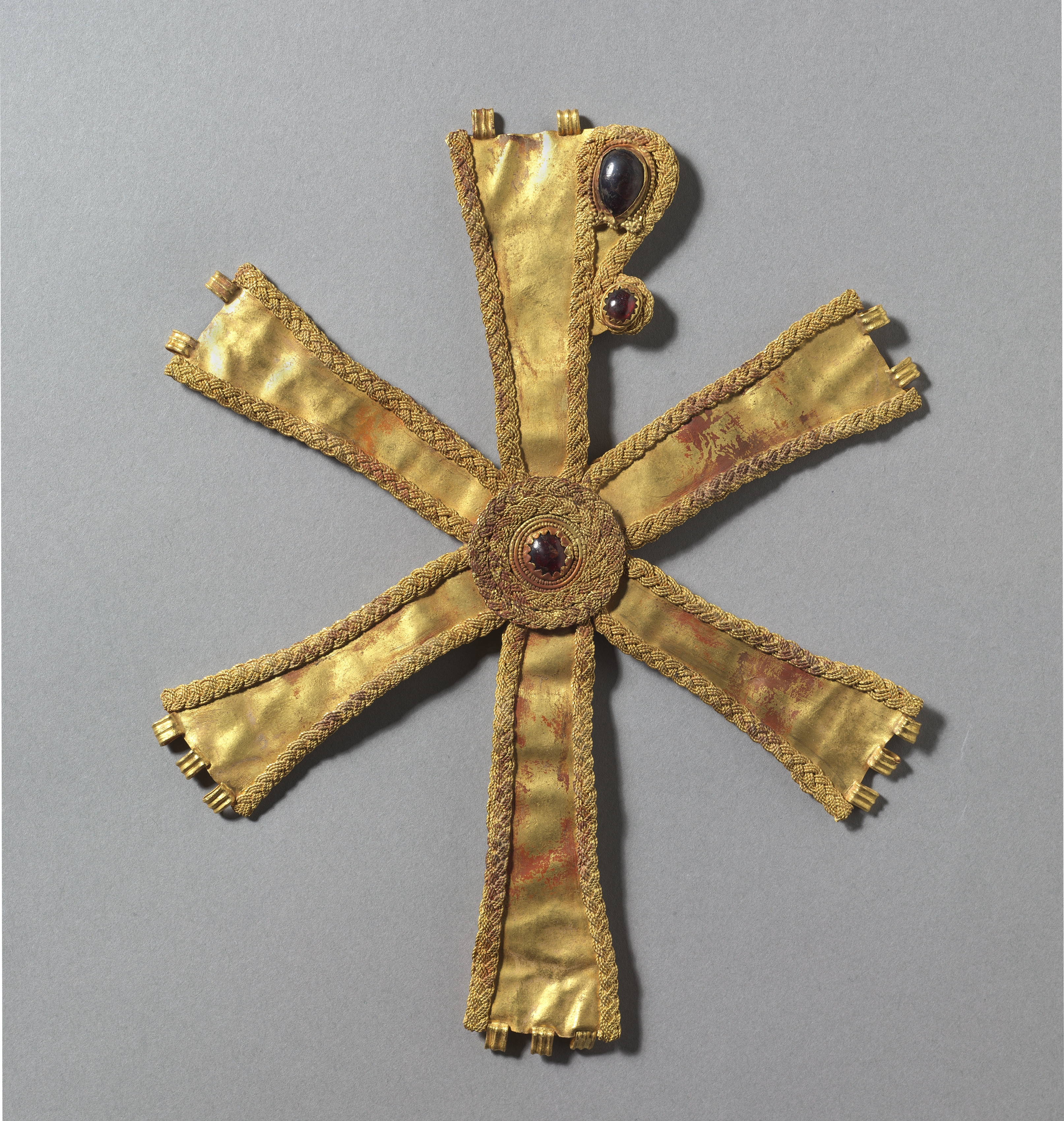
Monogram of Christ (Chrismon)
Doctrinal reflection
This Chrismon, or Chi-Rho monogram, is a sixth-century AD Syrian or broadly early Byzantine metalwork object executed in gold sheet, gold wire, and inset garnets, now housed in the Cleveland Museum of Art. The object superimposes the Greek letters chi (Χ) and rho (Ρ), the first two letters of ΧΡΙΣΤΟΣ, forming the standard Constantinian christogram that entered the visual vocabulary of imperial Christianity following the Battle of the Milvian Bridge in AD 312. The monogram's probable function as the centerpiece of a votive or honorific golden wreath situates it within a well-documented tradition of apotropaic and triumphal metalwork in the late antique and early Byzantine Mediterranean. Garnets, imported along eastern trade routes, serve both decorative and symbolically charged purposes, their blood-red hue evoking sacrificial and eschatological resonances common in sixth-century luxury arts. The piece reflects the theological program articulated in Constantine's vision narrative as transmitted by Eusebius and Lactantius: the identification of Christ as the divine guarantor of military and cosmological victory, a program consolidated throughout the fifth and sixth centuries in imperial regalia, church furnishings, and processional objects. Iconographically, the Chrismon frequently incorporates the Greek letters alpha and omega flanking the monogram, though their absence here does not diminish the eschatological freight of the object. The high technical quality of the goldsmithing—precise wire framing and secure collet settings for the garnets—indicates a professional workshop context, possibly connected to ecclesiastical or court patronage. The object contributes to scholarly understanding of the diffusion of imperial Christian symbolism into portable luxury arts across the Syrian and broader eastern Mediterranean sphere. Sources: Dumbarton Oaks Papers; Byzantine and Modern Greek Studies; Cahiers archéologiques.